Divvy
DivvyBalance Reconciliation Made Simple for Groups
By The Divvy Team · September 23, 2026 · 17 min read
You're halfway through dinner with friends when the receipt lands on the table. The total looks reasonable, but nobody remembers ordering the same things. One person paid for the shared appetizers, another covered drinks, and a third has already sent a payment request that doesn't include tax or tip. By the time everyone compares notes, the group has several different versions of what happened.
That's a small example of balance reconciliation. The same problem appears in roommate expenses, group trips, household bills, and business accounts. The totals may be close, yet someone still overpays, a charge gets missed, or an awkward follow-up remains unresolved.
A reliable process turns that confusion into a short sequence: capture the records, compare them, explain the differences, adjust what's wrong, and settle what's owed. The important shift is to stop treating reconciliation as a hunt for matching totals. It's a way to understand the context behind every difference.
Table of Contents
- Why Your Balances Never Seem to Match
- What Balance Reconciliation Really Means
- Three Ways to Reconcile and When to Use Each
- Why Reconciliation Fails and How to Spot the Cause
- Step by Step Workflows for Groups and Roommates
- How Divvy Automates Reconciliation Without the Ledger Hassle
- Keep Every Shared Balance Accurate Going Forward
Why Your Balances Never Seem to Match
The restaurant receipt says one thing. Your banking app says another. A Venmo request adds a third version, while everyone's memory supplies the least reliable record of all.
Suppose Maya paid the restaurant bill. She remembers that Alex had the pasta, Jordan ordered a cocktail, and the table shared an appetizer. Alex sends Maya money for the pasta but forgets the proportional tax and tip. Jordan includes the drink but assumes the appetizer was covered by someone else. Maya, trying to make things easy, rounds the requests to whole amounts.
Nobody is necessarily trying to avoid paying. The mismatch comes from missing context. Who shared the appetizer? Which card paid for the taxi? Did the cash transfer already happen? Was the service charge included in the amount someone copied from the receipt?
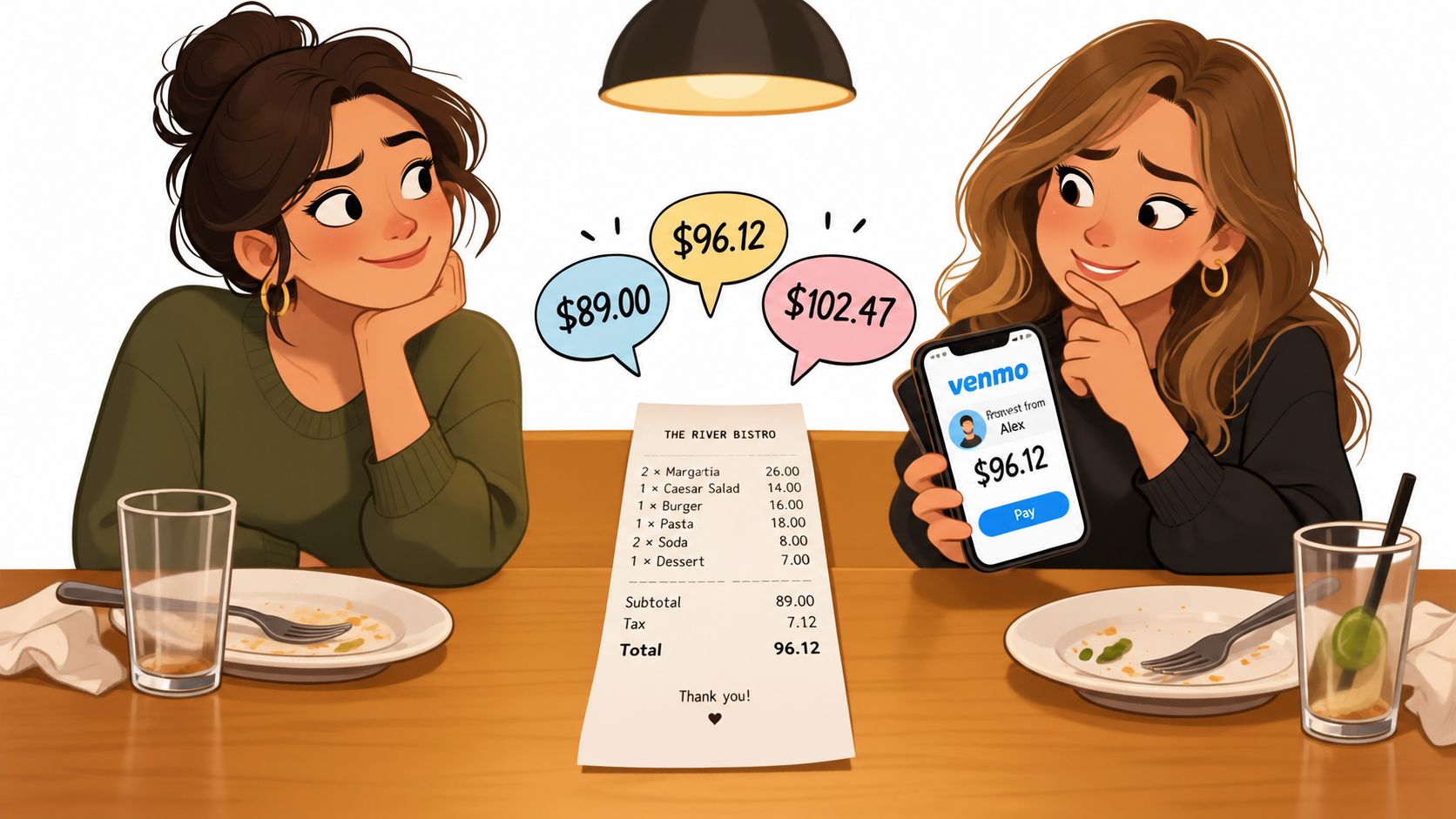
The awkward cost of a small difference
A minor gap rarely stays minor socially. Someone sends a reminder, another person checks their bank history, and the group starts debating what each person ordered instead of enjoying the evening. If nobody investigates, the person who paid may absorb the difference.
The same pattern gets harder to manage across a weekend trip. Hotel deposits, grocery runs, ride shares, and cash purchases may sit in different apps. A spreadsheet can record the entries, but it can't automatically explain why one payment is missing or whether two similar charges refer to the same purchase.
Practical rule: A balance isn't trustworthy just because the final totals look close. Every difference needs a reason.
A simple daily record, such as this Ledgerly daily expense entry, can help preserve the details while they're still fresh. Record who paid, what the purchase covered, who benefited, and whether the amount is shared or personal.
From confusion to a repeatable habit
Start by keeping the original receipt or transaction record. Then assign each item, distribute shared costs fairly, add tax and tip according to each person's share, and compare the result with the actual payment. If the numbers differ, investigate the item or timing instead of changing totals until they happen to agree.
For larger group expenses, a clear fair-share calculation provides a useful reference point before anyone sends a request. The aim isn't perfect memory. It's a transparent record that lets everyone see how the settlement was calculated.
What Balance Reconciliation Really Means
Think of two friends keeping separate notebooks for a shared trip. Priya writes down the train tickets and groceries she paid for. Sam records the museum tickets and dinner. At the end, they compare the notebooks to determine who covered more and what each person owes.
That comparison is the basic idea behind balance reconciliation. In formal finance, an organization compares its internal records with an independent external source, such as a bank statement, until it can explain the differences and make the adjusted balances agree. The process is described as a control for keeping recorded balances aligned with supporting records in balance sheet reconciliation guidance.
The phrase “independent source” matters. If you compare one copy of your own spreadsheet with another copy of the same spreadsheet, you may repeat the same mistake. A bank statement, card statement, receipt, payment confirmation, or detailed subledger gives you a separate point of reference.
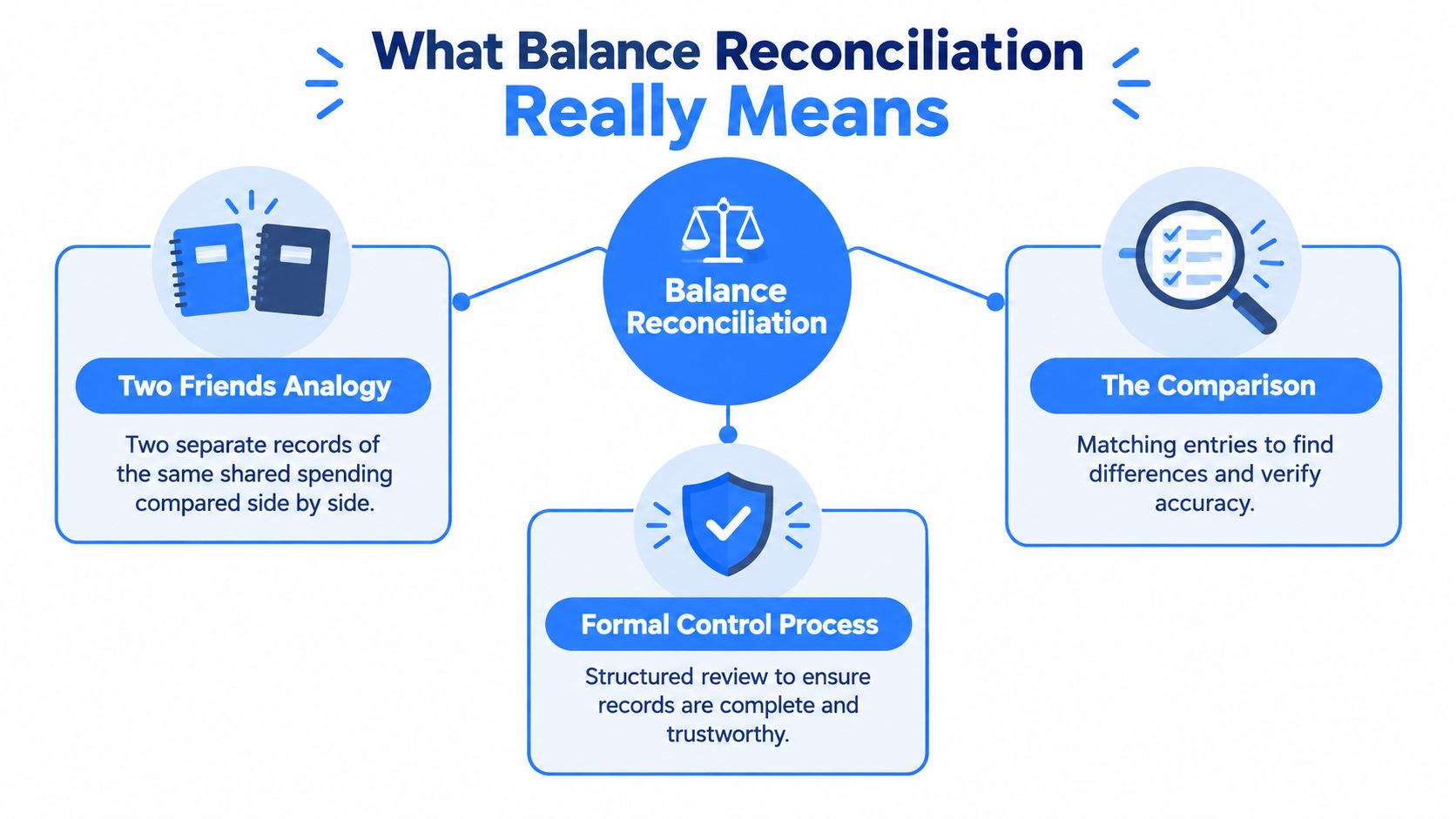
The four questions reconciliation answers
A useful reconciliation asks:
- What did our internal record say? This might be a ledger, a payment list, or one person's expense tracker.
- What does the supporting source say? Use the bank statement, receipt, invoice, or confirmed payment history.
- Which entries match? Match by amount, date, merchant, payer, and purpose.
- Why do the remaining entries differ? Classify each difference as a timing issue, missing transaction, duplicate, fee, allocation mistake, or unresolved context problem.
The work isn't arithmetic. You may find that a bank has recorded a transaction before it appears in the books, or that a roommate listed a transfer while the recipient hasn't received it. A difference can be valid, temporary, or an actual error.
Why documentation matters
Formal accounting teams preserve reconciliation histories so another person can see statement dates, statement balances, reconciled amounts, previous reconciled balances, and remaining differences. NetSuite reconciliation history documentation describes this kind of recordkeeping as an audit trail.
Friends don't need a corporate control file for a restaurant bill. They do need enough information to answer basic questions later: what was purchased, who shared it, what was paid, and what remains unsettled. If you're learning the broader mechanics, this guide to reconcile bank records manually can clarify how the same comparison works outside group expenses.
For a group bill, the equivalent of a formal control is a visible itemized breakdown. A person shouldn't have to trust a mysterious final request. They should be able to follow the path from receipt to personal share.
The distinction between splitting one charge and distributing an ongoing obligation also matters. A split billing explanation can help when recurring household costs need a defined allocation rather than a one-time reimbursement.
Three Ways to Reconcile and When to Use Each
Reconciliation changes depending on the records involved. A bank statement and a general ledger answer a different question from a general ledger and an accounts receivable subledger. A group dinner adds a human allocation problem that business systems usually don't face.
Bank versus ledger
This is the classic cash control. Compare the internal cash record with the bank statement, then investigate deposits, withdrawals, fees, interest, duplicates, and transactions that were recorded at different times.
A payment may appear in the books before the bank processes it. A bank fee may appear on the statement before anyone records it internally. The objective isn't to erase every difference. It's to identify each reconciling item and determine whether an adjustment or explanation is required.
Ledger versus subledger
A general ledger may show a total for accounts receivable or accounts payable. A subledger contains the supporting detail, such as individual customer invoices or vendor balances. Reconciliation checks whether the summary total agrees with the detailed records.
This method is useful when a total looks plausible but the underlying accounts may contain missing postings, unapplied payments, or duplicated entries. It supports a deeper review than comparing a bank balance.
Peer-to-peer settlement
A group split compares the receipt or shared expense list with each person's assigned share and the payments already made. It must account for consumption, shared items, tax, tip, discounts, reimbursements, and payment status.
Totals alone fail. Two people may have paid the same amount, but one payment could cover a personal item while the other covers a shared charge. A split expenses calculator can help establish each person's share before settlement requests go out.
| Method | Sources Compared | Best For | Common Reconciling Items |
|---|---|---|---|
| Bank versus ledger | Internal cash record and bank statement | Verifying cash activity | Fees, timing differences, missing entries, duplicates |
| Ledger versus subledger | General ledger and detailed account records | Checking summary balances | Unposted invoices, unapplied payments, classification issues |
| Peer-to-peer split | Receipt, assigned items, and payment history | Settling group expenses | Shared items, tax, tip, cash payments, rounding, partial payments |
A bank reconciliation asks, “Does our recorded cash agree with the bank after explained adjustments?” A peer settlement asks, “Did each person contribute the right amount for what they consumed or shared?” The mechanics overlap, but the second question depends much more heavily on human context.
This short video provides a visual introduction to the comparison process:
Choose the method based on the source records, not the label on the expense. A roommate utility bill needs a shared allocation and payment check. A business checking account needs statement matching and documented adjustments. A travel organizer may need both.
Why Reconciliation Fails and How to Spot the Cause
A traveler pays for the hotel, a roommate sends money, and the bank still shows a pending transfer. The totals may look wrong even when nobody made a calculation mistake. Reconciliation fails when records describe different moments, come from disconnected systems, or lack the context needed to explain a charge.
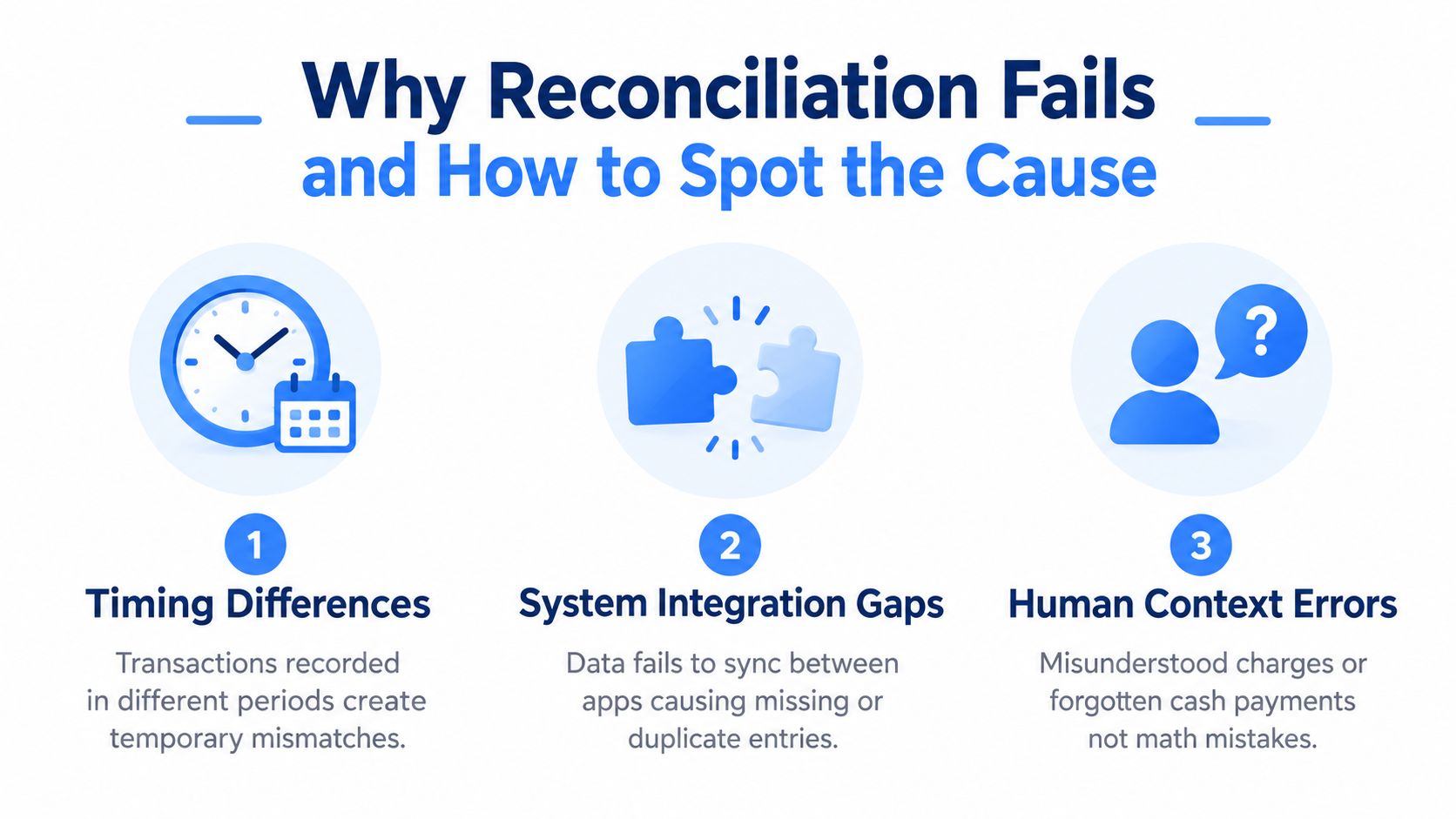
Timing differences
A card payment can be authorized immediately but posted later. A bank transfer can leave one account before appearing in another. A roommate may mark a transfer as sent while the recipient still sees it as pending.
Timing differences make up 65% to 75% of reconciliation exceptions in some settings, according to USTech Automations' reconciliation pain-point analysis. Record the transaction status and expected resolution instead of entering it again because one system has not caught up. The same approach works for group expenses: label a payment as pending, then check it again after processing completes.
Integration gaps
A group trip may involve a card app, bank account, payment service, and shared spreadsheet. If one connection stops syncing, a transaction can appear missing in one record and duplicated in another. Matching totals will not fix a record that lacks the same source information.
Payments teams identify cross-currency transactions as a 23% barrier, multiple payment channels as a 22% barrier, and high transaction volumes as a 20% barrier to accurate matching, according to survey data cited by DualEntry's balance reconciliation overview. These barriers describe a coordination problem. Currency conversions, separate payment channels, and busy transaction streams can strip away the details needed to identify who paid and what the payment covered.
Human context errors
A person may forget a cash payment, assign a shared dish to one diner, or accept a suggested match because two merchant names look similar. The arithmetic can be correct while the settlement remains unfair. A receipt does not explain by itself who shared an item, whether a transfer covered another expense, or whether someone already paid outside the main app.
Integration issues and human intervention together account for nearly half of reconciliation errors in the industry commentary cited by USTech Automations. For high-volume work, automation guidance from AppsE reports that manual reconciliation automation can eliminate 50% to 70% of manual reconciliation hours, reduce a month-end close from more than 6 days to under 4, and reduce matching errors from 5% to 10% to below 1%.
Start by identifying the kind of difference. Recalculating the entire total can hide the actual cause.
Give each exception a root-cause label:
- Timing: The records should agree after processing finishes.
- Missing: One source contains a transaction the other does not.
- Duplicate: The same transaction appears more than once.
- Allocation: The charge exists, but the share is assigned incorrectly.
- Context: The records cannot explain who benefited or what the payment covered.
The label determines the response. Wait for a timing issue, record or import a missing entry, and reassign an allocation error. A context problem usually needs a receipt review or a quick conversation before anyone sends another payment.
Step by Step Workflows for Groups and Roommates
A good workflow makes each person's responsibility visible. It also creates checkpoints so you can stop early when something doesn't make sense.
Restaurant and bar bills
Start while the receipt is still available.
- Capture the receipt. Photograph the full receipt, including the subtotal, tax, tip, discounts, service charges, and final total. Keep the payment confirmation from the person who paid.
- Separate personal and shared items. Assign the pasta to the person who ate it. Mark shared plates for the relevant diners. If nobody remembers an item, pause instead of assigning it by guesswork.
- Choose the split basis. Split a shared dish evenly among its consumers, or use an agreed proportion when people consumed different amounts. The rule matters more than the method.
- Allocate tax and tip. Add each person's share of the tax and tip in proportion to the items assigned to them. A person who ordered more shouldn't automatically transfer the full tax burden to someone with a smaller meal.
- Verify the receipt total. Add all personal shares and shared allocations. The result should agree with the final receipt total after accounting for discounts and service charges.
- Compare against payment. If Maya paid the restaurant, her share reduces what she should receive. If Alex already sent cash, mark that payment before creating a new request.
- Request settlement. Send each person the itemized amount and payment method. Include a short note for unusual charges, such as a shared bottle or a discount applied to the whole table.
If the result doesn't agree, check the receipt total first, then shared items, tax, tip, and existing payments. Don't round every person independently before checking the group total. Small rounding choices can create a leftover balance that looks like a missing transaction.
Roommates and household expenses
Household reconciliation works better as a recurring record than a conversation at the end of the month.
- List each cost: Record rent, utilities, internet, supplies, and one-off repairs with the payer, date, amount, and supporting statement.
- Set the allocation rule: Decide whether each cost is split evenly, by room size, by usage, or by another agreed basis. Apply the rule consistently.
- Record transfers separately: A bank transfer is a settlement event, not proof that the underlying expense was allocated correctly.
- Compare expected and received amounts: Match each roommate's obligation with actual transfers. Mark pending payments distinctly from completed payments.
- Explain differences: A roommate may have paid a supplier directly, covered a replacement item, or received a credit. Record that context rather than forcing the payment into the wrong category.
- Close the period: Confirm that the household costs are fully allocated and that the payer has received the agreed reimbursements.
Keep the record simple enough that everyone will use it. A shared sheet with links to receipts can work, but only if someone records expenses promptly and the group agrees not to overwrite the history.
How Divvy Automates Reconciliation Without the Ledger Hassle
For a one-time restaurant, bar, or takeout bill, Divvy applies the reconciliation logic directly to the receipt. Its iPhone app uses AI receipt scanning to read line items, tax, and tip, then lets the payer tap items to assign them to specific people or split shared dishes evenly.
That design addresses the first context problem: remembering who consumed what. Instead of entering a single total and debating it later, the group starts with the source document and builds each person's share from the item level.
From receipt to personal balance
Divvy calculates tax and tip proportionally based on each person's assigned items. It can then create payment requests through Apple Pay, Venmo, or Cash App, so friends don't need to install the app or create accounts to settle their balances.
The workflow connects four tasks that people often separate:
- Receipt capture: Read the source record rather than relying on memory.
- Item assignment: Identify personal and shared consumption.
- Cost allocation: Apply tax and tip to the resulting shares.
- Settlement tracking: Send requests and follow up on unpaid balances.
Automated reminders continue until balances are settled, which replaces repeated manual messages with a visible payment status. The product also includes a Pro plan with unlimited AI scans and web calculators for bill and rent splits.
Divvy is designed for immediate settlement of a specific bill, not for maintaining a broad running ledger across every household transaction. That distinction matters. A ledger-style tool may suit ongoing accounting, while a receipt-based workflow fits a dinner or trip expense where the main problem is assigning the current charge accurately.
Use the tool as part of a control habit, not as a substitute for agreement. The group still needs to decide who shared an item and how unusual costs should be handled. Automation can organize the evidence and calculate the allocation, but people provide the context when the receipt doesn't answer the question.
Keep Every Shared Balance Accurate Going Forward
Reconcile a charge while its details are still easy to verify. After a trip or billing cycle, timing differences, missing entries, forgotten cash payments, and unclear memories can look like one large problem. A quick check after each transaction keeps those exceptions separate.
Finance teams increasingly use continuous reconciliation to flag unusual differences before close. The same idea works for roommates and travel groups. Treat each shared expense like a group settlement: preserve the evidence, explain each person's share, and resolve exceptions while the context is fresh.
A lightweight routine is enough:
- Save the source: Keep the receipt, statement, or payment confirmation.
- Record the context: Note who benefited and which items were shared.
- Verify the total: Confirm that allocated shares equal the actual charge.
- Track payment status: Separate pending, completed, and disputed transfers.
- Label exceptions: Identify timing, missing, duplicate, allocation, or context issues.
- Follow up last: Exclude payments already made before sending a request.
A matching balance is only the starting point. An explained balance is one the group can trust, even when the receipt does not answer every question.
Divvy turns receipts into itemized shares, allocates tax and tip, and sends payment requests through services such as Venmo and Cash App. Visit Divvy to scan a shared bill and settle it without building a manual ledger.