Divvy
DivvyCalculating Travel Expenses for Group Trips
By The Divvy Team · October 4, 2026 · 16 min read
You're at the airport, bags packed, and someone has opened the group chat with the dreaded question: “Who owes whom?” One friend paid for the rental, another covered airport rides, someone else bought groceries, and the rest of the group are trying to reconstruct four days of spending from bank notifications and blurry receipts.
That's not really an accounting problem. It's a settlement problem. The trip already happened, the money has already moved, and now everyone needs a fair answer without forcing one person to become the group's unpaid bookkeeper. Calculating travel expenses works best when you plan enough to avoid sticker shock, then make the final settlement precise, fast, and easy to pay.
Table of Contents
- Why Shared Trip Costs Get Messy So Fast
- The Four Cost Buckets Every Group Trip Has
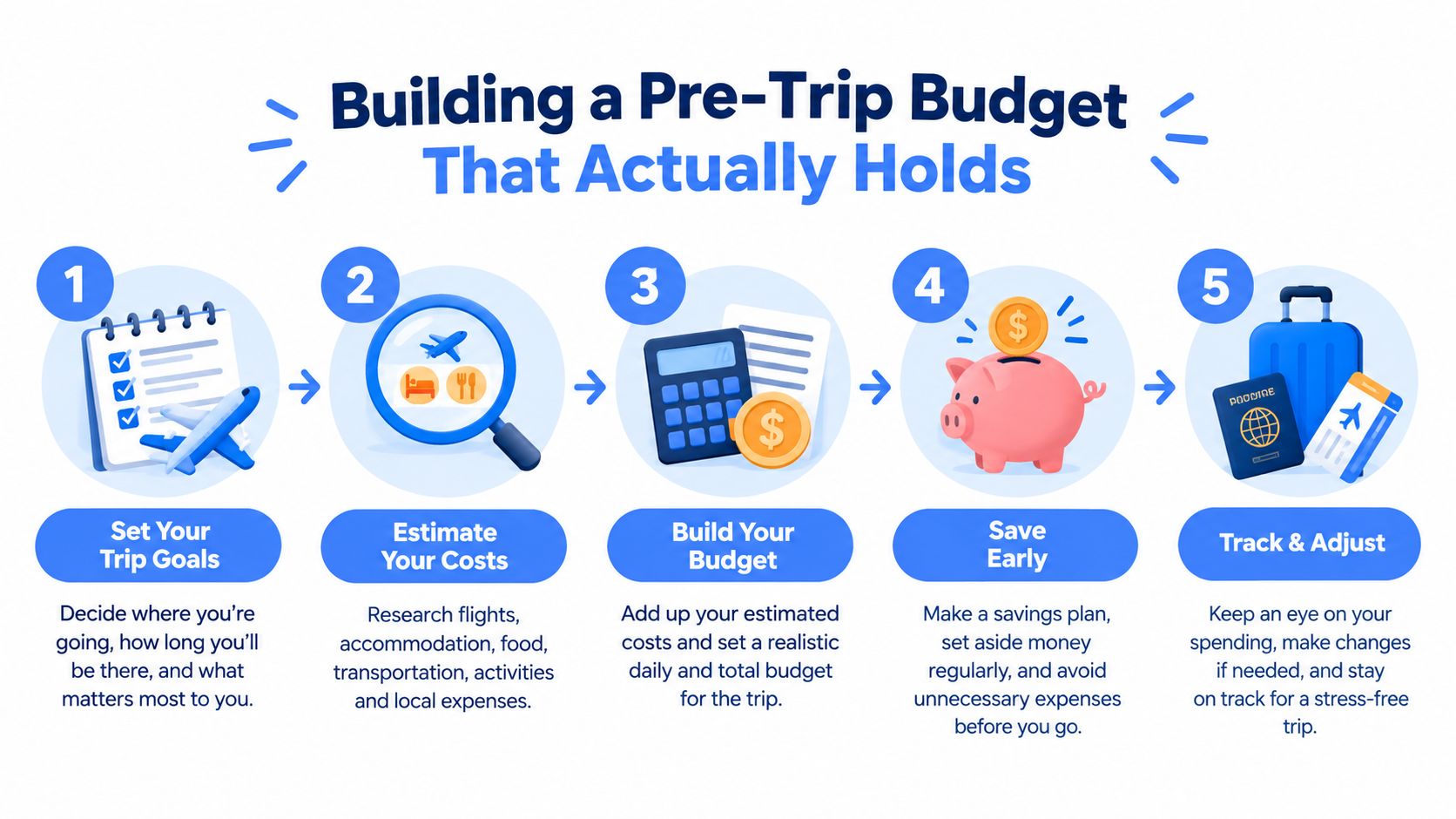
- Building a Pre-Trip Budget That Actually Holds
- Settling Up After the Trip Without the Awkward Math
- Pre-Trip Budgeting Versus Post-Trip Settlement
- How Item-Level Scanning Simplifies Group Settlement
- Your Pre-Trip and Settlement Checklist
Why Shared Trip Costs Get Messy So Fast
Four friends land in Lisbon. One paid for the Airbnb, another covered the Ubers, a third grabbed groceries, and the fourth wants everything settled before the flight home. Within minutes, the simple split starts falling apart.
The Airbnb was shared by everyone, but one person arrived later. One traveler skipped lunch. Two people took a taxi to a viewpoint while the others walked. One couple joined the cooking class, while the remaining friends chose a free afternoon at the beach. The group used different cards, dealt with different currencies, and kept receipts in several phones.
A group trip isn't one bill. It's a chain of purchases with different participants.
Start with participation, not equal shares
An even split feels tidy, but it often makes the wrong people subsidize the wrong choices. Shared lodging may belong in a common pool. A meal where one person didn't eat shouldn't automatically go there. A private cab belongs to the riders. An activity belongs to the people who attended.
Use three questions for every expense:
- Who benefited? List the people who used, ate, or attended.
- Who paid? Record the person who fronted the money.
- How should it split? Choose evenly, by item, by usage, or between a specific subset.
That approach prevents the most common argument, which isn't about the amount. It's about whether the amount was assigned fairly.
Practical rule: Every shared purchase needs a payer, a participant list, and a split method before it disappears into the group chat.
Budgeting prevents surprises, settlement closes the loop
A pre-trip budget gives everyone a spending boundary. It helps the group decide whether to book a central apartment, use public transit, cook some meals, or skip expensive activities. It also gives a traveler time to say, “That's outside my budget,” before the reservation is nonrefundable.
Pressure arrives later, when receipts get tallied and payment requests go out. A person who fronts a group bill is effectively extending a small loan to everyone else. If the group waits until the end, the payer has to remember every purchase, chase missing receipts, convert currencies, and defend each calculation.
The fix is simple: budget before departure, log expenses during the trip, and settle each meaningful bill while the details are still fresh.
The Four Cost Buckets Every Group Trip Has
Most group travel spending fits into four buckets: transport, lodging, meals, and activities. Separating them makes the budget easier to inspect and the final settlement easier to assign.
| Cost Bucket | Per-Person Daily Range (USD) | Typical Examples | Split Evenly? |
|---|---|---|---|
| Transport | Research by route and destination | Flights, rental cars, fuel, rideshares, local transit | Often, but only among users |
| Lodging | Research by room type and occupancy | Rental, hotel rooms, taxes, cleaning, booking fees | Usually, adjusted for room use |
| Meals | Research by eating style and meal plan | Groceries, group dinners, snacks, drinks | Rarely, unless agreed in advance |
| Shared activities | Research by planned attendance | Tours, tickets, rentals, entrance fees | Only among attendees |
The broad travel benchmark here is qualitative, not a universal rate. A mid-range trip can sit in a manageable daily band, while a city break with frequent taxis, restaurant meals, and paid attractions can rise quickly. Set your own target from current booking prices instead of borrowing a number from someone else's itinerary.
Transport is large, but not automatically communal
Flights and long-distance trains are usually personal expenses unless the group booked them together. Rental cars, fuel, tolls, and parking need more careful treatment. If everyone rides together, an even split is sensible. If two travelers extend the rental for a personal detour, that extra cost belongs to them.
Local rides need the same discipline. Tag the people in each rideshare or taxi as soon as it's paid. Waiting until the end makes every route harder to reconstruct.
Lodging needs a room-aware rule
A shared apartment is often easy to pool, but mixed sleeping arrangements complicate the split. A private room, sofa bed, extra night, or late arrival may justify an adjustment. Agree on the rule before booking, not while everyone is standing in the checkout line.
Include booking fees, cleaning charges, taxes, and required deposits in the lodging total. People often remember the nightly rate and forget the charges that appear below it.
Meals create the most resentment
Groceries can be shared if everyone eats from them. Restaurant meals are different. One person may order a modest entrée, another may add drinks, and someone else may skip the meal altogether. Split by item when the differences are meaningful, and split shared plates among the people who ate them.
The dining category deserves particular attention because food represents a major part of business travel spending. One corporate travel budget overview cites a Booking.com for Business survey in which dining represented roughly 63% of average out-of-pocket trip spending, with the average out-of-pocket amount at about $700 per corporate trip. A leisure group won't follow the same pattern, but the lesson carries over: don't hide meals inside a blanket split.
Activities should follow attendance
Tickets, tours, bike rentals, boat rides, and cooking classes belong to the people who use them. If a child receives a reduced price or a partner joins only one activity, record the actual price rather than forcing the entire group into an even division.
Building a Pre-Trip Budget That Actually Holds
A useful travel budget isn't a single number that everyone promises not to exceed. It's a set of guardrails built around per-person daily limits, category allocations, and a clearly labeled buffer.
Start by estimating the trip length and identifying who is participating. Then research the likely cost of transport and lodging before setting a meal or activity target. A budget based on wishful thinking fails before the first booking. A budget based on current prices gives the group something it can discuss.
Build the budget in five moves
- Set the daily target. Choose a per-person amount that reflects the destination, accommodation standard, and eating style. Use actual booking searches and sample menus rather than a generic travel rule.
- Allocate the four buckets. Give transport, lodging, meals, and activities their own limits. Don't let an attractive apartment consume the money reserved for activities.
- Add a surprise buffer. Reserve part of the plan for airport transfers, replacement transport, weather-related changes, extra groceries, or an activity the group discovers on the way.
- Confirm participation. Ask who is sharing rooms, joining dinners, taking the rental car, and attending paid activities.
- Choose the settlement method. Decide whether one person fronts each category, everyone contributes to a shared pot, or the group logs expenses as they occur.
For a business trip, the documentation rules may be different from a friends' holiday. The IRS per diem guidance summarized by Thomson Reuters explains that per diem can substantiate certain travel-away-from-home costs, but travelers still need to document the time, place, and business purpose. Allowances above the applicable limit may need to be taxed or repaid. That makes a per diem a policy tool, not permission to stop recording the trip.
Use a worked structure, not a fake precision
Suppose four travelers are visiting several European cities over ten days. Instead of pretending the trip will cost exactly a fixed amount per person each day, create four lines:
- Transport: long-distance routes, local transit, fuel, and rides
- Lodging: room allocation, rental charges, taxes, and fees
- Meals: groceries, planned group dinners, and personal meals
- Activities: only the attractions the group has agreed to consider
Then add a separate buffer. If the group needs an airport transfer, replaces a canceled train, or books a cooking class, the expense comes from that buffer first. If the buffer remains unused, return it proportionally or apply it to the final settlement.
The budget is a guardrail, not a contract. Travelers change plans. A good system makes those changes visible instead of pretending they didn't happen.
Settling Up After the Trip Without the Awkward Math
Consider six friends sharing a four-night Airbnb in Lisbon. Maya paid the lodging and several group purchases upfront. Everyone shared the accommodation, utilities, and groceries, so those costs belong in the common pool. A dinner had one person abstaining, another dinner belonged only to a couple, and solo cabs stayed with the people who rode in them.
The correct process is not “add everything and divide by six.” It's to create a participant list for each charge.
Assign each expense to the right people
For the common lodging and household costs, divide the total evenly among the six friends. The dinner attended by five people gets divided five ways. The couple's dinner stays with the couple. A cab used by two travelers is split between those two riders. Nobody pays for an activity, meal, or ride they didn't use.
Maya's final balance is then calculated in two directions:
- Maya's share: what she personally consumed or owed across all expenses
- Amounts fronted: what she paid on behalf of the group
- Net balance: the difference between those two figures
Each other traveler gets the same treatment. Once the six net balances are calculated, the group can decide whether to send money directly to Maya or simplify the transfers by routing payments through the people who are owed.
Keep a clear audit trail
Use one row per receipt, not one row per day. Each row should include:
- Date and merchant
- Total including tax, tip, and fees
- Person who paid
- Participants
- Assigned items or split rule
- Currency and conversion method
- Settlement status
That level of detail matters because expense reports regularly contain preventable errors. GBTA's expense-report analysis reports that 19% of expense reports contain errors or missing information, and that companies process an average of 51,000 reports each year, with manual processing taking about 20 minutes per report. The same source estimates an average hotel-stay report costs $58 to process, with errors adding $52 and 18 minutes of correction time. A friend group won't face the same administrative bill, but the friction has the same cause: incomplete evidence and unclear ownership.
A manual settlement means photographing every receipt, typing each item into a spreadsheet, checking who attended, calculating tax and tip, and sending separate payment requests. A scan-and-request workflow turns the same process into receipt capture, item assignment, automatic totals, and one request per person.
Pre-Trip Budgeting Versus Post-Trip Settlement
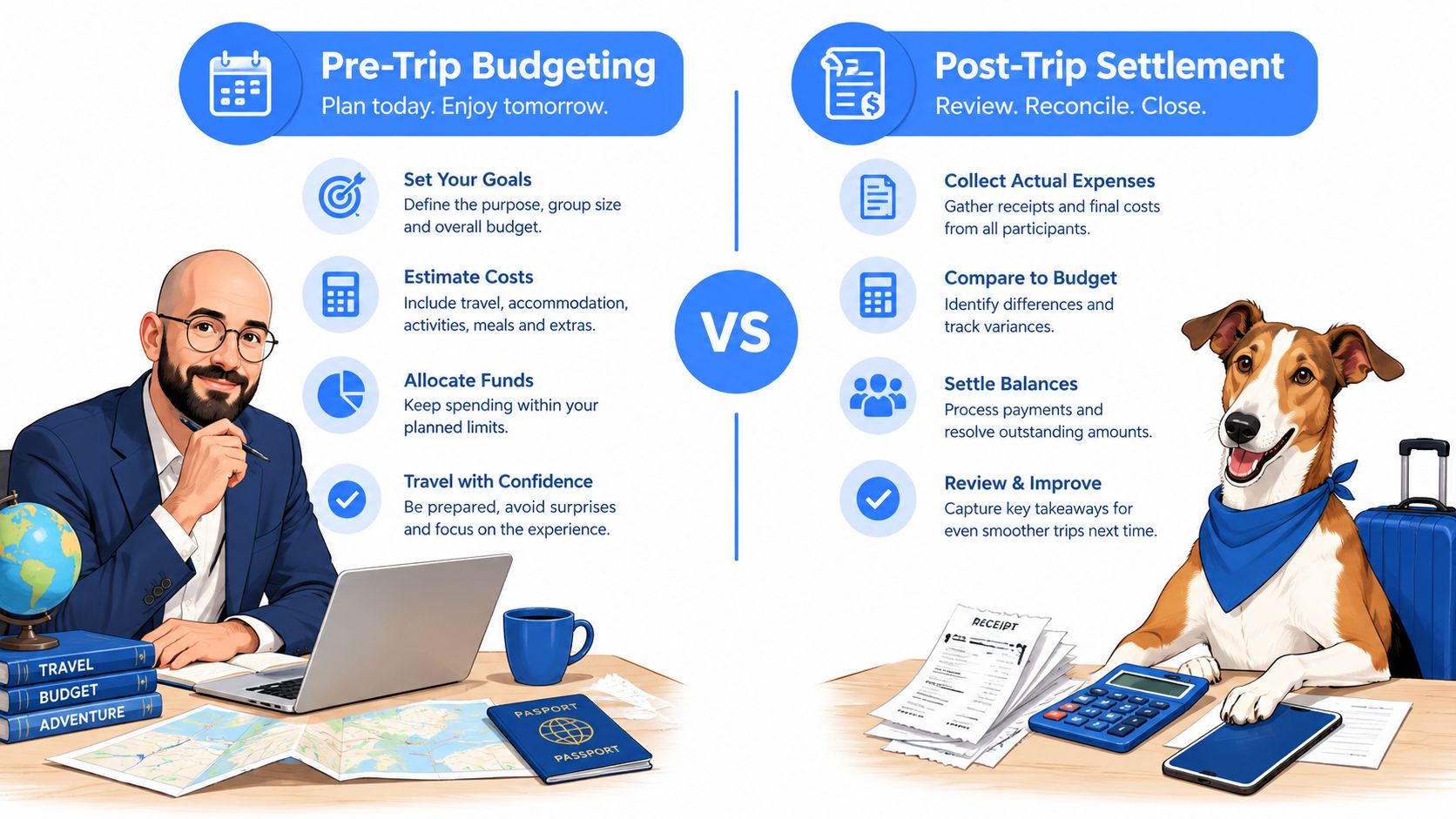
These approaches solve different problems. Pre-trip budgeting controls spending before money leaves the group. Post-trip settlement records what happened and assigns the final balances afterward.
| Approach | How it works | Best for | Main drawback |
|---|---|---|---|
| Pre-trip budgeting | Set daily caps, allocate categories, and collect money for shared commitments | Groups with strict limits or large shared bookings | Requires trust, agreement, and upfront contributions |
| Post-trip settlement | Travelers pay as they go, then reconcile receipts after the trip | Flexible itineraries and informal friend groups | Concentrates the math and awkward conversations at the end |
| Hybrid method | Fund shared bookings early, then settle variable expenses during or after travel | Most mixed group trips | Requires both an initial plan and ongoing logging |
Choose a budget when certainty matters
A budget works well when the group needs to reserve a rental, pay a deposit, or make sure everyone can afford the planned itinerary. A shared pot can also reduce the number of people fronting large charges. The danger is treating the pot as permission to spend without recording who participated. A common fund still needs a receipt trail.
Budgeting also exposes disagreements early. If one traveler wants restaurant dinners every night and another expects groceries, the conflict belongs before departure, when the itinerary can still change.
Choose settlement when flexibility matters
Post-trip settlement suits groups that don't want to lock up money in advance. Each person keeps control of their cash, and the final totals reflect actual participation. That flexibility comes at a cost. One person may carry the shared expenses for days, and the group may face a pile of receipts when everyone is tired and ready to go home.
Most groups should use the hybrid approach. Fund the fixed shared commitments upfront, such as lodging or a rental deposit. Log meals, rides, groceries, and activities as they happen. Then close the remaining balances before anyone has to reconstruct the trip from memory.
How Item-Level Scanning Simplifies Group Settlement
The hard part of splitting a group bill isn't addition. It's deciding who owes for each line, then getting everyone to agree without reopening the entire dinner.
Take a restaurant check with five participants. One person skipped the meal. Two people shared a bottle of wine. Everyone had some of the appetizer, while the entrées belonged to individual diners. A fair settlement assigns the absent person nothing, divides the wine between the drinkers, splits the appetizer among the people who shared it, and assigns each entrée to its owner.
Let the receipt carry the detail
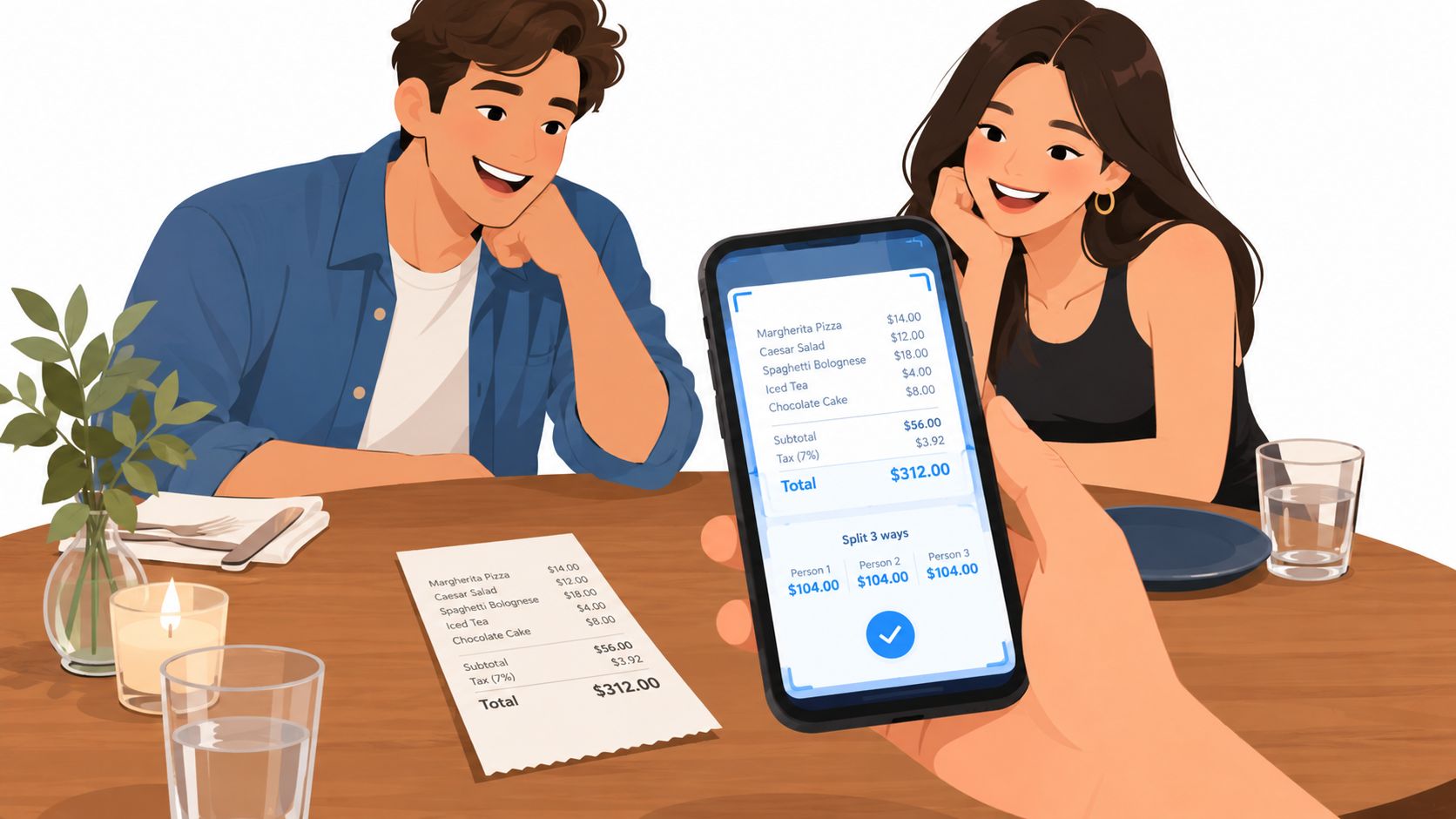
An AI receipt scanner can read the merchant, line items, tax, and tip from a photograph. The organizer then taps each item and assigns it to one person, several people, or the whole group. Shared dishes can be divided evenly, while personal items stay with the person who ordered them.
The resulting breakdown should show:
- Each person's assigned items
- Their share of shared dishes
- Tax and tip allocated proportionally
- Their final amount
- The amount already paid
- The remaining balance
That removes the need to type every line into a spreadsheet. It also makes the decision visible. A person can check the assigned items while the meal is still fresh instead of trying to remember what they ordered several days later.
Send the request while the context is fresh
The best payment request arrives after the group has agreed on the split, not after the organizer has spent an evening defending a mystery total. One-tap requests through familiar payment services reduce the number of separate messages, and reminders keep the settlement from becoming a permanent open tab.
That distinction matters because a trip expense tool differs from a running ledger. A ledger tells you that balances exist. Item-level scanning explains why each balance exists, then turns the explanation into a payment request. For a dinner, grocery run, or shared activity, that is the useful part.
Your Pre-Trip and Settlement Checklist
Save this before the group starts booking.
Before departure
- Set category limits: Create per-person targets for transport, lodging, meals, and activities.
- Confirm participation: Record room assignments, planned dinners, rides, and optional activities.
- Choose front-payers: Decide who will cover lodging, transport, groceries, and bookings.
- Agree on the method: Pick a shared log, receipt scanner, payment app, or hybrid process.
- Define the rule: Decide whether meals split by item, attendees, or an agreed common pool.
During the trip
- Scan shared receipts immediately: Capture the bill before it gets lost or the details fade.
- Tag participants: Mark who used the ride, ate the meal, or attended the activity.
- Check currencies: Record the conversion method and keep the original receipt.
- Send requests promptly: Close ordinary balances the same evening instead of carrying them home.
- Review exceptions: Handle skipped meals, private rooms, personal detours, and partial attendance separately.
The habit that prevents the “who owes whom” thread is simple: log every shared receipt before the bill leaves the table, then send the payment request that evening. You don't need a perfect spreadsheet. You need an agreed rule, a visible calculation, and no stale balances.
Divvy itemizes receipts with AI, assigns line items to the right people, allocates tax and tip, and creates payment requests through familiar money apps. Use Divvy to turn shared trip receipts into clear individual balances before the group chat becomes a collection agency.