Divvy
DivvyHow Do Restaurants Split Tips Explained Simply
By The Divvy Team · September 5, 2026 · 15 min read
At closing time, a restaurant's tip jar is full, card tips are sitting in the payment system, and several employees are asking the same question: who gets what? The server may have collected the gratuity, but the busser cleared plates, the bartender prepared drinks, and the kitchen helped complete the meal. If the restaurant hasn't written down a clear rule, even a routine shift can end with confusion.
The answer to how do restaurants split tips isn't just a percentage calculation. It depends on the restaurant's wage structure, the roles included in the pool, the distribution method, and the laws that apply. A fair-looking arrangement can still create wage risk if it ignores the difference between taking a tip credit and paying employees at least the full minimum wage.
This guide breaks the process into plain steps. You'll see how pooled tips, percentage-based tip-outs, and points systems work, how proportional calculations prevent cross-subsidies, and why automatic gratuities and mixed service channels complicate the final payout. The central lesson is simple: tip splitting is a wage-structure decision first and a math problem second.
Table of Contents
- Introduction Why Tip Splitting Confuses Everyone
- How Restaurant Tip Splitting Actually Works
- Legal Rules That Decide Who Can Be in the Pool
- Common Tip Pool Percentages and Role Based Splits
- Tip Splitting Calculations With Real Examples
- Mixed Service Formats and Where Splits Get Tricky
- How Restaurants Prevent and Resolve Tip Disputes
Introduction Why Tip Splitting Confuses Everyone
A restaurant can collect gratuities in several forms during one shift. A guest might leave cash at a table, add a card tip through the point-of-sale system, use a QR code, or pay a service charge already printed on the bill. Those amounts may look similar to the guest, but the restaurant still has to record, classify, and distribute them correctly.
The confusion grows when one employee appears to “own” the tip because it was attached to their table. Many restaurants have moved away from that individual-server model toward managed distribution. The reason is practical: service is usually a team effort, and a consistent pool can recognize employees whose work happens away from the guest's table.
At the same time, employees care about more than the final total. They want to know whether the rule is predictable, whether hours and roles are counted consistently, and whether management is taking any portion. Diners may also want to know whether a service charge goes to staff or whether an additional tip is expected.
The useful question isn't only “How much was tipped?” It's “Which employees are eligible, what formula applies, and when is the money redistributed?”
The numbers show why this issue is widespread. The National Restaurant Association's 2024 State of the Restaurant Industry Report found that 73% of full-service restaurants use some form of tip pooling or tip sharing. The same source reports an average tip level of about 19.4% in 2024 at those restaurants, compared with roughly 18% through much of the 2010s. Public opinion remains unsettled, however. Pew found that only 14% of nearly 12,000 respondents considered a pool including all restaurant staff the fairest approach, while 13% preferred a pool limited to servers, as reported in the same restaurant tipping overview.
Those figures don't settle the fairness debate. They show why a restaurant needs a policy that staff can understand, guests can interpret, and payroll can defend. The right system makes the flow of money visible from collection through final payout.
How Restaurant Tip Splitting Actually Works
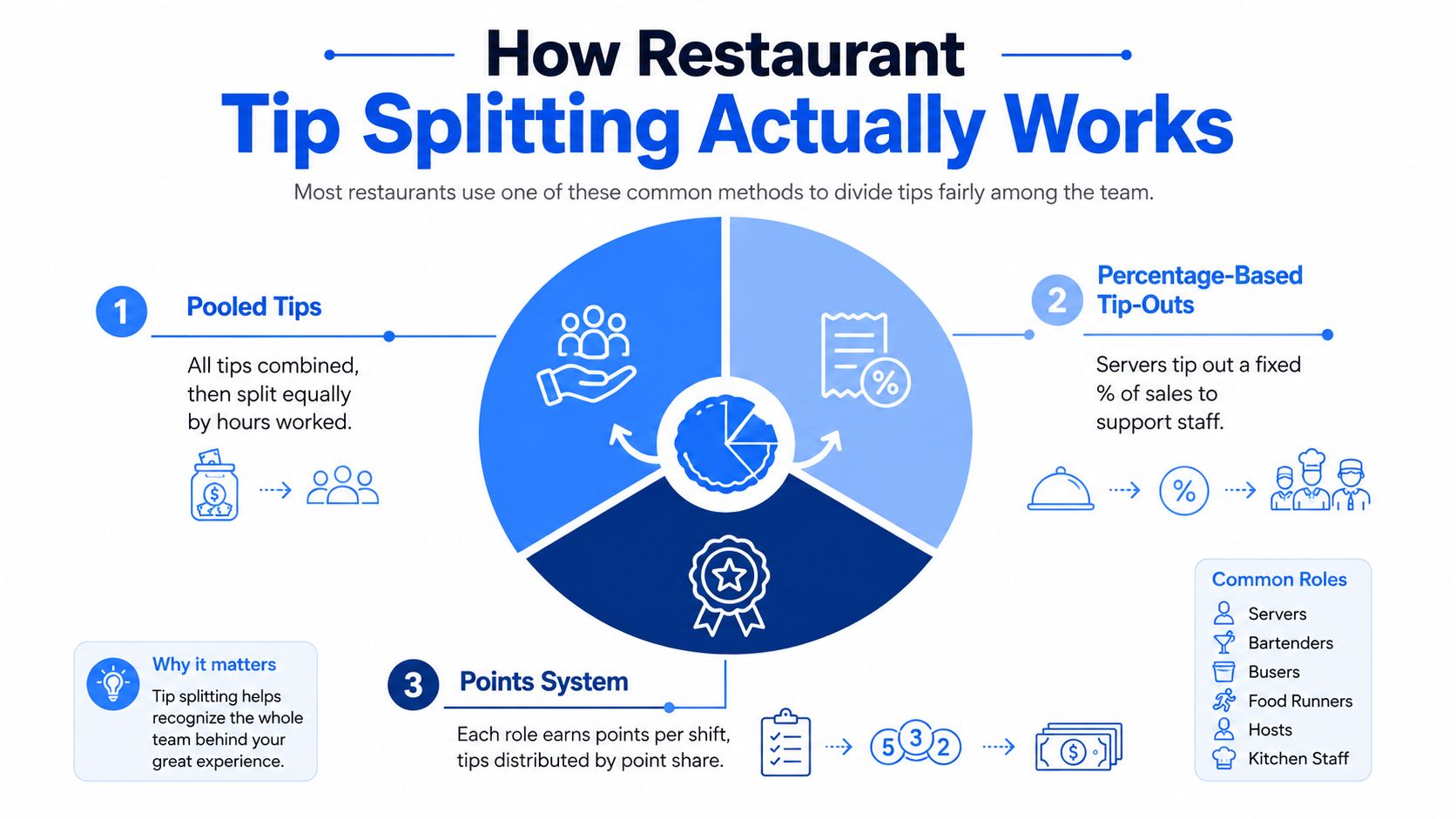
Think of the shift's gratuities as a pie. The restaurant first decides whether everyone receives a slice from one combined pie or whether each server keeps most of their own slice and shares a smaller portion with support staff.
Pooled tips
With pooled tips, eligible employees contribute gratuities to one shared total. The restaurant then applies a formula, often based on hours worked, role points, or another written rule. An employee who works longer may receive a larger slice, while employees with different responsibilities may receive weighted shares.
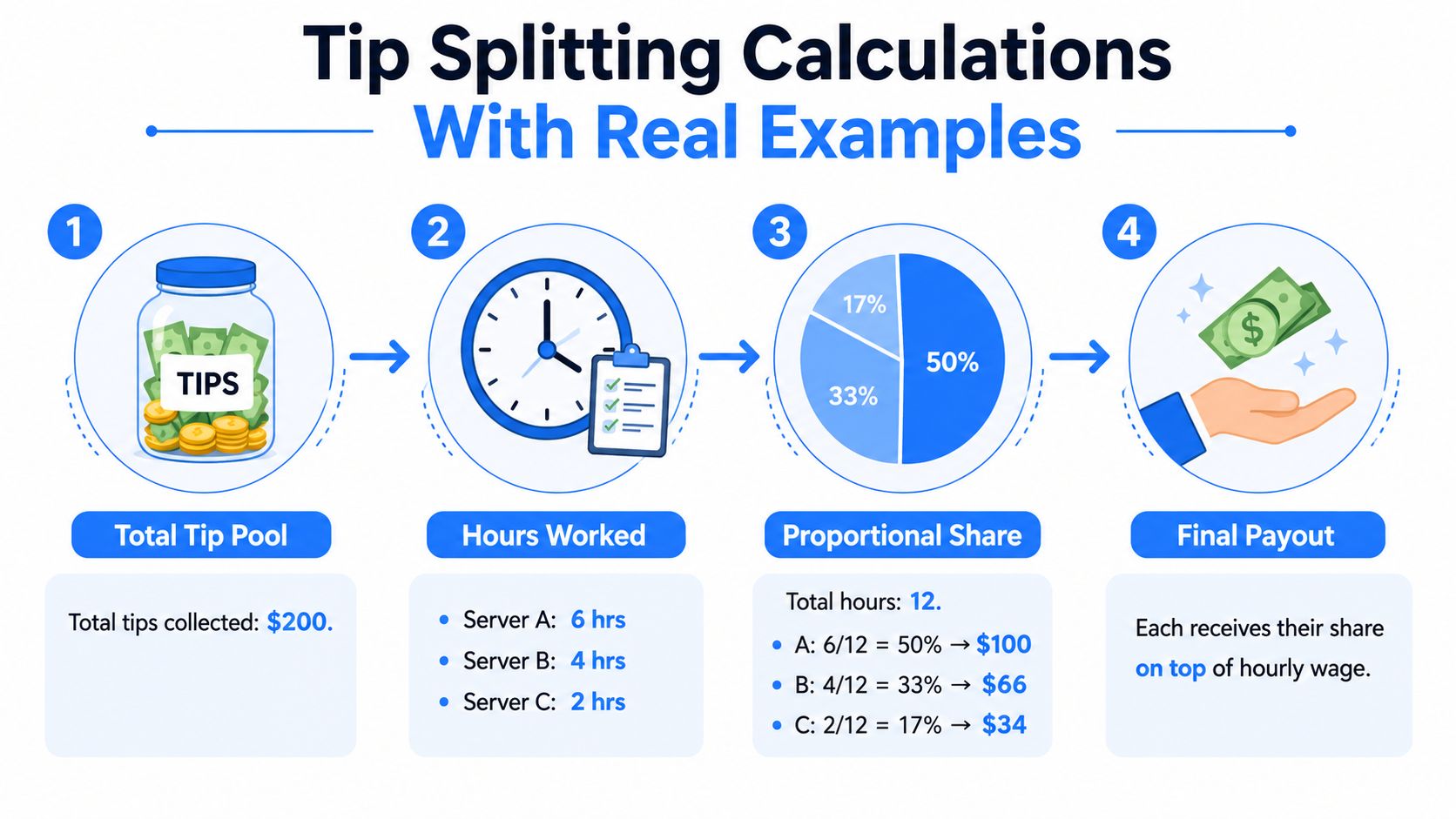
A simple hours-based pool works like this:
- Add the eligible tips collected during the shift.
- Add the hours worked by each eligible employee.
- Divide the pool according to each person's share of total hours.
- Record the result for payroll and pay it under the restaurant's stated schedule.
This model reduces the effect of one unusually busy section. It also requires accurate time records and a clear definition of which tips and employees belong in the calculation.
Percentage-based tip-outs
With percentage-based tip-outs, the server or bartender keeps the main portion of the gratuity and transfers a defined percentage of sales or tips to support roles. A restaurant might set a rule for bussers, food runners, barbacks, or bartenders.
The critical detail is the base. “Five percent tip-out” could mean five percent of a server's sales, five percent of food sales, or five percent of the tips received. Those are different calculations, so the policy must name the base rather than relying on shorthand.
Points systems
A points system assigns each eligible role a weight for the shift. A server might receive one point per hour, while a support position receives a different point value. The pool is divided according to each employee's share of all points.
This model gives the restaurant more control over role differences, but it also creates more room for disagreement. Employees need to see the point values, the hours counted, and the final calculation.
Restaurants also need reliable shift records, payment records, and communication. A calm restaurant operations guide can help managers build the broader operational habits that support accurate tip tracking, including consistent closeout procedures.
Legal Rules That Decide Who Can Be in the Pool
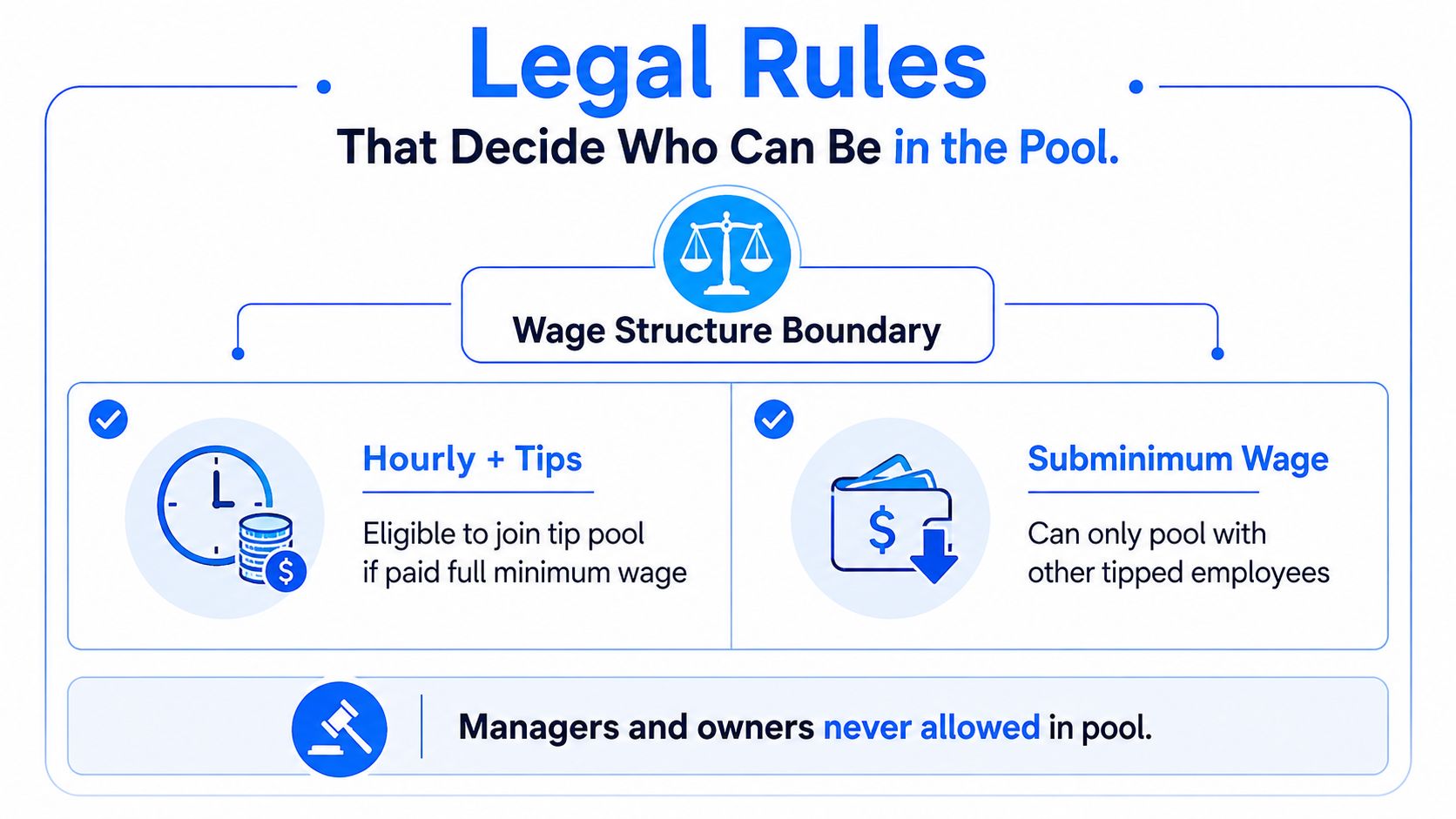
A restaurant shouldn't begin by asking whether an equal split feels fair. It should first ask which wage structure it uses. Federal rules create a major boundary between restaurants that take a tip credit and those that pay tipped employees at least the full federal minimum wage.
The wage structure changes eligibility
Under the U.S. Department of Labor's tipped employee guidance, a restaurant using a tip credit generally must limit the pool to employees who customarily and regularly receive tips. That usually covers roles such as servers and bartenders, along with other eligible tipped positions.
A restaurant that pays employees at least the full minimum wage and doesn't take a tip credit can generally create a broader pool that includes eligible back-of-house staff, such as cooks and dishwashers, subject to applicable federal and state rules. Congress made this broader federal framework possible through the Consolidated Appropriations Act on March 23, 2018, changing the Fair Labor Standards Act rules for qualifying pools, as documented in this history of U.S. tip pooling.
That change didn't make every pool automatically lawful. The wage structure still has to match the people included. A restaurant that changes its pay model midyear should review the pool rather than assuming its old formula remains valid.
Managers and owners stay outside
Managers and supervisors can't receive a share of employee tips under the federal rules described by the Department of Labor. Owners also shouldn't be placed in the pool merely because they worked during a busy service.
The rule matters because a manager may perform hands-on tasks while still holding managerial authority. The restaurant should classify the role carefully instead of using job titles alone. If a manager distributes the pool, that doesn't give the manager a right to receive part of it.
Timing and state rules matter
The employer must fully redistribute pooled tips within the pay period. State and local requirements can be stricter than federal rules, so a policy that works in one location may not work in another.
Compliance checkpoint: Identify the wage structure, list eligible roles, exclude managers and supervisors, confirm state requirements, and document when the money reaches employees.
A service charge also needs careful treatment because it isn't automatically the same thing as a voluntary tip. Restaurants should explain the distinction in their policy and on guest-facing bills. This guide to service charges versus tips provides useful context for separating those two concepts.
Common Tip Pool Percentages and Role Based Splits
Once the legal boundary is clear, the restaurant can choose a practical allocation. There isn't a single federal percentage that tells every restaurant how much each role must receive. Federal law doesn't impose a cap on each employee's percentage contribution in a valid mandatory pool, but the pool still has to follow the eligibility rules tied to the wage structure.
Many restaurants use role-based percentages because they recognize different responsibilities without treating every role as identical. One California labor example often cited as reasonable uses an 80/15/5 distribution among servers, bussers, and bartenders, as described in the history of U.S. tip pooling. That example is not a universal requirement. It's a reference point for thinking about how the work is divided.
Typical role based tip pool allocations
| Role | Example Share | When Used |
|---|---|---|
| Servers | 80% | When servers handle table service and collect most guest-facing gratuities |
| Bussers | 15% | When bussers reset tables, clear dishes, and support dining-room flow |
| Bartenders | 5% | When bartenders support table service or prepare drinks for dining-room guests |
The table shows an allocation pattern, not a legal template. A restaurant might instead use hours, points, or a percentage of sales. The right choice depends on service design, staffing, menu mix, and whether the distribution accurately recognizes the work performed.
Compare the tradeoffs
An equal split is easy to explain, but it can feel unfair when employees work different hours or carry different responsibilities. A role-based split gives the operator more precision, though staff may question why one role receives a particular percentage.
An hours-based pool rewards time and makes the arithmetic intuitive. It may still need role weighting if one position contributes differently from another. Points systems handle that weighting, but managers must publish the point values and apply them consistently.
A useful restaurant tip chart can help managers compare role-based structures before putting one into writing. Whatever method the restaurant chooses, employees should be able to reproduce the calculation from the policy and the shift records.
Tip Splitting Calculations With Real Examples
The cleanest way to divide a shared restaurant bill is proportional allocation. Each diner's item subtotal becomes their share of the group subtotal, and that share is applied to the tax, tip, or service charge.
Suppose three diners order different amounts. Diner A's items represent half of the group's item subtotal, Diner B's items represent one-third, and Diner C's items represent the remaining one-sixth. If the group decides to divide a total fee, each diner pays that same proportion of the fee.
The proportional formula
Use this formula:
Individual share = individual item subtotal ÷ group item subtotal × total fee
The “total fee” can be tax, a voluntary tip, or a service charge. The method prevents one diner who ordered less from subsidizing someone who ordered more.
For a practical example, assume the group's item subtotals are:
- Diner A: $50
- Diner B: $30
- Diner C: $20
- Group subtotal: $100
- Tip: $20
Diner A ordered half of the group's items, so A pays half of the tip, or $10. Diner B ordered three-tenths of the items, so B pays $6. Diner C ordered one-fifth, so C pays $4. The allocated tip adds up to the full $20, and each person's contribution reflects consumption.
A shared appetizer creates a separate choice. The group can assign it to one person, divide it evenly, or use another agreed rule. The important part is to make that decision before applying tax and tip.
Separate guest math from staff math
Restaurants may use proportional logic in staff distribution too, but the base can differ. A pool might divide according to hours worked, role points, or a stated percentage of sales. Don't assume that the guest's bill-splitting method is the same as the employee tip-pool formula.
If a service charge is already included, guests generally don't need to add another tip unless the service was exceptional, because the service charge may already be intended as the staff pool. The bill should make that treatment clear. For diners who want item-level assignment and automatic proportional allocation, the restaurant bill split calculator illustrates the underlying logic.
Use this video as a visual walkthrough of tip-pool calculations and proportional sharing:
Mixed Service Formats and Where Splits Get Tricky
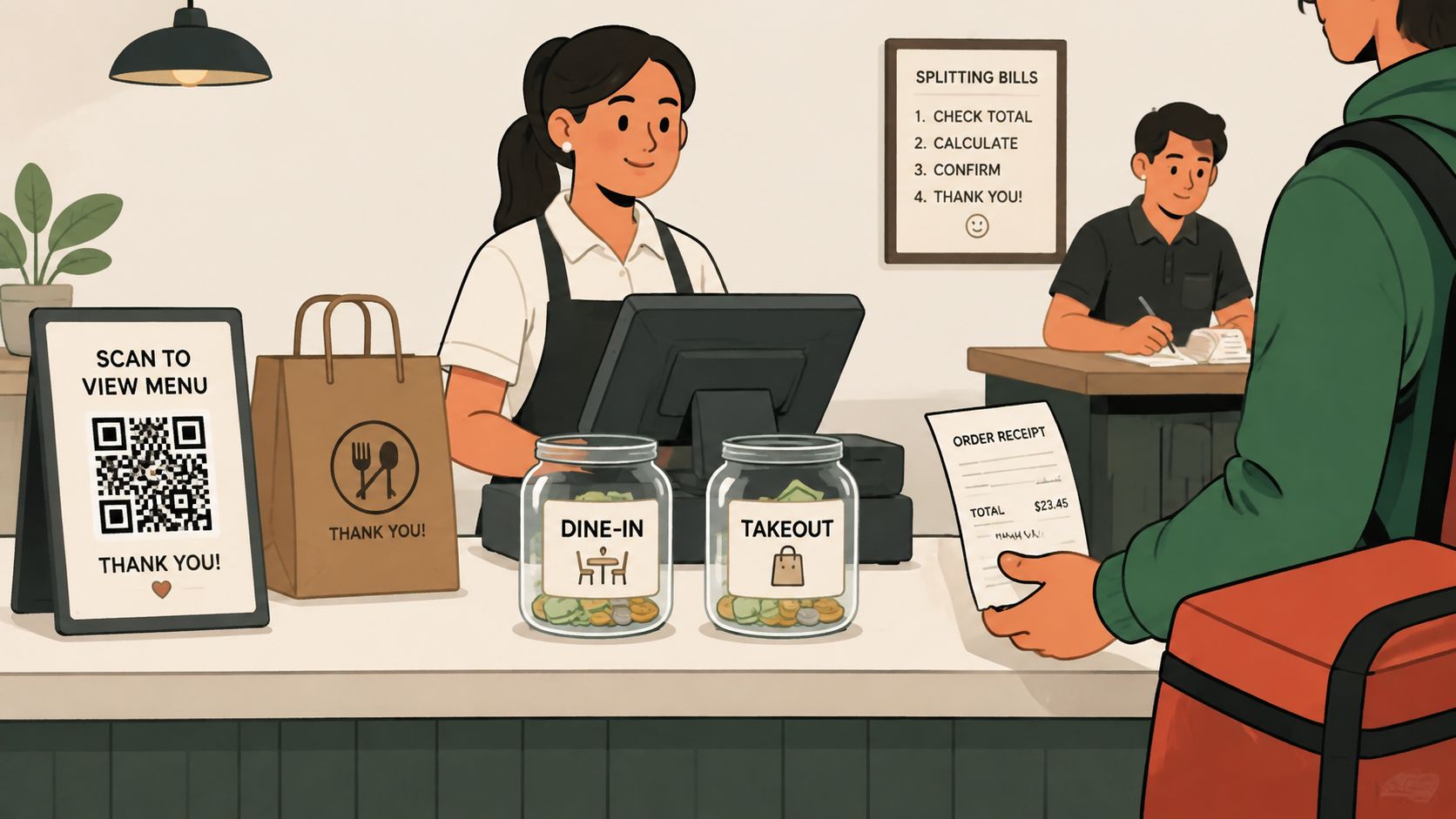
A modern restaurant may combine dine-in service, takeaway, delivery handoffs, QR ordering, and automatic gratuities on the same day. The guest sees one payment flow, but the restaurant has to decide which team performed the service and which rule applies to each type of transaction.
Channel changes the service question
A dine-in tip may relate to table service. A takeaway tip may recognize order preparation and handoff. A delivery tip may involve a different worker or platform process. QR ordering can reduce table-side steps while still leaving employees responsible for delivery, clearing, and guest support.
The restaurant should define whether each channel enters the same pool or a separate distribution. If a shared pool includes online orders, the policy needs a way to assign those tips to the employees who worked the relevant shift. A vague statement such as “all tips are pooled” isn't enough if the system can't show how online and in-person gratuities are handled.
Fees and automatic amounts need labels
Card-processing fees create another point of tension. Employees need to know whether collected tips are recorded and remitted in full, while managers need to verify the rules in each jurisdiction. The guidance on minimum wage and tip pooling highlights that operational details, including card-paid gratuities and pay-period redistribution, can affect the final handling.
The same source reports a Q3 2024 average tip of 19.3% at full-service restaurants and 15.8% at quick-service restaurants. Those figures describe different service formats, but they don't determine how an individual restaurant must distribute tips. The policy still needs to answer who receives the money, whether deductions occur, and when employees receive their share.
A service charge should be labeled clearly rather than presented as though it were a voluntary tip. When one bill combines several channels, the safest operational approach is to separate the categories in the records before applying the relevant distribution rule.
How Restaurants Prevent and Resolve Tip Disputes
Most tip disputes begin with an invisible rule. Employees can't tell whether the pool uses sales, tips, hours, or points, so they compare their payout with a coworker's and fill the gap with assumptions.
A written policy should state:
- Eligible roles: List who can participate under the restaurant's wage structure.
- Calculation base: Say whether the formula uses tips, sales, hours, or points.
- Role weights: Publish percentages or point values and explain when they apply.
- Payment timing: State when the restaurant redistributes the money.
- Record access: Keep shift, payment, and payroll records that show the calculation.
Managers should review discrepancies promptly. Start with the check records, declared cash, clock-in data, and the written formula. If the issue is a simple entry error, correct the payroll record and explain the adjustment. If the pool included an ineligible role, withheld money improperly, or failed to redistribute the full amount, the restaurant should seek qualified employment-law advice and correct the process rather than changing the numbers.
Regulatory direction also reinforces transparency. The UK now requires tips, gratuities, and service charges to be allocated fairly without deductions, showing that tip distribution is increasingly treated as a regulated pay practice rather than informal etiquette, as summarized in restaurant tip-pooling guidance.
The practical standard is easy to remember: a fair pool must be understandable, consistently applied, legally eligible, and traceable from guest payment to employee payout.
Divvy helps diners split restaurant, bar, and takeaway receipts by scanning line items, assigning dishes to people, and allocating tax and tip proportionally. Visit Divvy to see how item-level bill splitting and payment requests can remove the manual math after a shared meal.