Divvy
DivvyHow to Split the Money Fairly When You Share a Bill
By The Divvy Team · September 27, 2026 · 15 min read
The check lands in the middle of the table, and suddenly four friends are doing restaurant accounting instead of talking. One person had steak and wine, another ordered a salad, someone skipped dessert, and the group still has to decide whether to divide the total evenly or start passing phones around. Then comes the familiar week of polite reminders because nobody sent the right amount.
To split the money fairly, decide what “fair” means before anyone pays. For similar orders, an even split keeps the evening moving. For noticeably different orders, itemized assignment with proportional tax and tip is the better choice. The right workflow makes that decision quickly, shows everyone the calculation, and sends exact payment requests before people leave the table.
Table of Contents
- Two Ways to Split the Money on a Shared Bill
- A Restaurant Workflow That Takes Two Minutes
- Handling Tax and Tip Without the Awkward Math
- Divvy Versus Ledgers and Raw Payment Apps
- Splitting Rent and Household Costs Fairly
- Settling Up on Group Trips Without Losing Receipts
- Habits That Keep Shared Money From Getting Weird
Two Ways to Split the Money on a Shared Bill
Four friends at a diner can turn a simple check into a five-minute negotiation. The honest choice usually comes down to an even split or an itemized split.
An even split takes the total and divides it by the number of diners. It works when everyone ordered roughly the same amount, or when the table shared most of the food. Tapas, group appetizers, shared platters, and casual drinks are good examples. If one person owes a few cents more or less, the group may reasonably decide that speed matters more than precision.
An itemized split assigns each dish, drink, and add-on to the person who consumed it. That's the better method when prices vary, someone skipped alcohol or dessert, or the table includes different diets and appetites. The person who ordered the expensive entrée shouldn't cause the person who drank water to subsidize dinner.
Practical rule: Use an even split for genuinely shared consumption. Use itemization whenever the difference would be noticeable to anyone at the table.
Choose the method before the bill arrives
The awkwardness usually comes from choosing a method after everyone sees the total. Set the default early:
- Similar orders: Divide the bill evenly and move on.
- Mixed prices: Assign individual items.
- Shared dishes: Divide that item among the people who ate it.
- Strong preferences: Let anyone who wants precision opt into the itemized calculation.
Bill splitting itself isn't new. Historical accounts trace versions of the practice to ancient Rome and Greece, while the U.S. custom of “going Dutch” emerged in the nineteenth century. The practice became more common again after World War II and during the 1960s and 1970s as group socializing increased, according to this history of bill-splitting methods.
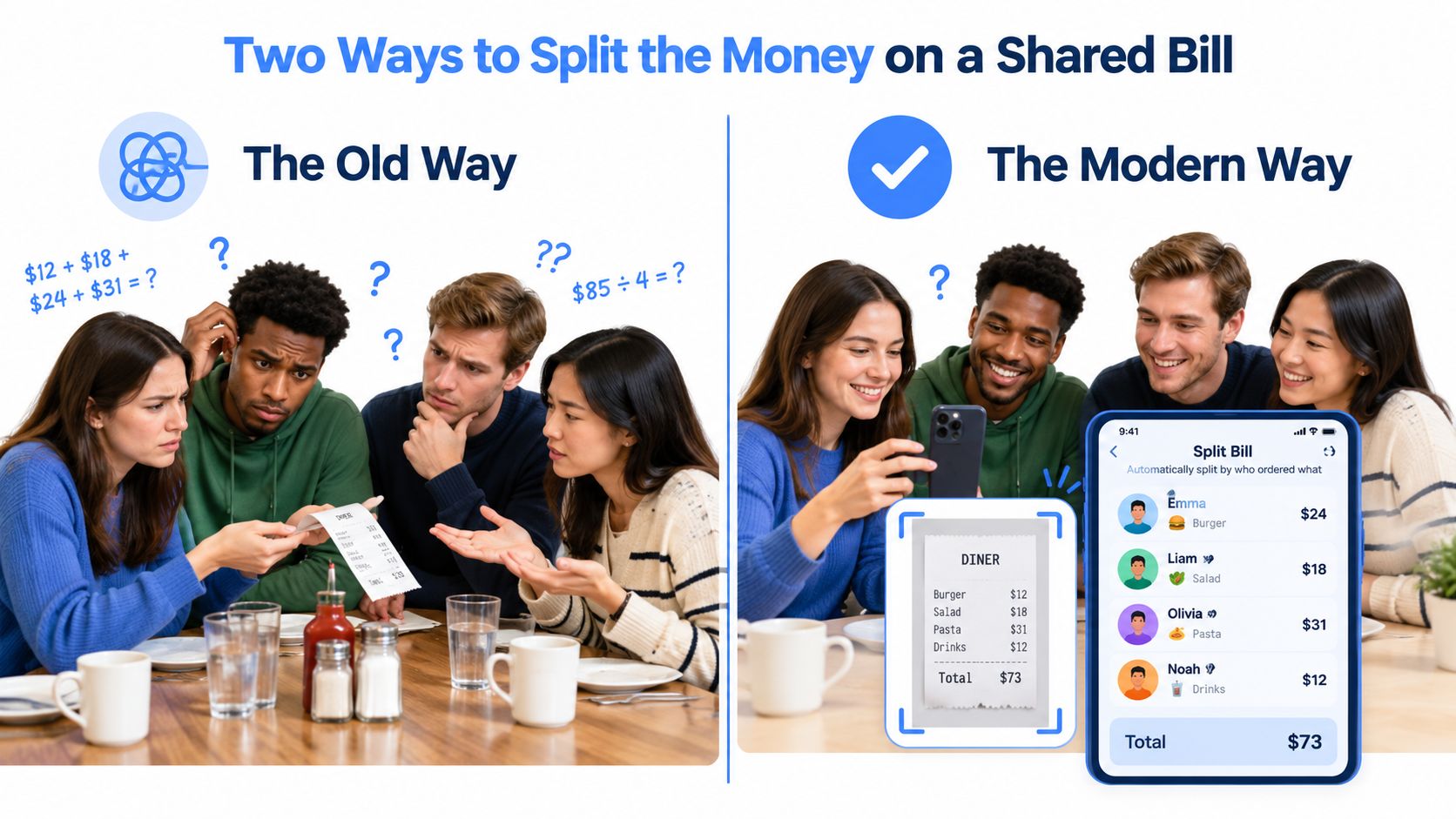
A useful explanation of the distinction appears in what split billing means. The key is not mathematical perfection. It's choosing a method everyone can understand, then applying it consistently without turning the meal into an audit.
A Restaurant Workflow That Takes Two Minutes
The fastest reliable process starts with the receipt, not a calculator. One person takes a clear photo while the bill is still on the table, then checks the extracted lines before the server returns with the card machine.

Capture and assign
The receipt scanner reads the line items, including dishes, drinks, tax, and tip fields. Review the result for obvious mistakes, especially blurred quantities, modifiers, or handwritten additions. A receipt image should stay in its original form during processing. One comparative evaluation found 87.46% accuracy with native image processing on scanned receipts, compared with 47.00% for a converter-first text pipeline, as reported in this receipt-scanning comparison.
Next, tap each item and assign it to the diner who ordered it. A shared appetizer or bottle can be selected across several people and divided evenly among them. That's the point where a vague group total becomes a transparent list of individual obligations.
Add the shared charges
Tax and tip should follow each person's portion of the pre-tax subtotal. The app handles that allocation after the items are assigned, so nobody has to calculate separate percentages on a phone balanced against a dinner plate.
Then show the table the breakdown. A quick review catches the forgotten side dish and gives everyone a chance to correct an assignment while the receipt is still available. Once the group agrees, create a payment request for each person's exact amount through the payment app they already use. People who never install the splitting tool can still receive a request through common payment services.
The most important timing rule is simple: finish before the group leaves. Manual entry in Venmo or Splitwise can work, but somebody still has to type every item, decide how shared food is divided, and handle tax and tip. A scanning-first workflow keeps the calculation and the request in one short sequence.
For a visual walkthrough, watch the process here:
The broader payment habit is already established. A Forbes Advisor and OnePoll survey of 1,000 Americans found that 47% were splitting bills through apps such as PayPal, Zelle, Cash App, and Venmo in ways they usually wouldn't because of inflation. The share reached 51% among millennial and Generation Z adults, according to reporting on the survey. The opportunity isn't merely moving money. It's removing the manual work before the payment request.
Handling Tax and Tip Without the Awkward Math
Tax and tip are where an apparently fair split becomes unfairly uneven. Adding the same dollar amount to every diner's subtotal makes the person who ordered water contribute the same surcharge as the person who ordered premium drinks.
The proportional method is cleaner. First, calculate each person's share of the pre-tax subtotal. Then apply that same share to the tax and tip lines. The result preserves the relationship between what each person consumed and what they owe.
A worked example
Suppose the food subtotal is $50, tax is $8, and tip is $20. One diner ordered $15 of food, while the other ordered $35. The first diner represents 30% of the subtotal, and the second represents 70%. Each person receives the same percentage of the tax and tip.
| Diners | Food Ordered | Share of Subtotal | Tax Owed | Tip Owed | Total Owed |
|---|---|---|---|---|---|
| Diner A | $15 | 30% | $2.40 | $6.00 | $23.40 |
| Diner B | $35 | 70% | $5.60 | $14.00 | $54.60 |
| Total | $50 | 100% | $8.00 | $20.00 | $78.00 |
The calculation is straightforward:
- Divide each food subtotal by the full subtotal.
- Multiply that share by the tax.
- Multiply the same share by the tip.
- Add food, allocated tax, and allocated tip.
For a deeper explanation of this approach, see how proportional tax works in bill splitting. Modern itemized tools apply this logic automatically after assigning the food, which prevents cross-subsidies that an equal surcharge creates.
The same principle applies outside restaurants. If you're dividing a service gratuity among people who paid for different activities, decide whether the tip reflects equal participation or proportional consumption. Guidance on service tipping can help in specialized situations, such as what to tip your snorkel crew.
Round deliberately. If the final amounts produce leftover cents, round each share up rather than down and let the small surplus absorb the rounding difference. Tell the group that's what you're doing. A visible rounding rule feels intentional, while unexplained cents make people wonder whether the calculation is wrong.
Divvy Versus Ledgers and Raw Payment Apps
Different tools solve different parts of the problem. Before choosing one, separate the jobs: calculate who owes what, preserve the record, and move the money.
A scanning-first tool such as Divvy handles the receipt capture and item assignment in the same flow as settlement requests. It fits a restaurant bill where the main challenge is turning a paper receipt into accurate individual totals.
Ledger-style apps such as Splitwise are better suited to ongoing shared finances. They're useful when a group records many expenses over time and settles a running balance later. The tradeoff is manual entry and a separate payment step, especially when a receipt contains several items shared in different combinations.
Raw payment apps, including Venmo and Cash App, are payment rails. They're good at sending money and requesting repayment, but they don't determine who consumed which item or allocate tax and tip. If you use one by itself, someone at the table still has to do the accounting.
| Capability | Divvy | Ledger Apps, such as Splitwise | Payment Apps, such as Venmo |
|---|---|---|---|
| Receipt capture | Scans itemized receipts | Usually requires manual entry | Not the core function |
| Per-item assignment | Built into the bill workflow | Possible through manual records | Not designed for it |
| Shared dishes | Can divide selected items | Requires entries and adjustments | Requires manual math |
| Tax and tip allocation | Applies proportional amounts | Depends on the entry method | Usually manual |
| Running group history | Focuses on immediate settlement | Strong for ongoing balances | Limited expense context |
| Payment requests | Sends requests through common apps | Often a separate action | Native payment and request tools |
Use the tool that matches the actual priority. Choose an itemized scanner when accuracy at the table matters, a ledger when the group shares costs over days or months, and a payment app when the amount is already known and the only remaining job is settlement.
Splitting Rent and Household Costs Fairly
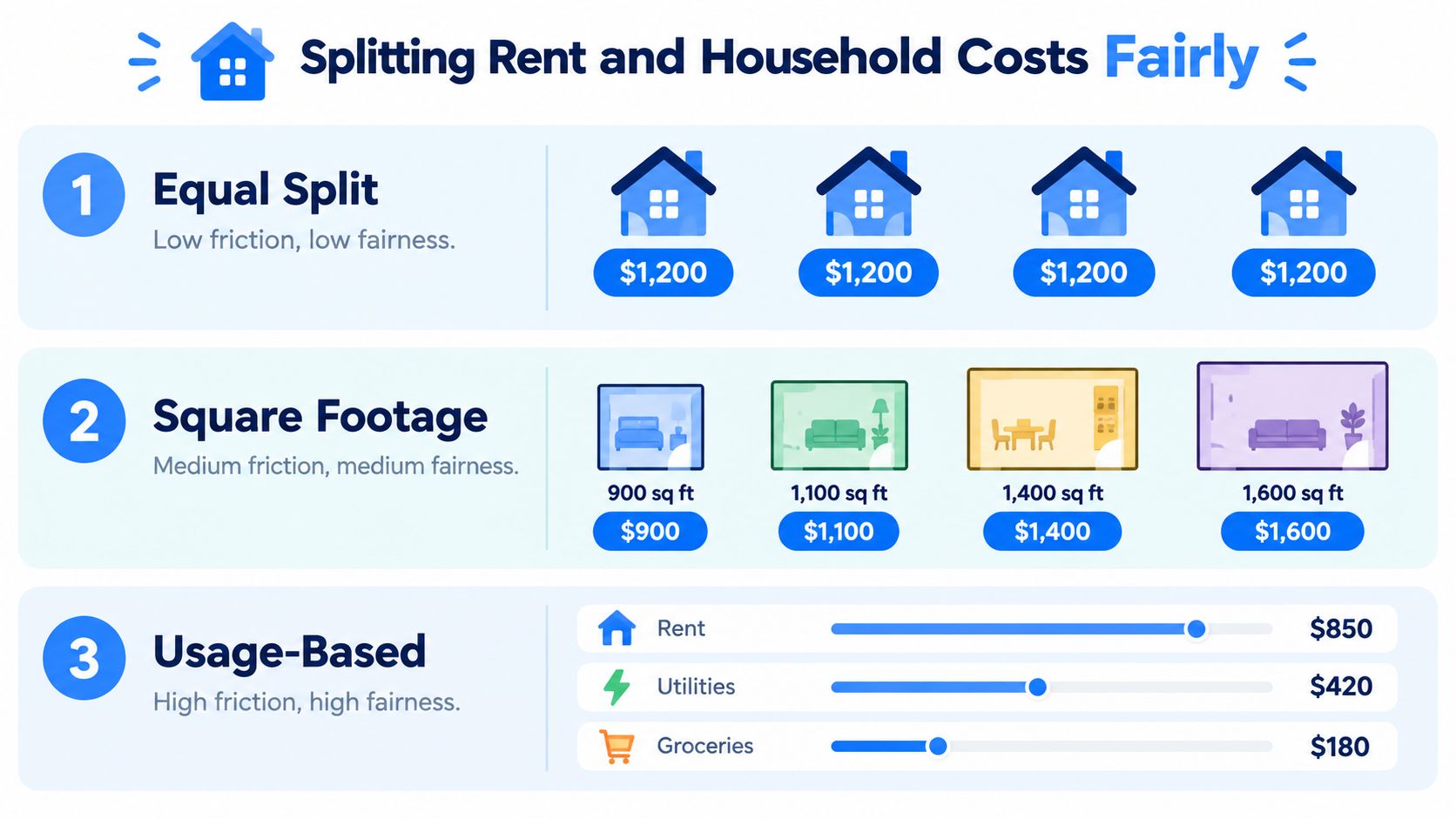
Recurring household bills need a written rule because memory becomes unreliable after the first month. Equal splitting is easiest and makes sense when rooms, incomes, and use of shared space are broadly similar. It becomes harder to defend when one roommate has a much larger private room or earns substantially more.
Three methods cover most household arrangements:
- Equal split: Divide the cost into identical shares. This has the lowest friction and works well for similar rooms and similar financial circumstances.
- Income-weighted split: Each person contributes according to their share of the household income. This can suit couples or roommates with significantly different earnings, provided everyone agrees to disclose the figures used.
- Room-size split: Allocate rent according to private square footage and shared-space access. This is useful when bedrooms differ clearly, though utilities may still be divided equally or by usage.
Consider three roommates sharing $3,600 in monthly rent. Their incomes are $36,000, $54,000, and $90,000. An equal split gives each person $1,200. An income-weighted split uses income shares of 20%, 30%, and 50%, producing $720, $1,080, and $1,800. Those figures may feel fair to one household and unacceptable to another, which is why consent matters more than pretending one formula is universal.
Room-size allocation needs the actual private and shared areas. Measure the rooms, decide how to value common space, and write down the formula. Don't use an income-weighted rent calculation while dividing utilities by a different standard unless everyone understands the distinction.
A practical rent or buy guide for 2026 can provide broader housing context, but the household decision still comes down to your rooms, income arrangement, and shared usage. For a calculator-based approach, use the rent split calculator.
Put the agreement in a shared note. Include rent, utilities, groceries, cleaning supplies, internet, due dates, and the rounding rule. If the method changes, record the change before the next bill. A written decision prevents the same negotiation from restarting every month.
Settling Up on Group Trips Without Losing Receipts
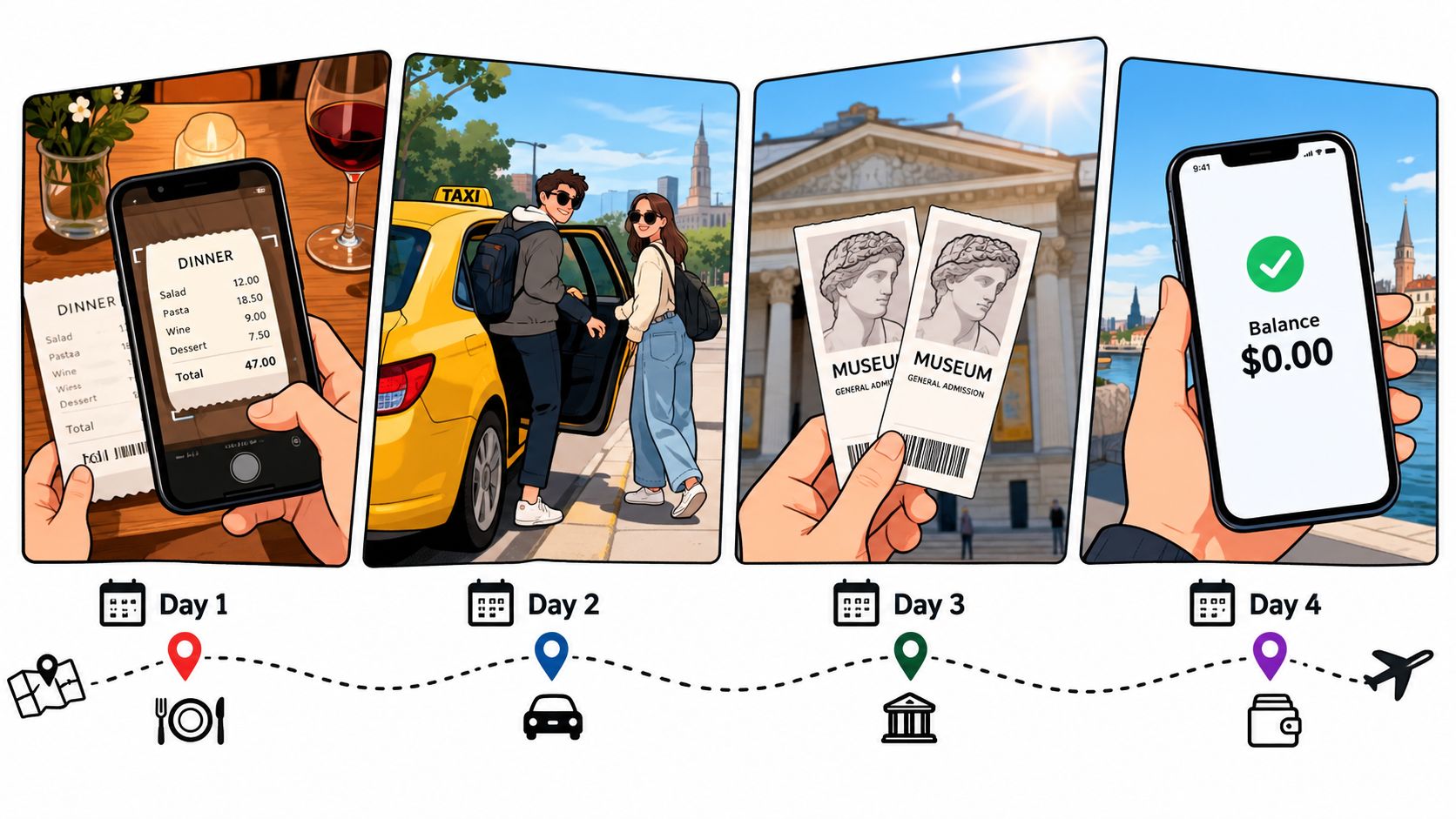
On a four-day trip, the expense pattern changes constantly. One person pays for dinner, another covers a taxi, a third buys museum tickets in local currency, and the Airbnb sits in the background as a shared cost. Waiting until the airport means trying to reconstruct four days of decisions from card notifications and blurry photos.
Take the running record during the trip. After dinner, log who paid and who ate. When two travelers leave a taxi early, assign the fare to the people who rode each segment rather than splitting it blindly among the whole group. For museum tickets, record the local-currency amount and identify exactly who entered.
Keep the currency decision simple
The person who paid should record the original local-currency amount, the date, and the participants. Reimbursements should use the original currency where practical, rather than converting from one currency to another and then converting again through a payment service. Layered exchange rates and fees make a small disagreement harder to audit.
If the group needs to settle in one home currency, agree on the conversion reference before anyone pays. Use the same reference for all trip expenses, keep the original receipt, and avoid changing the rate for each individual transaction. Consistency matters more than chasing a theoretical perfect exchange rate after the fact.
The shared ledger should show the running balance while the trip is still happening. Everyone can see whether they're ahead or behind, and the person organizing the Airbnb doesn't have to remember who promised to contribute. Add the expense immediately, even if the final settlement won't happen until the last morning.
Finish with one settlement ritual
On the final morning, choose one person to review the list. Check the dinner, taxi segments, museum tickets, accommodation, and any shared groceries. Resolve missing participants while everyone is still in the same place.
Then send one batch of payment requests based on the final balances. The goal is to leave with a clean slate, not a trail of reminders that survives the trip for months. If someone can't pay immediately, record the agreed date in the same shared note instead of relying on memory.
Habits That Keep Shared Money From Getting Weird
Money gets uncomfortable when small decisions stay implicit. Set the split style before ordering, record expenses as they happen, and settle while the context is fresh. The longer a group waits, the more likely someone forgets a shared dish, misremembers a taxi route, or assumes another person covered the tip.
Use one shared place for the record. Don't scatter receipts across text messages, screenshots, and separate notes. For recurring expenses, schedule a short monthly check-in rather than waiting for a large end-of-trip reconciliation.
Social rules matter as much as arithmetic
If a friend consistently under-orders, don't force an equal split just because it's convenient. Say, “Let's itemize tonight so everyone pays for what they chose.” That sentence makes the method the focus instead of making the person feel accused.
If someone forgets to pay, send a direct reminder with the exact amount and the original context. “You still owe $18 for dinner on Friday. Can you send it today?” is clearer and kinder than a vague reaction to an old payment notification. If the amount is small and the friendship matters more, choose to absorb it consciously, then use a different split method next time.
Agree on the tip policy before the check arrives. Decide whether everyone tips proportionally, whether shared service charges are divided evenly, and how rounding works. Don't leave those choices to the person holding the receipt.
Use this checklist after every shared bill:
- Scan the receipt: Capture it while the details are visible.
- Allocate items: Assign individual dishes and divide shared items.
- Add tax and tip proportionally: Match shared charges to each person's subtotal.
- Send requests the same day: Don't create a week of follow-ups.
- Settle weekly: Clear recurring balances before they become a ledger nobody understands.
The reliable habit: Decide the rule early, record the expense immediately, and ask for payment before the social moment disappears.
Divvy turns a photographed receipt into assigned items, proportional tax and tip, and individual payment requests through familiar money apps. If you're tired of doing group-bill math and chasing friends afterward, visit Divvy and use a repeatable settlement workflow instead.