Divvy
DivvyWhat Is a Delivery Fee: A Complete 2026 Cost Guide
By The Divvy Team · September 24, 2026 · 14 min read
A delivery fee is a transactional charge added at checkout to cover the logistics of moving an order from seller to customer. In food delivery, it's commonly around $2 to $5 per order, and it's separate from platform commissions and tips.
You've chosen your meal, confirmed the address, and seen a reasonable subtotal. Then the checkout screen loads. A delivery fee appears, followed by a service fee, perhaps a platform charge, and a tip suggestion. The meal that looked affordable now costs enough to make pickup seem appealing.
That moment creates several questions: What is a delivery fee paying for? Is it the same as a tip? Why does it change between platforms or orders? And when several friends share one delivery, who should pay which part?
A clear answer starts with the invoice. The delivery fee is only one line in the final price, but it can affect how every other charge feels, especially when a group has to divide the bill.
Table of Contents
- The Checkout Surprise Most People Miss
- What Is a Delivery Fee Really Covering
- Why Delivery Fees Vary So Much
- Hidden Fees, Transparent Pricing, and Real Consumer Frustration
- How Delivery Fees Add Up in Real Orders
- Splitting Delivery Bills Without the Math Headaches
- Understanding Delivery Fees and Splitting Bills Confidently
The Checkout Surprise Most People Miss
You order dinner for yourself and two friends. Everyone sends menu choices in a group chat, and one person places the order. The food subtotal looks manageable, but the final screen contains several additions. The delivery fee is visible, yet it sits beside charges that sound similar enough to blur together.
That confusion gets worse after the food arrives. One friend ordered an inexpensive side, another chose a larger entrée, and someone else added dessert. If the group divides the final total evenly, the people who ordered less may subsidize the people who ordered more. If one person pays the delivery fee alone, the split becomes even less clear.

One checkout total contains several decisions
A delivery receipt can include:
- Food subtotal, the listed price of the items.
- Delivery fee, the charge connected to moving the order to the customer.
- Service or platform fee, a separate charge for using the ordering system or marketplace.
- Menu markup, when delivery prices differ from in-store or pickup prices.
- Tip, money the customer chooses to give for service.
Restaurants may also face platform commissions that don't appear as a customer-facing delivery fee. This means the visible charge at checkout doesn't necessarily show the full cost of providing delivery.
For merchants that configure online stores, checkout systems can also support additional charges and conditional fee rules. Businesses comparing ways to present these costs may find WooCommerce checkout fee options useful when thinking about how delivery, handling, or other charges appear before payment.
Practical rule: Read the full checkout breakdown before deciding whether delivery is cheaper than pickup.
The same habit helps with group payments. Before asking friends to reimburse you, save the receipt and separate shared charges from personal items. Guidance on whether you have to tip on Uber Eats can also help distinguish an optional tip from the delivery charge itself.
What Is a Delivery Fee Really Covering
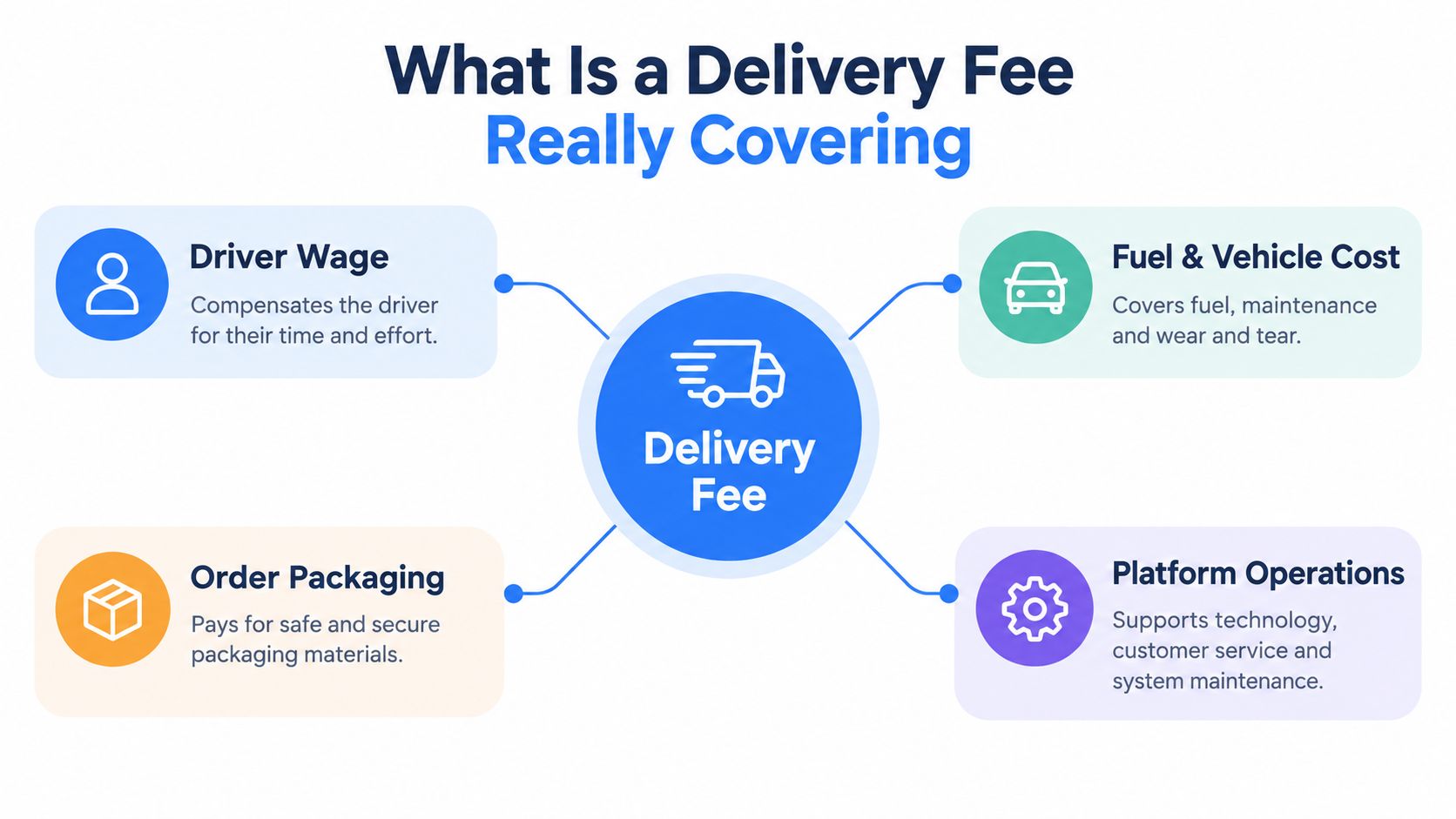
A delivery fee is a checkout charge that helps cover the cost of moving an order from the seller to the customer. It usually supports several parts of the handoff at once: dispatching the order, compensating the driver, covering packaging, and keeping the systems that coordinate delivery running.
A simple example makes this easier to see. If a checkout shows a $3 delivery fee, part of that amount may go toward driver pay, part may help cover fuel and vehicle wear, and part may offset platform overhead that keeps the order moving. The exact split changes by business model, but the fee is meant to support fulfillment rather than just the final drive.
McKinsey describes customer-facing delivery fees in major marketplace models as commonly falling around $2 to $5 per order, while restaurants may separately pay commissions of about 15% to 30% of order value (McKinsey's analysis of food delivery economics). The two charges do different jobs.
The fee and the commission are not the same
The delivery fee covers fulfillment costs: driver compensation, fuel, packaging, and dispatch. A restaurant commission is a marketplace access charge, paid for services such as platform visibility, ordering infrastructure, payment processing, or access to a delivery network.
A customer may see a delivery fee on the receipt while the restaurant also pays a commission on the same order. That setup explains a common point of confusion. The charge a customer sees does not necessarily cover the full cost of delivery, and it does not show what the restaurant is paying behind the scenes.
| Charge | Usually paid by | What it generally relates to |
|---|---|---|
| Delivery fee | Customer | Moving the order to its destination |
| Platform commission | Restaurant or merchant | Access to marketplace and related services |
| Service fee | Customer | Platform or order-processing functions |
| Tip | Customer | Optional recognition of service, commonly directed toward the driver or staff |
Service fees cover platform operations, while tips are discretionary payments directed toward drivers or staff. Menu inflation is different again, because it changes the item price rather than naming a logistics charge.
Why the distinction matters
Restaurants often work with tight margins. When delivery orders include both customer-facing charges and merchant-side commissions, a low-value order can become hard to serve profitably. The delivery fee may help recover transportation, driver compensation, vehicle and fuel handling, packaging, and dispatch overhead, but it does not erase the other costs.
For readers trying to separate platform charges from delivery charges, this explanation of service fees gives a useful comparison.
Why Delivery Fees Vary So Much
Distance matters, but it isn't the only factor behind a delivery fee. Order density, wage levels, delivery ownership, batching potential, and marketplace pricing all affect the economics.
A driver who can collect several nearby orders during one route may serve each customer more efficiently than a driver making a single isolated trip. In a dense area, that shared route can help spread labor and vehicle costs across multiple orders. In a sparse area, the same journey may require nearly the same driving time for one order.
The main cost drivers
High-wage markets can have hard delivery costs that exceed $12 per drop when driver labor, fuel, vehicle maintenance, and packaging are included, according to analysis of food-on-demand delivery costs. A flat customer fee can therefore under-recover the fulfillment expense, particularly on short, low-basket orders.
Several conditions push fees in different directions:
- Density: More nearby orders can make route batching practical.
- Labor costs: Higher driver wages increase the cost of every delivery run.
- Distance: Longer routes consume more time and vehicle resources.
- Timing: Busy periods can require more driver capacity and dispatch effort.
- Delivery model: First-party delivery and third-party delivery distribute costs differently.
- Marketplace strategies: Platforms may shift costs through commissions, promotions, or fee structures.
Promotional pricing doesn't mean the underlying cost disappears. A platform may reduce the customer-facing amount while recovering more from the merchant, or a restaurant may subsidize part of the charge to remain competitive.
Why identical routes can have different prices
Two customers living near the same restaurant may see different fees because their orders were placed at different times, through different platforms, or under different promotions. A platform might also adjust pricing according to demand, available drivers, or whether the order can be combined with another route.
Restaurant invoices can contain layered charges such as service fees, marketing fees, and delivery adjustments. That makes the merchant's effective cost different from the customer's visible delivery fee.
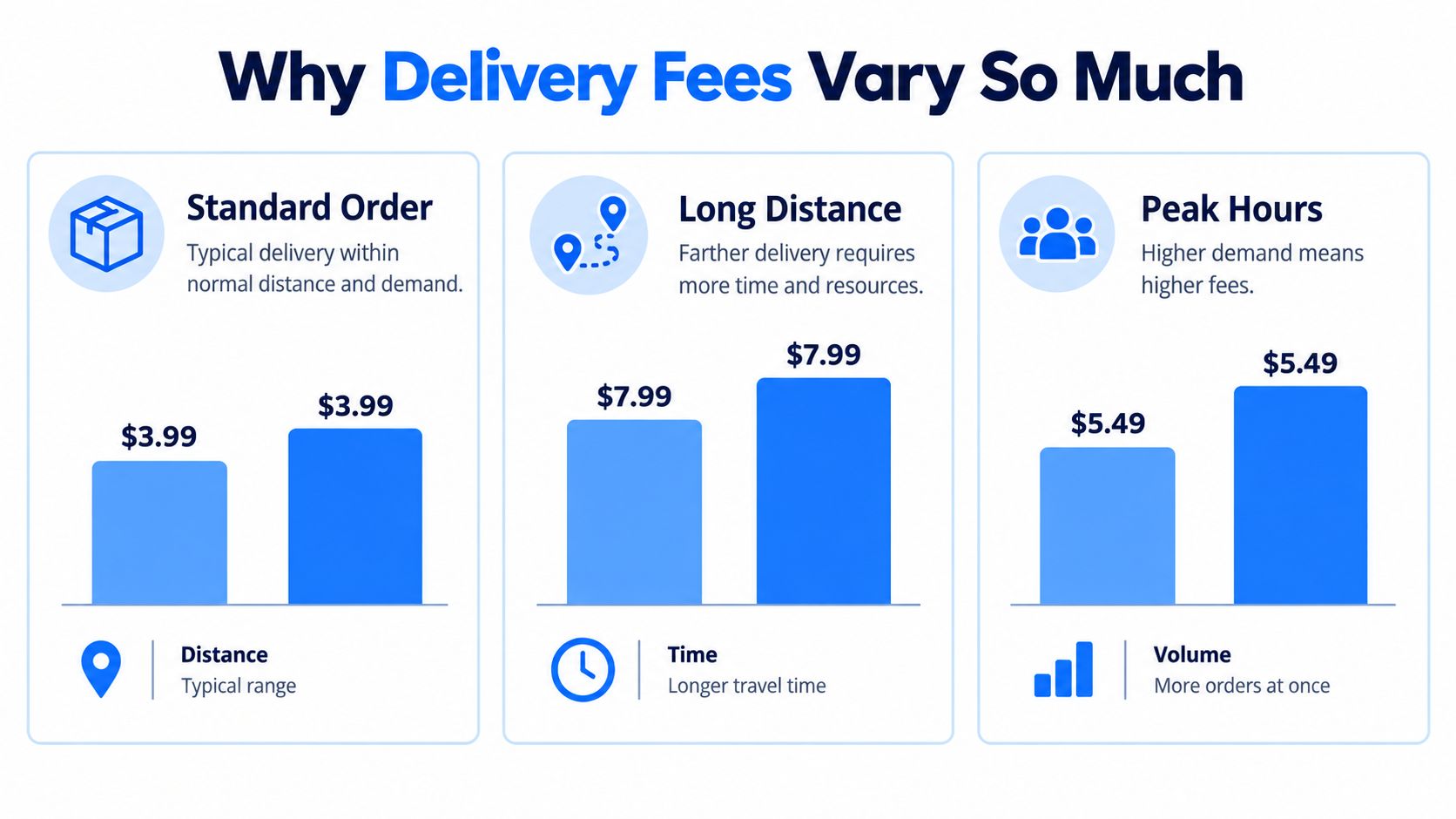
The practical lesson is simple: delivery fees reflect a fulfillment system, not distance alone.
Hidden Fees, Transparent Pricing, and Real Consumer Frustration
A group orders dinner for several people, and everyone agrees to split the food. At checkout, the total rises enough that the organizer must explain every added charge before asking others to pay. The difficulty is practical: each person may remember their own items, while the shared charges require a fair rule.
A clearer policy starts with an all-in price shown before payment. The customer should be able to see the food subtotal, delivery cost, platform cost, merchant pricing differences, taxes, and optional tip in separate lines. A short label should explain who receives each charge and whether it is shared across the order.
The coverage of the convenience economy survey reports that many shoppers abandon delivery orders after seeing the full cost, and that consumers set a limit before choosing pickup. The useful lesson for platforms is straightforward: reveal the complete total early, before customers invest time in customizing an order. For group orders, early disclosure also gives the organizer time to choose whether delivery and service charges should be divided equally or allocated another way.
Clear pricing helps people make better choices
A platform can present two totals side by side:
- Pickup total: the food and applicable taxes.
- Delivered total: the same order plus delivery, platform, and optional charges.
That comparison turns an unexpected checkout increase into a visible choice. A restaurant or platform might also show whether a promotion reduces the customer's charge, changes the merchant's share, or applies only under certain conditions.
Regional evidence shows why one pricing rule cannot fit every market. The reporting on platform delivery costs describes consumer concerns about hidden fees, taxes, and higher menu prices in India, along with differences in total basket costs among platforms. A lower delivery line can still accompany a higher overall bill, so customers need the complete basket comparison.
Clear labels matter after payment too. A receipt should preserve the same categories used at checkout, giving the group a reliable record for settlement. The organizer can then assign each person's items and divide shared charges without guessing what a vague fee represented.
Message design matters when platforms send fee notices by SMS. Teams can consult understanding UCS-2 and emojis because character encoding and message length affect how much pricing detail fits clearly in a notification. Better disclosure supports better decisions, and it makes group bill splitting easier to verify.
How Delivery Fees Add Up in Real Orders
The fastest way to understand a delivery fee is to read a receipt from the bottom up. Start with the food subtotal, identify each added charge, then decide how the total should be shared.
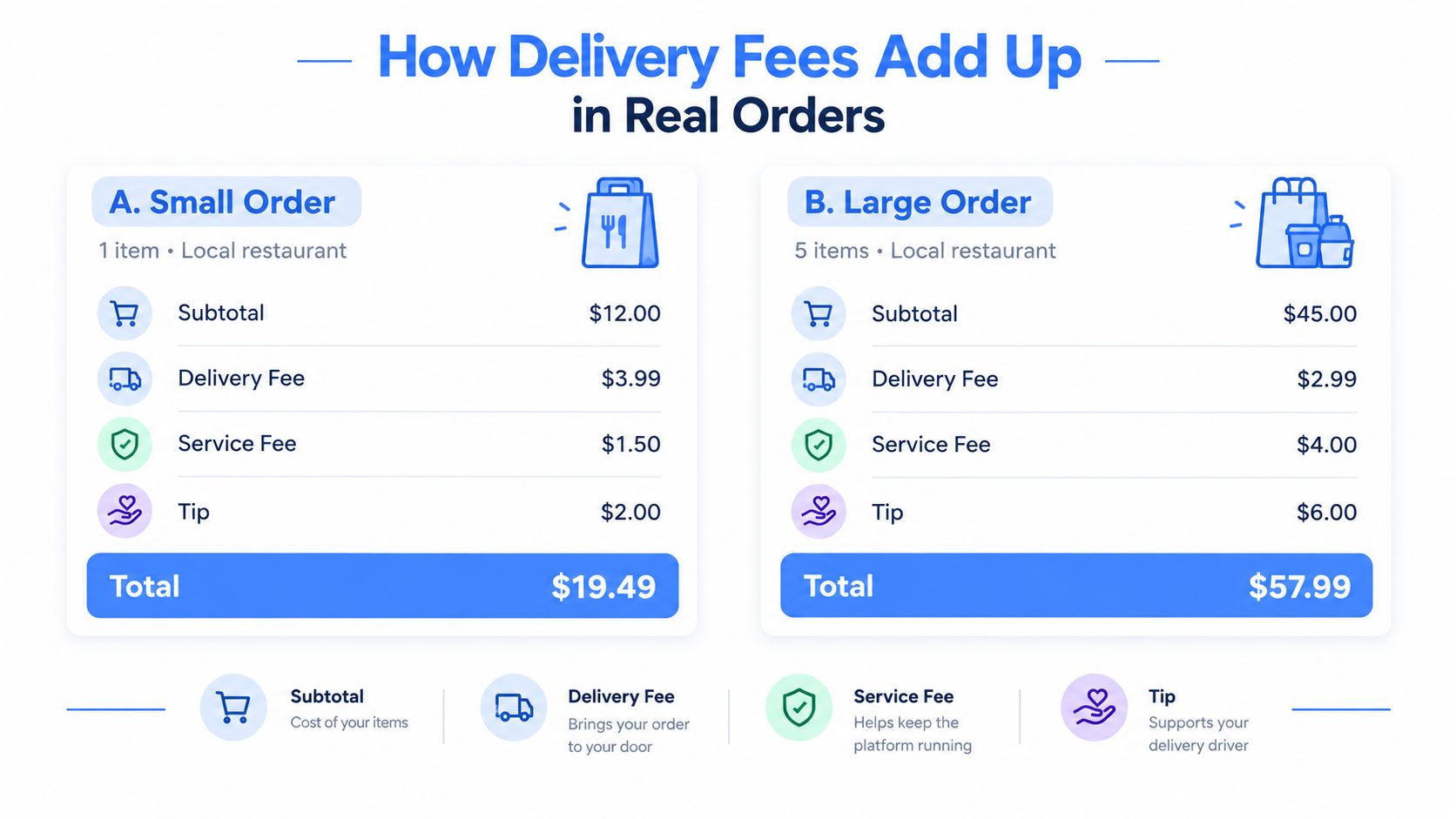
Consider a small group order with a $12.00 subtotal, a $3.99 delivery fee, a $1.50 service fee, and a $2.00 tip. The calculation is:
$12.00 + $3.99 + $1.50 + $2.00 = $19.49
The delivery fee is only one part of the increase, but it's a large addition relative to the small food subtotal. That's why low-value orders often feel disproportionately expensive.
Compare the structure, not just the headline fee
Now take a larger order with a $45.00 subtotal, a $2.99 delivery fee, a $4.00 service fee, and a $6.00 tip:
$45.00 + $2.99 + $4.00 + $6.00 = $57.99
The larger order has a higher final amount, but the delivery fee represents a smaller share of the food subtotal. The platform may also price delivery differently because the basket is larger, the order qualifies for a promotion, or the route is easier to batch.
Use this receipt-reading sequence:
- Check the item prices. Compare them with the restaurant's pickup or in-store menu when possible.
- Separate mandatory charges. Mark delivery, service, platform, and other required fees.
- Review the tip. Confirm whether it's optional and whether the amount matches your intention.
- Calculate the final total. Don't rely on the advertised delivery amount.
- Choose the split method. Assign personal items first, then distribute shared charges fairly.
If your group is deciding how to handle gratuity, tipping standards in the United States provides broader context. The important point is that a tip should not be mistaken for a delivery charge.
Splitting Delivery Bills Without the Math Headaches
Delivery fees become harder to discuss when one person places the order for a group. The receipt may show one total, but the group consumed different items. Someone might have ordered a main dish, two people may share an appetizer, and everyone benefited from having the food delivered.
An equal split is quick, but it can be unfair when item prices vary. Asking each person to calculate a share of tax, tip, delivery, and service charges by hand is fairer in theory, yet it creates opportunities for rounding mistakes and missed items.
A practical group workflow
Start with the receipt, not memory. List each item, assign personal dishes to the person who ordered them, and divide shared food evenly among the people who ate it.
Then handle the common charges:
- Delivery fee: Divide it evenly if everyone used the delivery service, or agree on another rule before requesting payment.
- Service fee: Treat it as a shared order cost unless the group agrees otherwise.
- Tax: Allocate it in proportion to each person's item share.
- Tip: Allocate it proportionally or use a clearly agreed group rule.
Divvy offers an iPhone app that uses AI receipt scanning to read line items, tax, and tip. People can tap to assign items, split shared dishes evenly, and generate payment requests through Apple Pay, Venmo, or Cash App. Friends don't need to install the app or create accounts to respond to a request, and automated reminders can continue until balances are settled.
That workflow keeps delivery costs visible instead of burying them inside an equal split. It also supports the broader bill-splitting problem, including restaurant, bar, takeout, travel, and household expenses. Divvy also provides web calculators for bill and rent splits, which can help when the shared cost extends beyond one receipt.
The fair split isn't always an equal split. It's a transparent split that gives everyone a way to see how the total was assigned.
Understanding Delivery Fees and Splitting Bills Confidently
A delivery fee is a checkout charge for fulfillment, not a tip and not automatically a service fee. Its amount can reflect driver labor, transportation, packaging, dispatch operations, order density, market wages, and platform pricing. The visible amount may also sit alongside merchant commissions or other charges that customers don't see directly.
The most useful habit is to evaluate the whole receipt. Check the subtotal, inspect item prices, identify mandatory fees, review the tip, and calculate the final amount before confirming the order. A delivery fee that looks small in isolation can feel very different when added to a low-value basket or combined with several other charges.
Group orders add a second layer of complexity. Each person should be responsible for personal items, shared dishes should be divided among the people who shared them, and delivery, service charges, tax, and tip should follow a rule everyone understands.
You don't need to memorize every platform's pricing model. You need a repeatable way to read the receipt and settle the result. When the charges are named clearly and assigned deliberately, the group can discuss the cost without guessing who subsidized whom.
Divvy scans receipts, assigns items to each person, splits shared dishes, and allocates tax and tip proportionally, with payment requests through familiar services such as Venmo or Cash App. Visit Divvy to make your next shared delivery bill easier to understand and settle.