Divvy
DivvyWhy even tip splits go wrong
Tax and tip both scale with what was ordered — tax is a percentage of the bill, and tip is usually calculated as one too. Splitting them per head breaks that link. On a $150 dinner where you ordered $20 and your friend ordered $70, an even split of the $30 tip charges you $15 to tip on food you didn't eat. Small on one dinner; corrosive across a summer of them.
The proportional formula
- Find your share of the subtotal: your items ÷ pre-tax subtotal.
- Pay that percentage of the tax — and the same percentage of the tip.
Example: subtotal $120, tax $10.80, tip $24. Your items total $30 — 25% of the subtotal. You owe $30 + $2.70 + $6.00 = $38.70. The friend who ordered $60 of it owes $77.40. Both of you paid the same 29% overhead on your own food — that's the definition of fair here.
The mental-math shortcut
At the table, multiply your own items by roughly 1.30 (for ~9% tax + 20% tip). It's not exact — but it's within a dollar or two and infinitely better than the even split. For exact numbers, use a calculator or an app.
Divvy does this on every scan
- 1Scan the receiptDivvy reads the subtotal, tax, and tip lines along with every item.
- 2Assign itemsTap who had what; shared items split among whoever shared them.
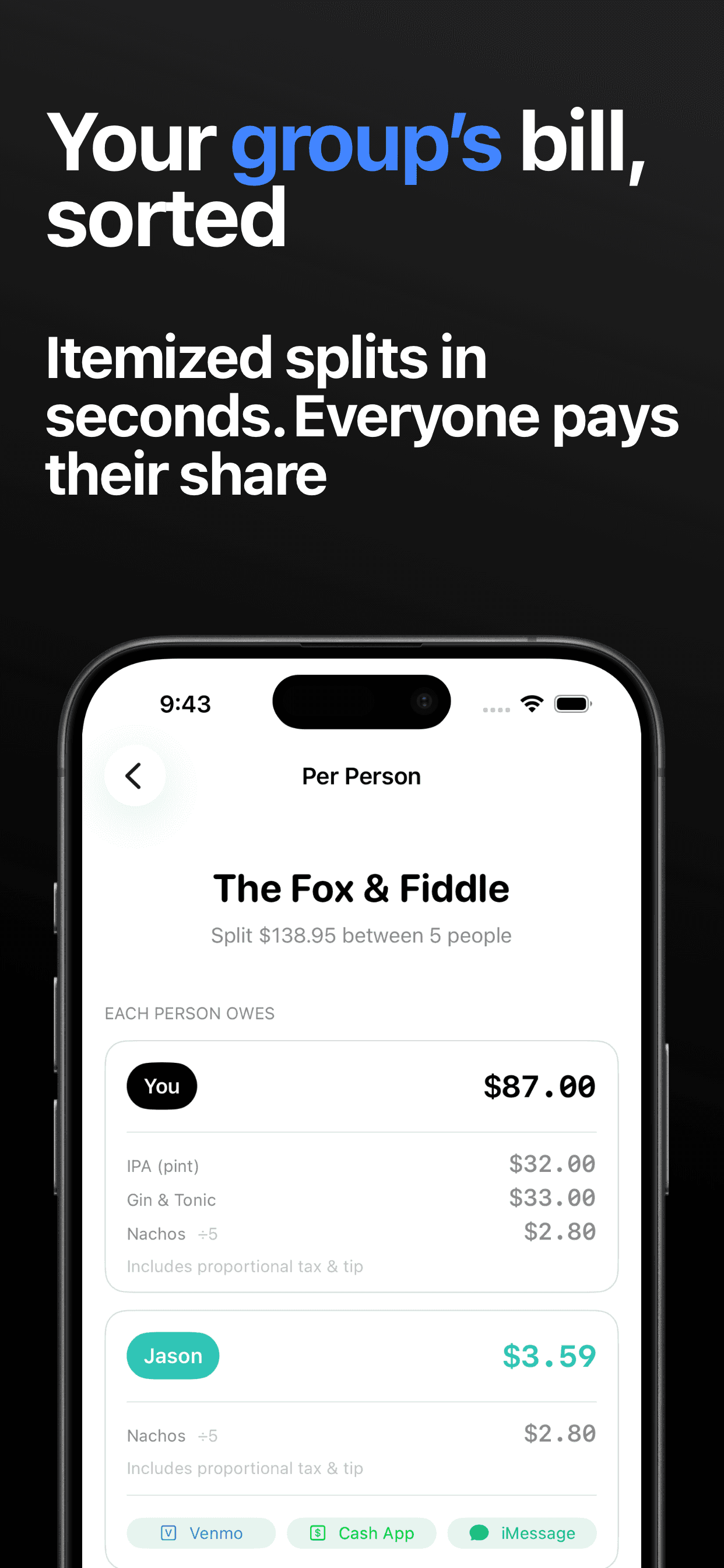
- 3Proportional overhead, automaticallyEvery person's total already includes their exact share of tax and tip — labeled on their breakdown.