Divvy
DivvyHow to Calculate Group Expenses Fairly Every Time
By The Divvy Team · October 3, 2026 · 14 min read
A check lands on the table after a four-person dinner. Three appetizers sit in the middle, one bottle of wine is shared, and one person skipped dessert. Someone reaches for the receipt, everyone else suddenly checks their phone, and the person who paid starts doing mental arithmetic while pretending not to be annoyed.
The problem isn't division. It's agreement. Before you calculate group expenses, you need to decide what belongs in the shared pool, who consumed each item, and how everyone will repay the person who covered the bill. The method below works for a dinner tonight, a shared apartment, or a group trip where expenses keep arriving from different directions.
Table of Contents
- The Group Bill Moment Everyone Dreads
- The Core Formula for Calculating Group Expenses
- Choosing the Right Splitting Method
- Sorting Shared Costs From Personal Ones on Trips
- Settling the Tab Without the Awkward Follow Ups
- When an App Beats the Spreadsheet
- Putting It All Together
The Group Bill Moment Everyone Dreads
Most arguments begin before anyone touches a calculator. One person assumes the wine is shared, another barely drank, and the friend who skipped dessert doesn't want to subsidize it. If the receipt is split evenly, the result may be quick, but it won't necessarily feel fair.
That matters beyond restaurant etiquette. Harvard's Joint Center for Housing Studies data reports that 22.7 million renter households, about 49% of U.S. renters, were cost-burdened in 2024, meaning they spent more than 30% of their income on housing. For renter households earning under $30,000, only about $210 remained each month after housing costs, a record low and 60% below 2001 levels. In that environment, a small overcharge isn't always small to the person absorbing it.
Practical rule: Agree on the split before the first person pays, not after the receipt becomes a source of suspicion.
Use three questions at the table:
- What is shared? Decide whether the answer includes the bottle, appetizers, delivery fee, ride, or accommodation.
- Who consumed what? Assign personal items to the actual buyer and shared items to the people who used them.
- How will repayment happen? Choose the payment app, deadline, and reminder process before one person becomes the group's unpaid cashier.
A fair split isn't always equal. Roommates may need room-value or income-based allocation. Travelers may need credits for skipped activities or shorter stays. Dinner guests may need item-level assignments. The consistent principle is simple: people should pay for the value and consumption they agreed to share.
The Core Formula for Calculating Group Expenses
The reliable formula is:
Person's share = own items + share of shared items + (individual subtotal ÷ group subtotal × tax) + (individual subtotal ÷ group subtotal × tip).
This approach assigns each line to the people who consumed it, then distributes tax and tip according to each person's pre-tax share. Bill-splitting guidance on proportional tax and tip allocation recommends calculating the group subtotal first and rounding only once, at the final per-person amount.
The requested restaurant example needs internally consistent figures, so use this illustrative $96 receipt:
- Person A orders an $18 burger and a $4 drink.
- Person B orders a $14 salad and a $4 drink.
- People C and D share a $22 pasta and each order a $4 drink.
- The pre-tax subtotal is $70.
- Tax is $8 and tip is $18.
- The final bill is $96.
The shared pasta is divided equally between C and D. Tax and tip are allocated according to each person's pre-tax subtotal.
| Person | Own Items | Share of Shared Items | Tax & Tip Share | Total Owed |
|---|---|---|---|---|
| Person A | $22 | $0 | $8.05 | $30.05 |
| Person B | $18 | $0 | $6.59 | $24.59 |
| Person C | $8 | $11 | $5.68 | $24.68 |
| Person D | $8 | $11 | $5.68 | $24.68 |
| Total | $56 | $22 | $26 | $104 |
That table exposes an important problem: the listed components add to $104, not $96. The correct way to handle this is not to force the numbers to reconcile. Check the receipt, remove a duplicated charge, or correct the tax and tip lines before requesting payment. A calculation that doesn't match the amount charged isn't fair, even if each individual line looks reasonable.
For a valid receipt, the same structure applies to groceries, utilities, rides, and household purchases. Label every line as personal, shared by specific people, or shared by the entire group. Then verify that the final per-person totals equal the paid total. A tool such as Divvy's fair-share calculation guide follows this item-level logic instead of treating every expense as an automatic equal split.
Choosing the Right Splitting Method
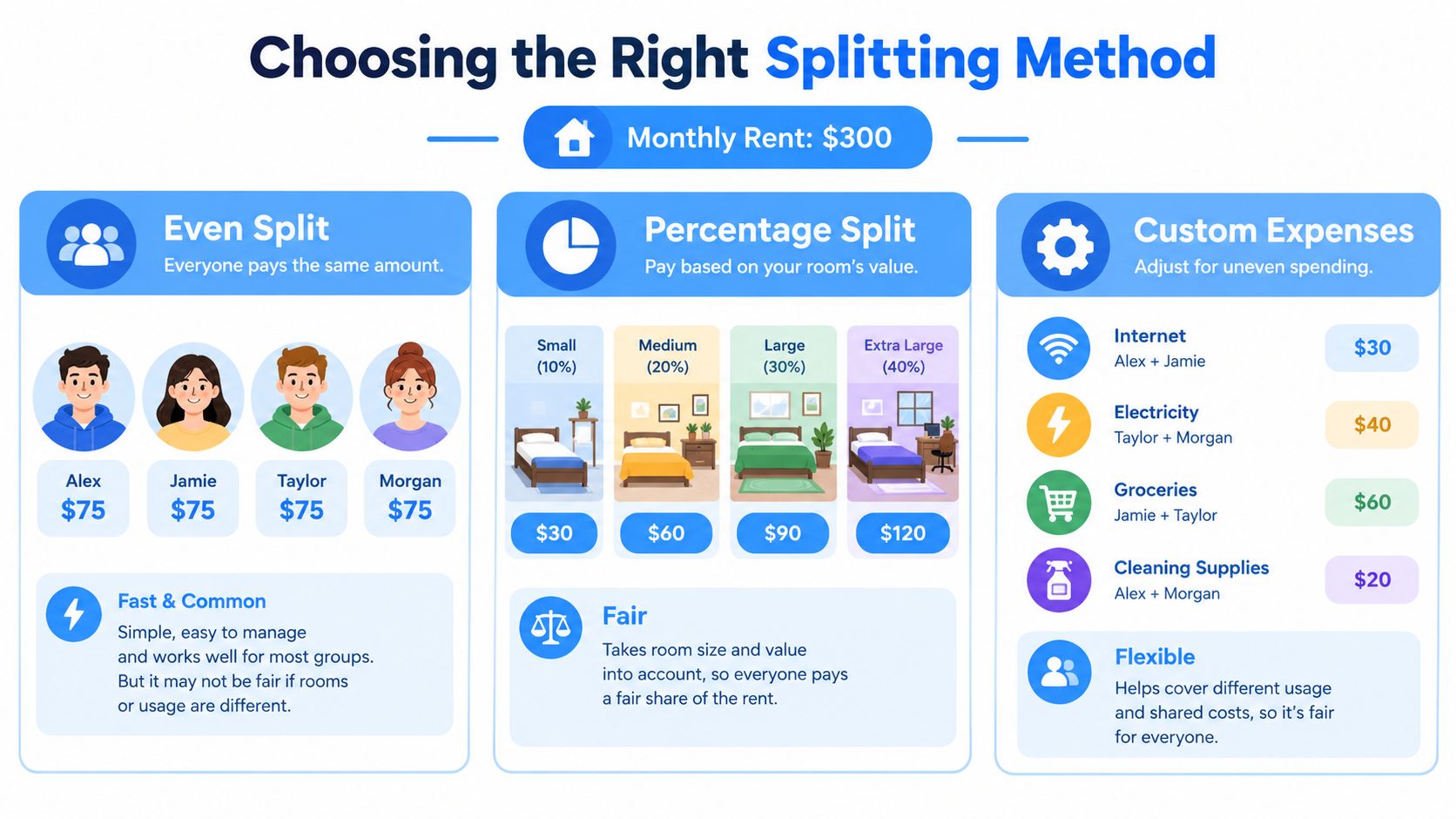
The easiest method is not always the fairest. Use the method that matches the relationship, the expense, and how long the arrangement will last.
| Method | $300 Monthly Rent Case | Best Use | Main Risk |
|---|---|---|---|
| Even split | Four roommates pay $75 each | Similar rooms and shared expectations | Ignores differences in space and amenities |
| Percentage split | 35%, 30%, 20%, and 15% means $105, $90, $60, and $45 | Unequal rooms or private bathrooms | Requires agreement on the percentages |
| Income-weighted split | At 25%, 15%, 25%, and 35%, payments are $60, $36, $60, and $84 | Households that intentionally share costs by ability to pay | Income can feel personal or intrusive |
An even split works well for a one-off meal where the prices are close and the group values speed. It's also reasonable for a shared utility used in roughly equal amounts. Don't use it automatically for a long lease when one roommate has the largest room, a private bathroom, or substantially more storage.
A percentage split makes the most sense when the physical value differs. Roommates can agree on percentages before signing the lease, taking account of room size, natural light, bathrooms, parking, and private outdoor space. Carnegie Mellon's summary of Spliddit's envy-free rent allocation approach describes a method where people state what each room is worth to them, then an algorithm assigns rooms and payments to produce a provably fair result.
Income-weighted allocation is more sensitive, but some couples and households prefer it because it reflects ability to pay. Use it only when everyone agrees voluntarily and understands the percentages. Never use income as a surprise justification after someone has already committed.
Equal is a shortcut. Fair means the group agrees that the shortcut fits the situation.
For restaurant bills, use per-item allocation whenever menu prices vary. For a long-term rental, use room-value percentages. For household finances where people have explicitly agreed to share according to means, an income-weighted method can work. This guide to dividing bills based on income can help structure that conversation before the first transfer is made.
Sorting Shared Costs From Personal Ones on Trips
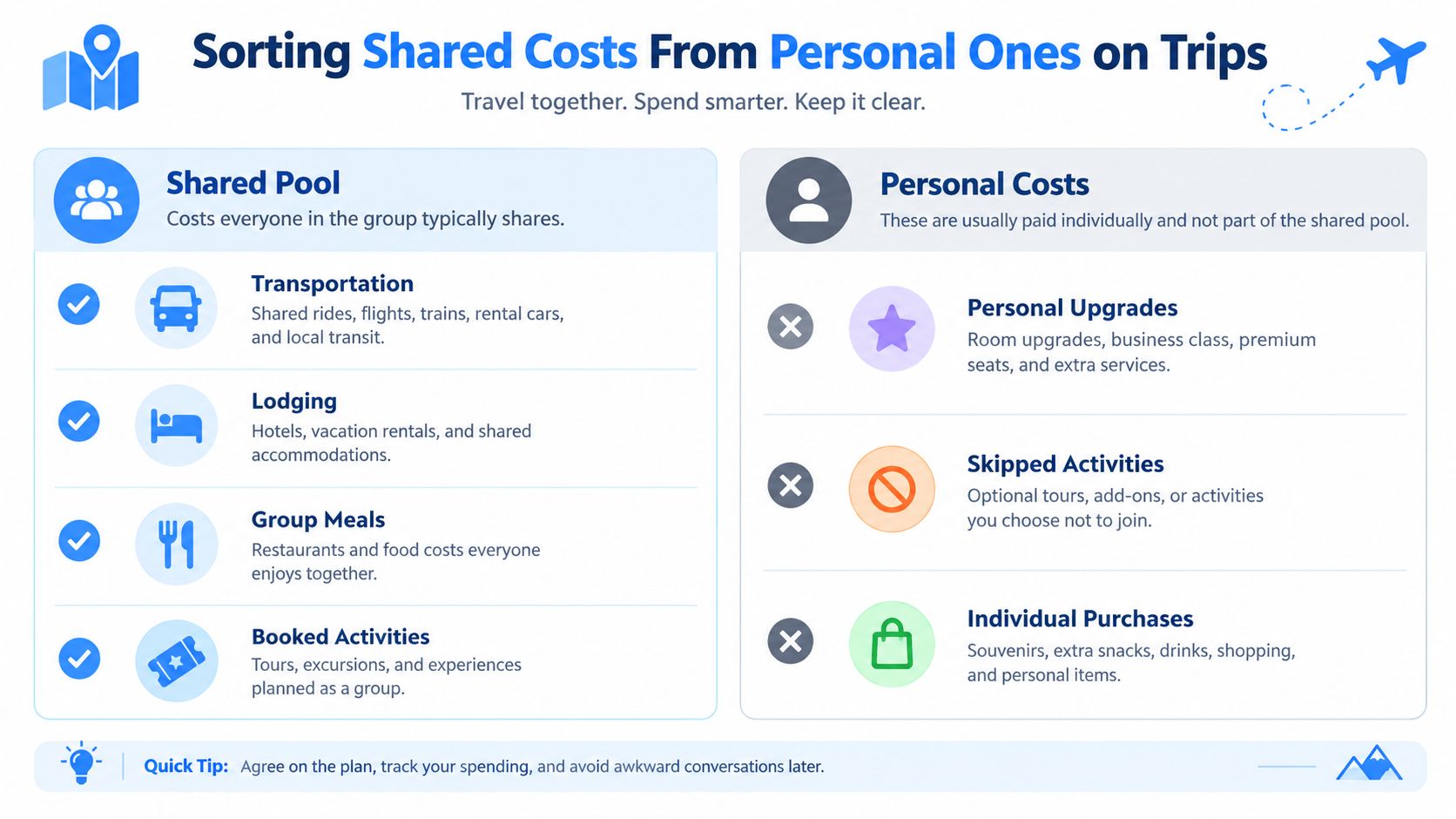
Trip expenses go wrong when people debate the total instead of defining the pool. Write the rule before departure:
Shared costs usually include transportation booked for everyone, lodging, group meals, and activities the whole group chose. Personal costs include upgrades, souvenirs, solo snacks, skipped activities, and purchases made for one person.
Take an illustrative $1,200 trip for four. If $960 covers lodging, shared transport, group meals, and a booked activity, that is the shared base. Divide the shared base evenly and each person owes $240. The remaining $240 stays outside the shared pool and is assigned to the people who made those personal purchases.
The rule becomes useful in real situations:
- Skipped activity: If one roommate doesn't join a $200 wine tour, remove that activity from their share. The participants cover it according to the agreement made before booking.
- Individual lunch: If a partner buys a $14 corner-shop lunch instead of joining the group meal, that person pays the $14. Nobody else absorbs it unless the group explicitly agreed to treat all food as shared.
- Personal upgrade: If one traveler chooses a better seat, room, transfer, or add-on, assign the extra cost to that traveler.
For more disciplined categorization, bookkeepers can use this guide by BankStatementWizard for bookkeepers as a useful reference for separating expense types and documenting decisions.
At the airport, on the road, or at the hotel desk, ask: Did everyone benefit, did everyone agree, and would the group have paid for it without this person's individual choice? If the answer is no, keep it outside the shared pool.
Settling the Tab Without the Awkward Follow Ups
The arithmetic usually takes less time than repayment. One person fronts the bill, three people say “I'll send it later,” and the organizer becomes responsible for remembering who paid. That turns a clear transaction into a social negotiation.
Use a four-step settlement workflow.
- Set the deadline immediately. For a dinner, make it the same night. For a trip, agree on a regular batch schedule.
- Send itemized requests. Include the person's amount and a short description, such as “Dinner, burger, shared pasta, tax and tip.”
- Attach proof. Use the receipt or a payment request that shows how the amount was calculated.
- Follow up once, clearly. A single reminder is better than a series of vague hints.
Suppose a $156 dinner leaves Alex owing $47, Jordan owing $33, and Sam owing $22. Send three separate requests:
- “Alex, your dinner share is $47, including your entrée, shared items, tax, and tip. Please send it tonight.”
- “Jordan, your itemized dinner share is $33. I've attached the receipt so the amount is clear.”
- “Sam, your share comes to $22. Please settle it by tonight so I can close the bill.”
The specificity removes the opening for debate. If someone spots an error, they can challenge a line rather than questioning the entire total.
| Situation | Settle By | First Reminder | Final Follow Up |
|---|---|---|---|
| One dinner | Same night | Before bed | Next day |
| Weekend trip | Agreed batch day | After the batch is sent | Before the next shared booking |
| Shared apartment | Regular bill date | When the request is issued | Before the next bill cycle |
| Missing receipt | After the receipt is reconstructed | When the estimate is shared | When the original proof arrives |
For recurring business reimbursements or more formal approval chains, an expense claim software alternative can provide a more structured workflow than informal messages. For friends and roommates, the same principle still applies: document the amount, identify the deadline, and avoid making the other person guess what they owe.
Pew Research Center found that 76% of U.S. adults had used a payment app such as PayPal, Venmo, Zelle, or Cash App in a survey conducted in 2022, while only 21% of users said splitting expenses was a major reason for using one. Among users aged 18 to 29, that figure rose to 44%, and it fell below 10% among users aged 50 and older, as reported in Pew's payment-app research. The payment rails are familiar. The missing piece is a clear settlement routine.
When an App Beats the Spreadsheet
Spreadsheets fail at the receipt stage. Someone has to type every item, remember the tax line, enter the tip, assign shared dishes, and send the final requests. One duplicated entrée or missed fee can make the totals look polished while still being wrong.
An app such as Divvy uses AI receipt scanning to read line items, tax, and tip, then lets users assign each item to a person or to a shared pool. That approach fits the method above because the calculation begins with consumption, not with an arbitrary number of people.
The earlier restaurant example shows why this matters. If the group has an item subtotal, an 8% tax line, and an $18 tip, each person's tax and tip share should follow their proportion of the pre-tax subtotal. Someone who ordered less shouldn't carry the same fee as someone who ordered more. Someone who shared a dish with one other person shouldn't pay for the entire dish.
Three practical benefits matter most:
- Less manual entry: Receipt lines can be captured instead of retyped.
- Automatic proportional fees: Tax and tip follow each person's assigned subtotal.
- Faster requests: Payment links can be created through Apple Pay, Venmo, or Cash App, so repayment doesn't require every guest to join the same ledger.
The app also supports item assignment, even division of shared dishes, and reminders for unpaid balances. Friends can receive requests without installing the app or creating an account. That distinction matters because the person organizing dinner shouldn't have to persuade every guest to adopt a new financial system.
After the calculation, the group still needs to review the assignments. Scanning reduces transcription work, but it doesn't know whether a person merely tasted the pasta or ate half of it. Human agreement remains the fairness check.
The best app for splitting costs depends on whether the group needs item-level settlement, a running travel ledger, recurring household expenses, or simple equal division. For immediate receipt-based repayment, an itemized workflow is usually more useful than a spreadsheet that someone must maintain manually. This cost-sharing app overview gives another way to evaluate the difference between one-bill settlement and ongoing expense tracking.
The video below shows how a receipt-splitting workflow can fit into the moment when the bill arrives.
Move to an automated workflow when the group has regular dinners, shared rent, or a trip with several diners. If the same person keeps typing receipts and chasing balances, the spreadsheet has already become the expensive option.
Putting It All Together
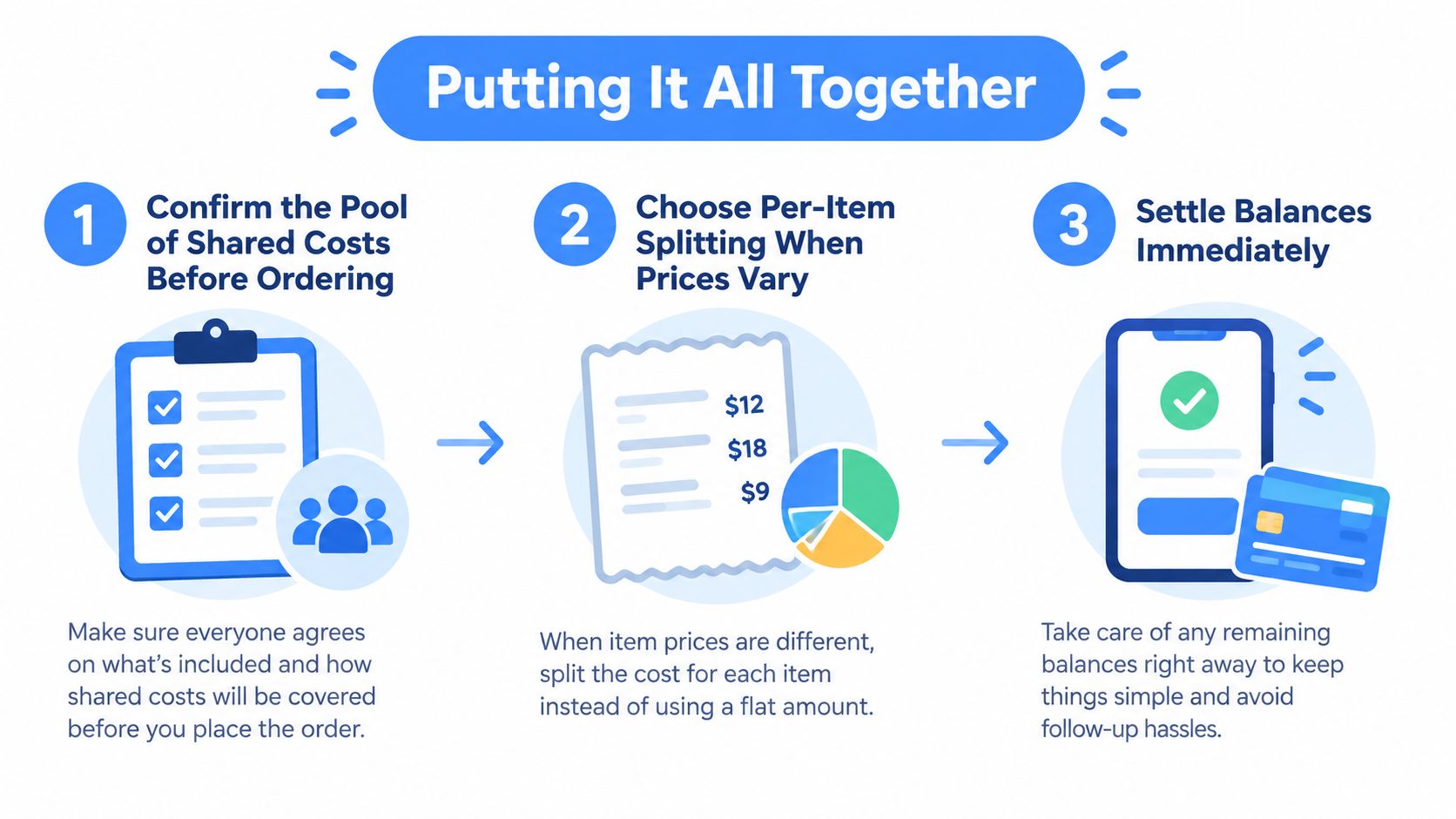
Before anyone orders, confirm what belongs in the shared pool. Don't wait until the receipt arrives to decide whether the wine, ride, activity, or upgrade was communal.
Use this checklist:
- Confirm the pool: Mark shared transportation, lodging, group meals, and agreed activities before spending.
- Split by item: Assign personal purchases to the buyer and shared dishes to the people who consumed them.
- Allocate fees proportionally: Apply tax and tip according to each person's pre-tax subtotal.
- Choose a long-term method: Use room-value percentages or income-weighted allocation only when everyone agrees upfront.
- Exclude personal extras: Keep solo activities, skipped events, souvenirs, and upgrades out of the shared pool.
- Settle promptly: Send one itemized request per person and close balances within 48 hours.
Two developments deserve attention in 2026 as projections rather than established facts. Bank-integrated expense feeds may help identify which charges belong to a shared pool, while AI assistants may pre-categorize receipts before a person confirms the split. Neither removes the need for a human decision about fairness, but both could reduce the manual handoff between a receipt and a payment request.
The rule that prevents most arguments is also the least complicated: agree first, assign accurately, check the total, and request repayment while the event is still fresh. A receipt workflow such as the one described above applies those rules without rebuilding a spreadsheet every time.
Divvy scans receipts, assigns items to the people who consumed them, allocates tax and tip proportionally, and sends payment requests through familiar money apps. Visit Divvy before your next dinner, shared household bill, or group trip, and replace the awkward end-of-night math with a clear settlement workflow.