Divvy
DivvyHow to Divide Bills Based on Income: A Fair Method
By The Divvy Team · July 23, 2026 · 11 min read
You can feel the tension before anyone says it out loud. One person is paying more rent relative to income, the other is tired of hearing that “fair means equal,” and both of you are wondering why a simple bill split keeps turning into a recurring argument. The fix isn't more spreadsheets for the sake of spreadsheets, it's a system that matches the money coming in, the bills going out, and the way you live together.
Table of Contents
- Why Splitting Bills 50/50 Often Isn't Fair
- The Proportional Method Explained Step-by-Step
- Handling Financial Variations and Edge Cases
- How to Have the Money Talk Without the Awkwardness
- Implementing and Automating Your New System
- Frequently Asked Questions About Fair Bill Splitting
Why Splitting Bills 50/50 Often Isn't Fair
A 50/50 split sounds clean until you look at what it does to each person's budget. If one roommate brings home a lot less than the other, equal does not feel neutral, it feels like one person is stretching every paycheck while the other still has room to breathe. That's where resentment starts, not because anyone is being dramatic, but because the burden lands unevenly.
Fairness in shared finances is usually about equity, not identical numbers. A proportional split asks a better question than “Did we both pay the same amount?” It asks, “Did we each pay a share that matches our real earning power?”

Why equal doesn't always mean fair
The problem with equal splits is that they ignore context. Taxes, deductions, debt payments, and uneven paychecks all change what “equal” feels like in practice. A share that looks tidy on paper can still leave one person short at the end of the month.
A better approach is to divide shared costs by income proportion, using each person's real take-home pay. That keeps the split tied to what each person can contribute, instead of pretending both budgets work the same way.
Fair splitting doesn't mean both people feel the same pressure. It means both people can cover their share without the lower earner carrying the emotional weight of the household.
The other reason 50/50 often fails is communication. If one person is subsidizing the shared life while pretending not to care, the relationship starts collecting hidden resentment. Once that happens, the argument is no longer about rent, it's about whether the system itself is respectful.
The Proportional Method Explained Step-by-Step
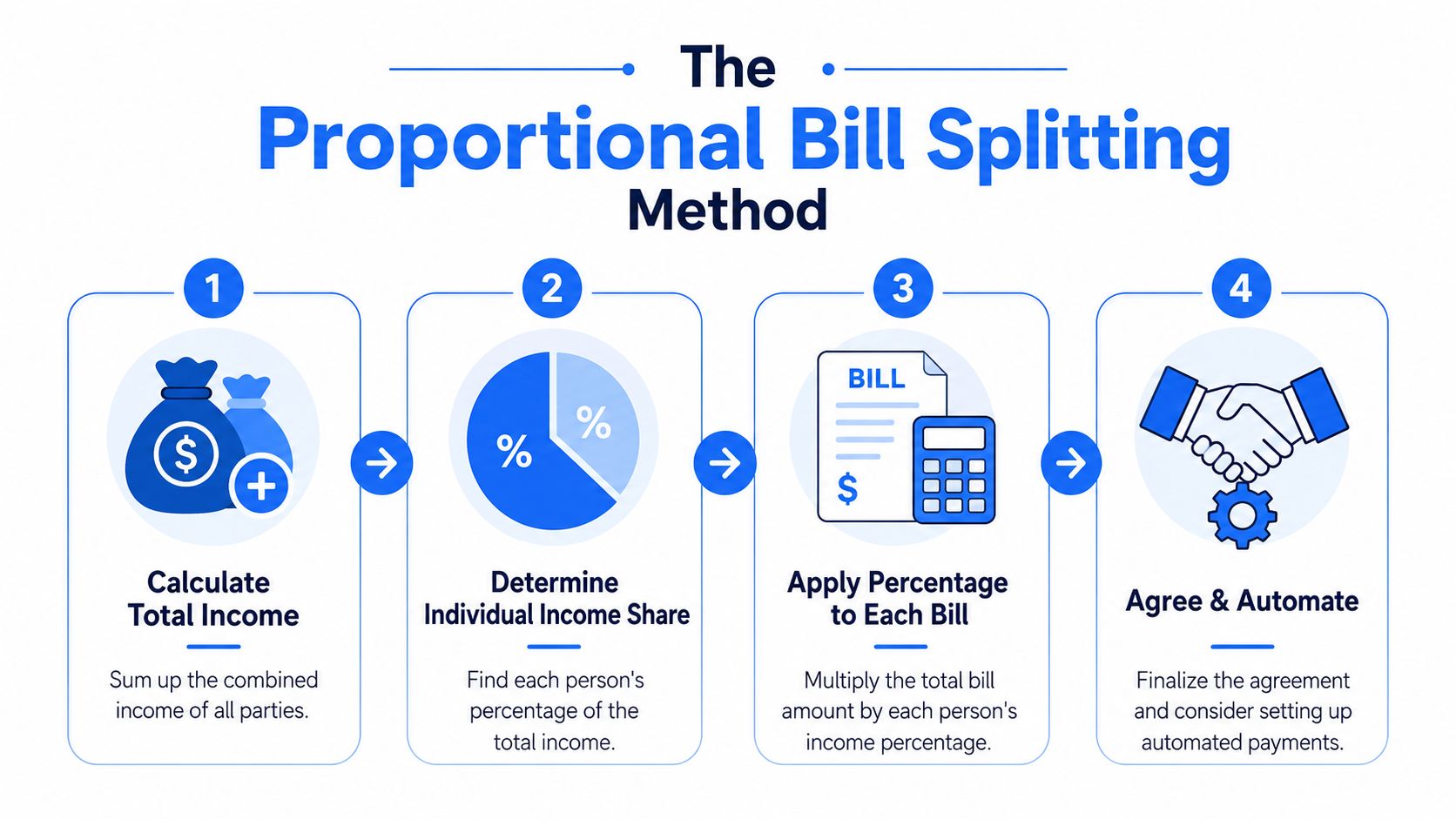
A proportional split starts with net monthly income, not gross pay. Use each person's take-home pay, calculate their share of the household total, then apply that percentage to shared expenses. That keeps the split tied to what each person can contribute, and it avoids distortion from taxes and deductions. A practical guide from Sapience's practical guide on splitting expenses as a couple also recommends revisiting the split when income changes, often on a monthly or quarterly review cycle.
Start with the right bills
Before you do any math, agree on which costs are shared. Common examples are rent, utilities, internet, groceries, and any other recurring expense you both treat as household spending.
That list needs to be clear. If you leave items vague, one person may assume they are included while the other assumes they are personal, and the split will fall apart before it even starts. A simple spreadsheet or bill list helps keep the household total complete before you apply the ratio, which is the kind of setup recommended in ClearCash on income-based bill splitting.
Practical rule: decide what counts as shared before you decide who pays what. If the list is vague, the split will feel vague too.
Use this formula
Income share = individual net income divided by combined household net income.
Each person's contribution = income share multiplied by total shared expenses.
Here's a simple worked example. Say Jordan brings home 3,000 a month and Casey brings home 2,000 a month. Their combined net income is 5,000 a month. Jordan's share is 60 percent, and Casey's share is 40 percent.
If their shared monthly bills total 1,500, Jordan pays 900 and Casey pays 600. The point is not that both people pay the same number. The point is that both people pay in proportion to what they earn.
Make the payment flow simple
A proportional split works best when the payment process is easy to follow. Keep shared money in one place, then pay common bills from that pool. If you want to handle the housing piece with less manual math, Divvy's rent split calculator can help you set the rent side up in a way that matches the broader system.
The strongest habit is to automate the transfer on payday. That way, the shared account fills before the bills arrive, instead of after someone has already forgotten to send money. If you rely on ad hoc reimbursements, the split becomes a repeated chase, and the tension usually lands on the person doing the reminding.
Handling Financial Variations and Edge Cases
The basic formula works best when both incomes are steady. Real life is messier. Bonuses, overtime, freelance work, side income, raises, and job loss all change the math, and a split that felt fair last quarter can start feeling off very quickly.

Variable pay needs a written rule
If one person gets paid irregularly, use a rule before emotions enter the room. One option is to average variable income across a recent period, then recalculate on a fixed schedule. That aligns with the guidance that says fair splitting can be temporal rather than fixed, because income volatility changes what a fair percentage looks like over time, as noted by WECU's discussion of couple finances.
The same logic applies after a raise or job loss. Don't improvise from memory, agree in advance that a major income shift triggers a review. That keeps the conversation about process, not blame.
Bonuses, debt, and one-time costs
Bonuses and overtime are easiest to handle when you decide whether they count as regular household income or as personal windfalls. If you don't decide, each person will assume the rule favors them. That's where fights start.
Personal debts need a separate decision. Some couples keep student loans and credit cards fully individual, while others treat debt payments as part of the household picture because they affect cash flow. There isn't one universal answer, but the rule should be explicit before money gets tight.
If the income picture changes often, the split should flex often too. A fixed percentage can become unfair the moment one person's compensation shifts sharply.
One more edge case is a temporary income shock, like a short layoff or a reduced client load. In that situation, a couple needs a rebalancing rule, not a moral debate. Agree on how long a temporary adjustment lasts, then revisit it on a set date.
How to Have the Money Talk Without the Awkwardness
Start the conversation when nobody is rushed, tired, or already irritated about a bill. The wrong time turns a practical talk into a defensive one. The right time makes it easier to talk like teammates instead of opponents.
Bring numbers, not vague concerns. If you walk in with the actual shared bills, each person's net income, and a proposed formula, the conversation stays concrete. That alone lowers the odds of a messy back-and-forth.
Use language that lowers defensiveness
“I want us to find a split that feels fair to both of us, and I've put together a simple income-based option.”
“Can we look at our take-home pay and shared bills together, then agree on a formula we both trust?”
“I'm not trying to nickel-and-dime anything, I just want a system that doesn't leave either of us resentful.”
Those scripts work because they make the issue about the household system, not about who's being difficult. They also leave room for the other person to suggest changes without feeling cornered.
Keep the talk short and specific
Decide in advance what the conversation needs to resolve. That usually means three things, which bills are shared, what income number you're using, and when you'll revisit the split. If the discussion starts drifting into unrelated money grievances, park those for later.
If someone owes reimbursement for a past shared cost, use a separate process for that instead of folding it into the new arrangement. Divvy's guide on asking someone to pay you back is useful if the relationship already has a small pile of unpaid reimbursements and you need to clean that up first.
The goal isn't perfect harmony in one meeting. The goal is a plan both people can follow without dread.
Implementing and Automating Your New System
The quickest way to break a fair bill split is to keep it manual. People forget transfers, lose receipts, and get tired of reminding each other what still needs to be paid. A good system puts shared costs in one place and cuts down on the follow-up that usually causes tension.
A dedicated joint account or transfer bucket helps because shared money arrives before shared bills leave. That lowers the chance of missed payments and avoids the awkward back-and-forth of chasing reimbursements. A structured bill list or spreadsheet also helps make sure every shared expense is captured before the ratio gets applied.
Build one home for shared money
The cleanest setup is a shared account funded on payday. Each person transfers their proportional share right away, then all common bills come out of that pool. That keeps the household budget easy to track and separates personal spending from shared obligations.
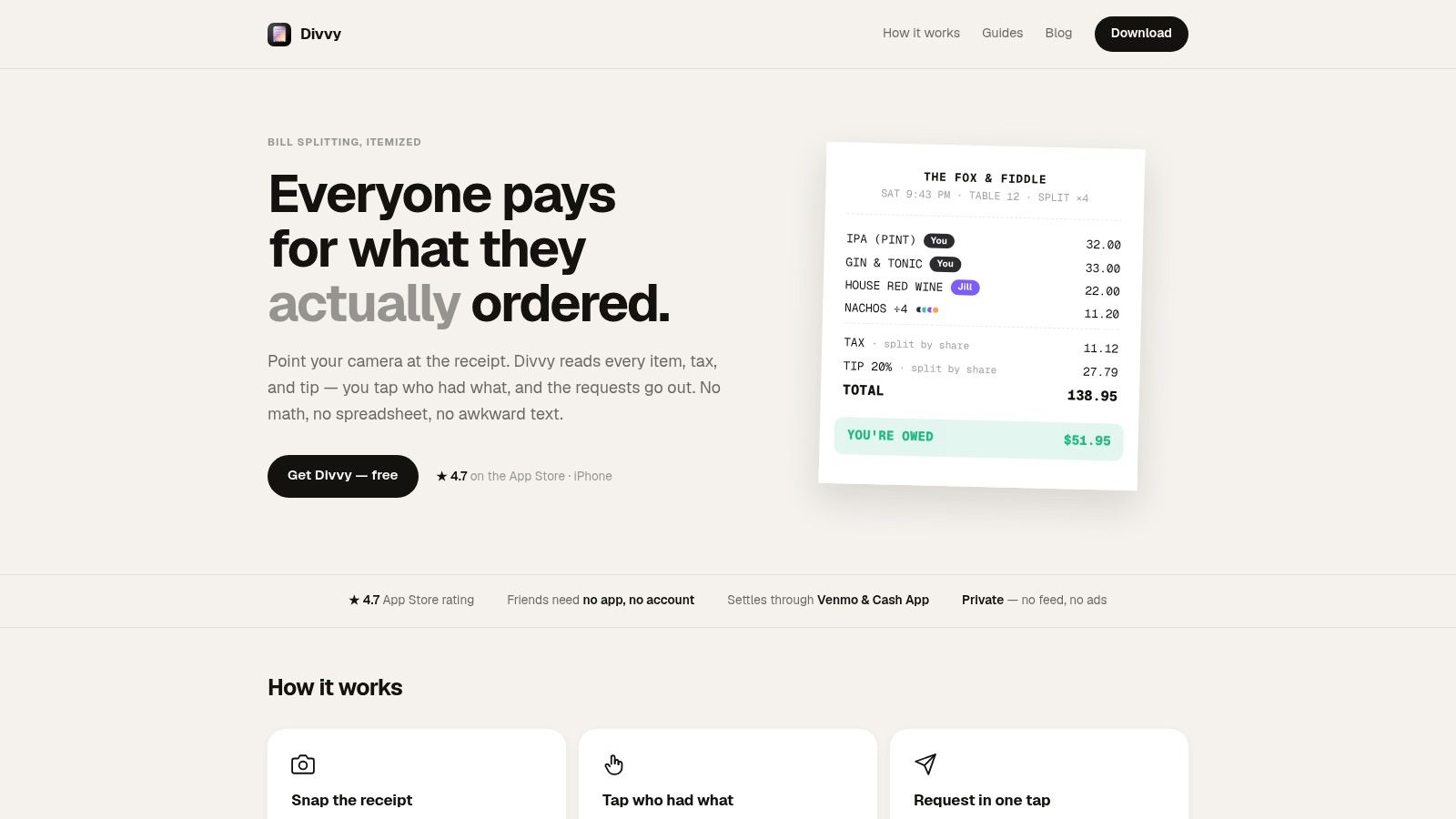
If you want less manual tracking, a tool can do the tedious parts for you. Divvy's receipt management app can help with receipt scanning, line-item allocation, and automated payment requests for shared purchases. It gives you a repeatable way to turn an agreement into an actual process, instead of relying on memory every month.
Reduce the number of decisions
You do not want to renegotiate the same bill every time it shows up. Decide which expenses are always shared, which are personal, and who keeps an eye on the payment flow. Then put the schedule somewhere both people can see it, so nobody has to reconstruct the system from memory.
A spreadsheet gives you more control. An automated app gives you fewer moving parts. Either can work if the process is clear and both people use it the same way every time. The point is consistency, because even a fair split falls apart if one person has to keep policing it.
The win is not perfect math. The win is a routine that keeps the split fair without turning every bill into a conversation.
Frequently Asked Questions About Fair Bill Splitting
How often should we recalculate the split? Revisit it whenever income changes in a meaningful way, and otherwise on a regular review cycle. Practical guides suggest monthly or quarterly reviews, and variable earners may prefer a slightly broader averaging window.
What if one person gets a raise or loses a job? Re-run the ratio using current net income, then agree on when the new split starts. If the change is temporary, define how long the adjustment lasts before you revisit it.
Should savings count as a shared expense? Only if you both agree that the savings goal is collective. Some households treat emergency savings or shared goals as part of the bill list, while others keep savings separate and only split recurring household costs.
What if we don't agree on every expense? Use a shared list, decide what counts as communal, and keep personal expenses out of the split. Clarity beats compromise-by-confusion every time.
If you want a cleaner way to run the math, keep the split visible, and cut down on payment reminders, try Divvy for shared bills and receipts.