Divvy
DivvyHow to Calculate Rent Per Square Foot: A Practical Guide
By The Divvy Team · September 26, 2026 · 12 min read
You're comparing two apartments, offices, or retail spaces that look similar on paper. One has the lower monthly price, while the other offers more room, better access, or a different lease structure. The cheapest number may not be the best value, because rent per square foot only works when the rent and the area use the same basis.
That means checking whether the quoted amount is monthly or annual, then confirming whether the square footage is usable, rentable, or gross. The arithmetic is simple. The difficult part is knowing which figures belong in the formula.
Table of Contents
- Why Rent Per Square Foot Matters for Your Lease
- Understanding Square Footage Definitions
- Step-by-Step Calculation Methods
- Common Pitfalls and Market Nuances
- Tools for Accurate Rent Calculations
- Final Checklist for Your Lease Review
Why Rent Per Square Foot Matters for Your Lease
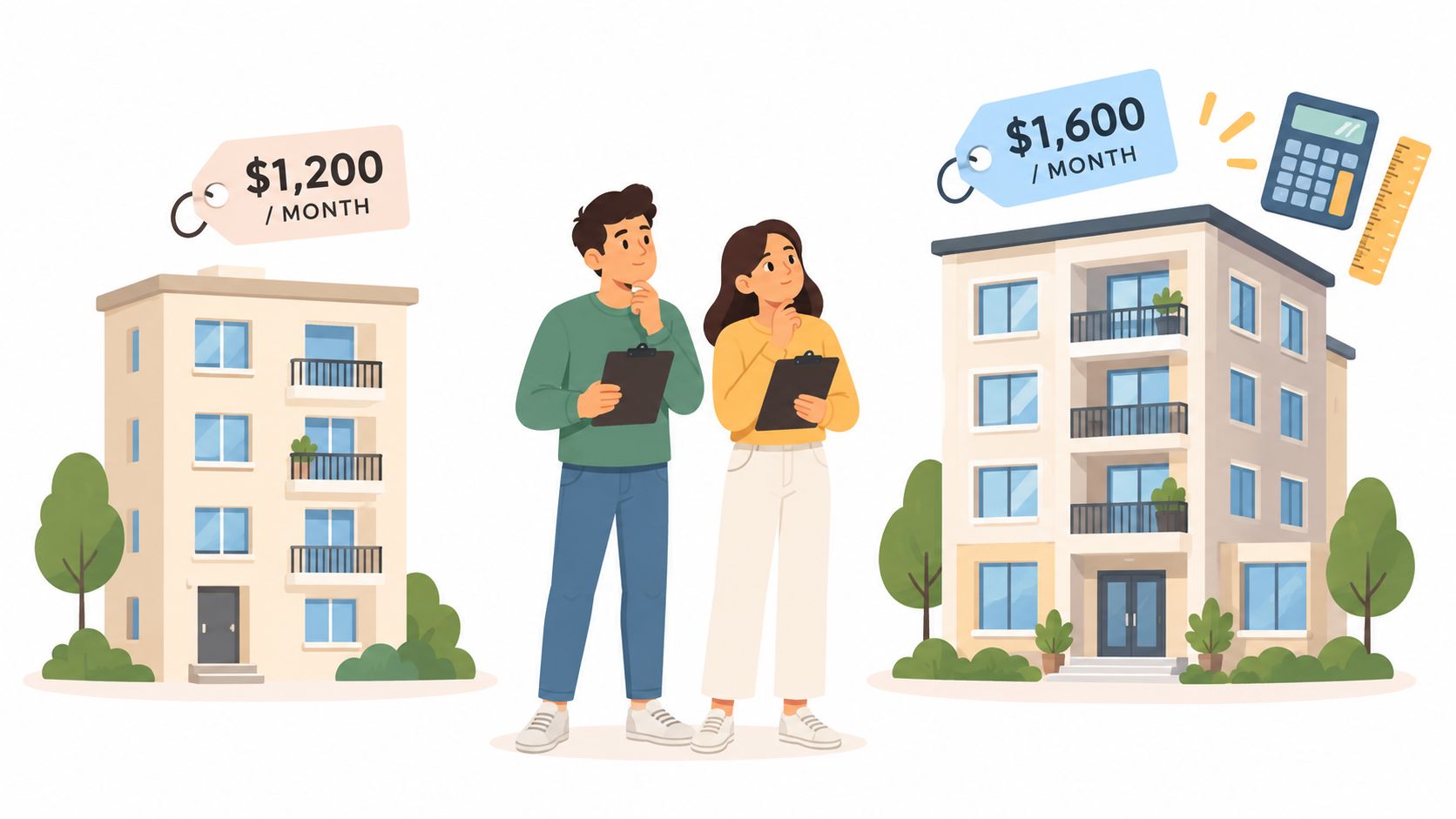
Two roommates comparing apartments often start with the monthly rent. One apartment costs less, but it may also be much smaller. The second costs more and provides more space. Dividing rent by square footage gives both people a common measure, so they can compare value instead of reacting to the headline price.
The core formula is:
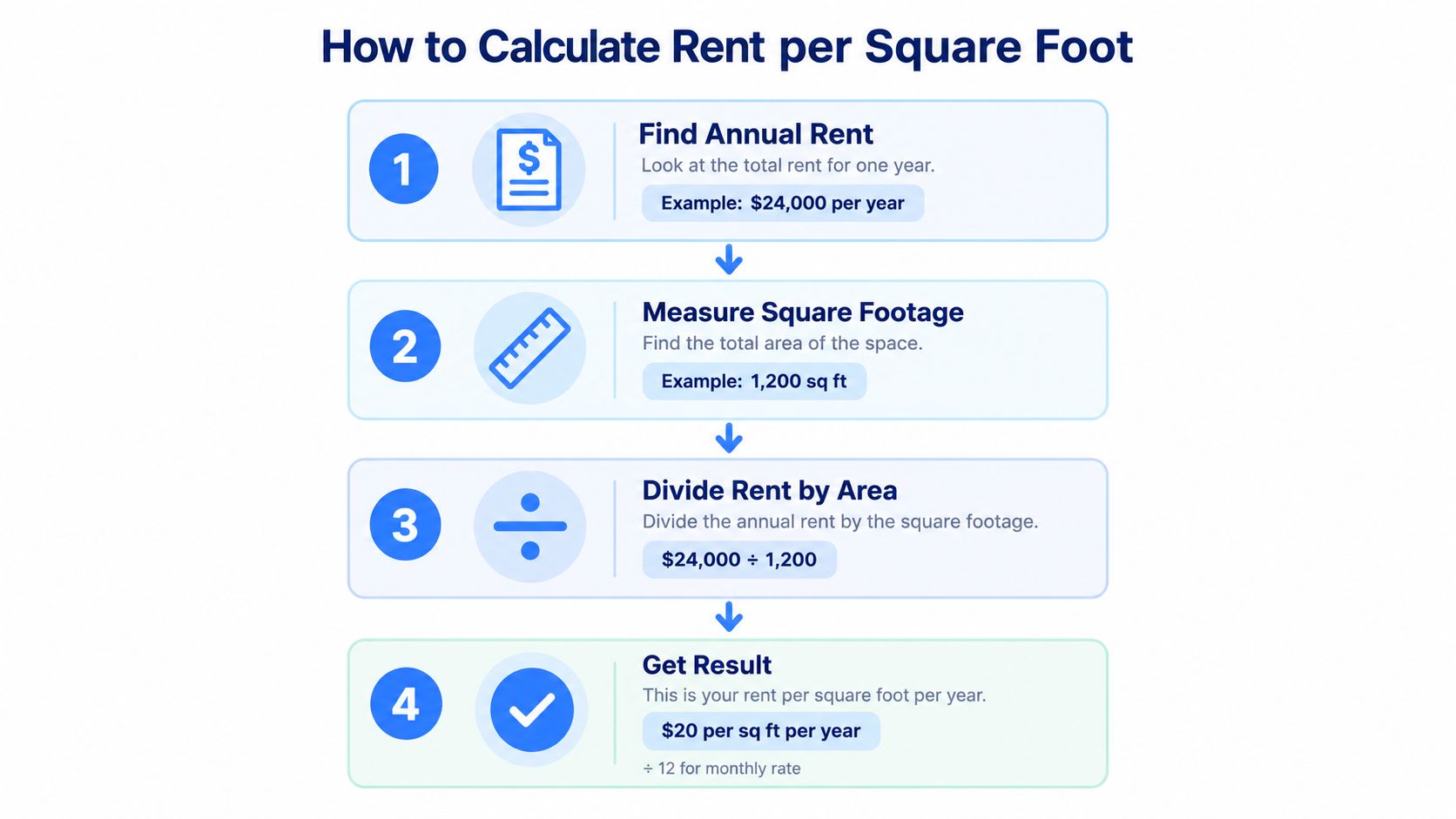
Rent per square foot = rent ÷ square footage
For commercial property, the quote is usually an annual rate. The standard calculation is annual base rent = rentable square footage × annual rate per square foot, followed by division by 12 to find the monthly base rent, as explained in this commercial rent calculation guide.
A commercial space with 2,000 square feet at $30 per square foot per year produces $60,000 in annual base rent, or $5,000 per month. That example also shows why commercial listings commonly use annual dollars per square foot. The format lets tenants compare properties with different sizes without allowing the monthly total to dominate the decision.
Use the metric as a first filter
Rent per square foot helps you compare a studio with a larger apartment, or a compact office with a broad retail unit. It doesn't tell you whether the property is suitable, but it quickly identifies listings that deserve closer review.
For residential property, the figure is often presented as a monthly amount per square foot. Commercial listings more commonly use annual dollars per square foot. Never compare the two until you've converted them to the same time period.
Practical rule: Write down the time basis and measurement basis beside every quote before comparing properties.
The metric also supports broader valuation work. If you're assessing a residential property, factors such as location, condition, demand, and income potential can change the result, so this overview of key factors affecting rental value in London provides useful context beyond the initial calculation.
Monthly price isn't the whole household decision
A low price per square foot doesn't automatically make an apartment comfortable or affordable. Room layout, storage, light, transport access, utilities, and the way roommates use the space all matter.
Before signing a first lease, combine the space comparison with a complete housing budget. A practical first apartment budgeting guide can help you account for recurring costs instead of treating rent as the only payment.
Understanding Square Footage Definitions
The most common rent-per-square-foot disputes start before anyone touches a calculator. The parties are using different definitions of area.
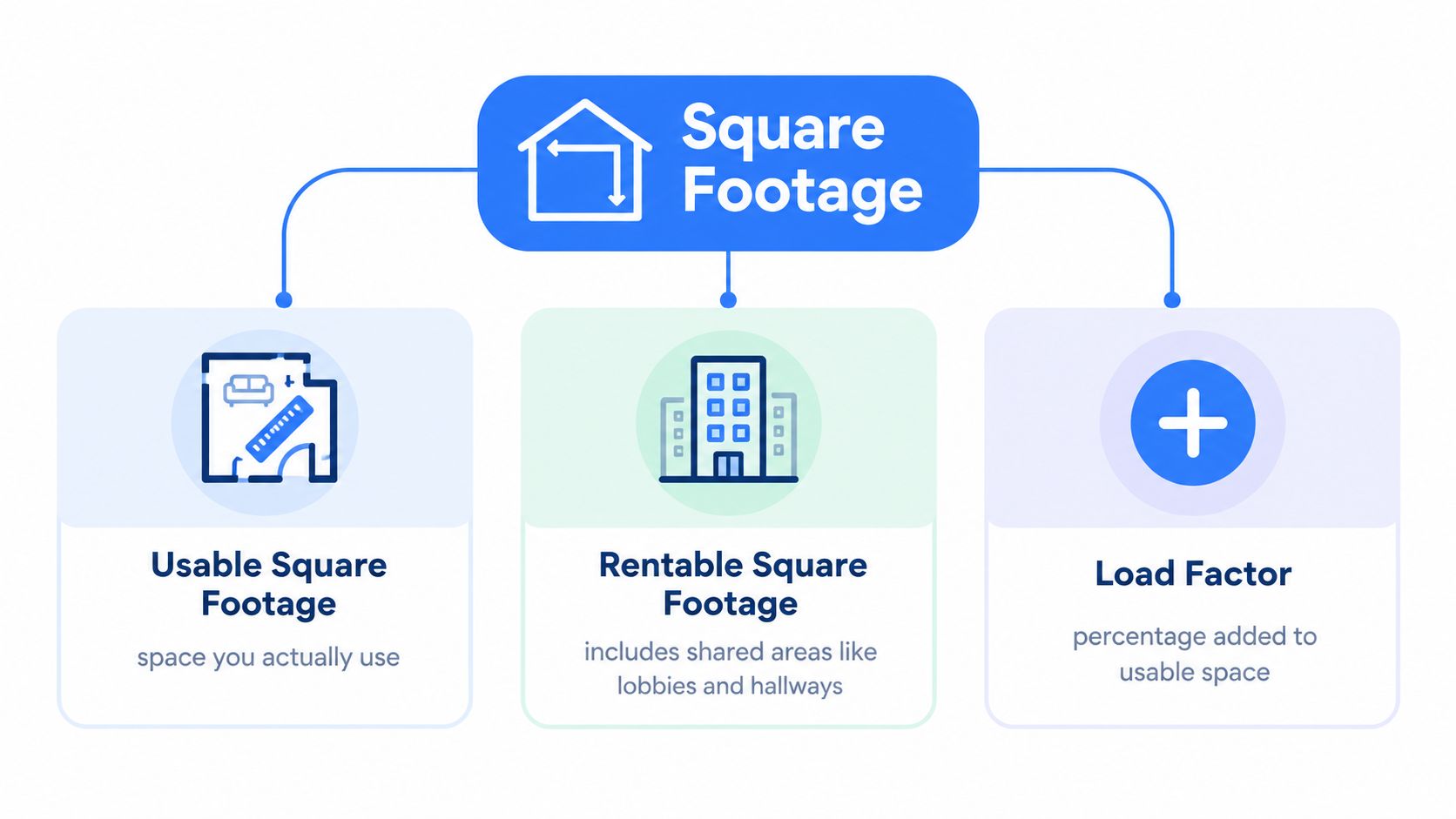
Usable square footage is the space a tenant can directly occupy and use. In an apartment, that generally means the interior living area. In an office or shop, it means the area inside the tenant's premises, excluding shared building areas.
Rentable square footage includes the usable area plus the tenant's allocated share of common areas. Those areas may include corridors, lobbies, bathrooms, and other shared facilities. NYC's commercial lease guide describes rentable area as usable area plus a portion of common space.
Gross square footage is a broader building measurement. It may include the full constructed area, depending on the measurement convention and the document using it. It isn't automatically the figure that determines a tenant's rent.
Why the denominator changes the deal
Suppose two offices provide the same usable floor area. One building has a modest lobby and limited shared facilities. The other assigns tenants a larger share of corridors, bathrooms, and amenities. If both landlords quote rent using rentable area, the spaces can show different rentable square footage and different total rent even though the usable work area is the same.
That distinction affects the apparent rate too. A tenant who divides rent by usable area while the landlord calculates rent using rentable area is comparing different denominators. The tenant's result will look more expensive, but the calculation won't match the lease.
| Measurement | What it generally represents | Why it matters |
|---|---|---|
| Usable area | Space the tenant directly occupies | Useful for evaluating functional space |
| Rentable area | Usable area plus allocated common space | Often the lease rent basis in commercial property |
| Gross area | Broader building or floor measurement | Must be matched to the document's stated convention |
Ask for the load factor
The relationship between usable and rentable area is often expressed through a load factor. It describes how much additional area is allocated beyond the tenant's direct premises.
Don't infer this factor from a marketing brochure. Ask the landlord or broker for:
- The stated measurement basis: Confirm whether the quote uses usable, rentable, or gross area.
- The rentable area: Use the figure that appears in the lease or formal proposal.
- The usable area: Check how much space the tenant can occupy.
- The allocation method: Ask what common areas are included and how the tenant's share is calculated.
A quote can appear attractive because it uses a low rate, while a larger rentable area pushes the actual annual base rent higher. Conversely, comparing a quoted rate on rentable space with a competing rate on usable space can make one property look artificially cheap.
The right denominator is the one stated in the lease, not the one that produces the more favorable answer.
Residential listings create a related problem. Apartment data may report monthly price per square foot, while commercial guides commonly use annual rent based on rentable square footage. Confirming both the time period and the area definition prevents a technically correct division from producing a commercially misleading result.
Step-by-Step Calculation Methods
Once the measurement basis is clear, the calculation is mechanical. Keep the rent period and square-foot definition consistent from beginning to end.
Start with an annual quote
Use this workflow when the lease gives an annual rate:
- Identify the quoted area. Use rentable square footage if the lease uses rentable area.
- Multiply area by the annual rate. This produces annual base rent.
- Divide annual base rent by 12. This produces monthly base rent.
- Label additional charges separately. Taxes, insurance, maintenance, utilities, and other pass-throughs may not be included.
For example, a 1,500-square-foot space at $15 per square foot per year costs $22,500 annually, or $1,875 monthly. A 2,000-square-foot space at $25 per square foot per year costs $50,000 annually, or $4,166.67 monthly.
The calculations follow the standard workflow described by this rent-per-square-foot calculator guide. The important discipline is to use the same area basis for both examples and for every property in your comparison.
Reverse the calculation from monthly rent
Sometimes a landlord gives you only a monthly figure. Annualize it first:
Annual rent = monthly rent × 12
Then calculate the annual rate:
Annual rent per square foot = annual rent ÷ square footage
If a property costs $5,000 per month and measures 2,000 square feet, annual rent is $60,000. Dividing that amount by 2,000 square feet gives $30 per square foot per year.
Convert a monthly rate correctly
If a listing says $2.50 per square foot per month, multiply the rate by 12 before comparing it with annual commercial quotes. That converts the figure to $30 per square foot per year.
Don't multiply the square footage by a monthly rate and then describe the result as annual rent. Either keep every value monthly or convert every value to annual terms first.
For a complete comparison, place each property in a worksheet with columns for quoted rate, time basis, area basis, square footage, annual base rent, monthly base rent, and additional charges. This makes inconsistencies visible before they reach the lease review.
Common Pitfalls and Market Nuances
The most expensive errors usually come from mismatched assumptions, not difficult math. A monthly quote compared with an annual figure can distort the result by a factor of 12, as explained in this rent-per-square-foot explainer. Record the time basis before comparing any rates.
Square footage creates a second source of disputes. Usable area covers the space a tenant can occupy. Rentable area may add a share of common areas, while gross area can use a broader building or property measurement. A quote based on rentable area cannot be compared directly with one based on usable area. Ask the landlord or agent which definition appears in the lease, and confirm how the stated measurement was calculated.
Commercial tenants must also separate base rent from operating expenses, taxes, insurance, utilities, and other pass-through charges. A lower base rate may produce a higher total commitment when another quote includes more costs.
Compare like with like
Use this sequence before ranking properties:
- Time period: Convert every quote to annual or every quote to monthly.
- Area basis: Compare rentable with rentable, usable with usable, or gross with gross.
- Lease scope: List what the quoted rent includes and excludes.
- Property type: Compare apartments with apartments, offices with offices, and retail with retail.
- Total commitment: Review the rent schedule and additional charges, not only the opening rate.
Residential listings often show monthly price per square foot, while commercial leases commonly quote annual dollars per square foot. A tenant comparing both markets needs a normalized worksheet and a clear record of each area definition.
Read the market behind the number
Market conditions can make a quoted rate look stable even when the comparison is changing. Recent market reporting found that Manhattan and Brooklyn average rent per square foot reached $88.95 in May 2025 and $91.07 in August 2025, according to market analysis from GrowthFactor. In expensive markets, a small change between usable and rentable area can materially alter the apparent value.
Apartment affordability can move differently from price per square foot. Realtor.com reported 26 straight months of year-over-year rent declines for 0-2 bedroom properties by September 2025, while Rent. Research reported that apartment price per square foot fell 0.4% year over year in February 2025 after hovering around $1.80 for over a year, according to Rent. Research. A lower unit-level rate does not automatically mean lower monthly spending if unit sizes, supply, and tenant preferences are changing.
Teams handling large property datasets can use rental analysis for proptech teams to organize comparisons, but lease documents still require human verification. For shared housing, a guide to splitting rent between roommates can help residents apply a consistent method after confirming the total rent and the area being allocated.
Tools for Accurate Rent Calculations
A spreadsheet is enough for a single property. It becomes less reliable when you compare several listings, convert multiple quote formats, and allocate a shared household payment. The tool should preserve the assumptions, not hide them.
Start with a calculator that records:
- Annual or monthly basis: Store the original quote and the converted figure.
- Measurement definition: Mark the area as usable, rentable, or gross.
- Base rent: Separate it from other lease charges.
- Room or tenant allocation: Use a stated rule, such as equal shares or proportional room area.
For technical teams building property workflows, a rental calculator for PropTech developers can provide a structured starting point for rental calculations. It still needs accurate source data from the listing or lease.
For roommates, Divvy offers rent-splitting calculators that can allocate rent by room size or other agreed methods. Its bill-splitting app also uses AI receipt scanning to itemize charges and can create payment requests through services such as Venmo or Cash App. The effective rent calculator is useful when you need to turn a shared total into transparent individual amounts.
The calculation should remain auditable. Keep the original rent, the total area, each room's area when relevant, and the allocation rule in the same record. That way, everyone can check the result without rebuilding the math from memory.
Final Checklist for Your Lease Review
Before signing, confirm:
- Time basis: Is the quote monthly or annual?
- Area basis: Is it usable, rentable, or gross?
- Formula: Does the calculation match the stated square footage and rent?
- Scope: Are operating costs included or charged separately?
- Comparison: Are competing properties measured on the same basis?
- Sharing: If roommates are involved, is the allocation method written down?
A correct rent-per-square-foot figure is only useful when the lease language supports it. Verify the denominator, the period, and the total payment before you commit.
Divvy can help roommates turn a shared rent total into clear individual amounts using room size or another agreed allocation method. Visit Divvy to simplify the calculation and payment requests after you've verified the lease figures.