Divvy
DivvyEffective Rent Calculator: Features and Fair Split Methods
By The Divvy Team · September 18, 2026 · 16 min read
The lease is open on the coffee table, the rooms are empty, and everyone is doing silent math. One roommate wants the larger bedroom, another earns more but hates the idea of subsidizing anyone, and the third keeps asking whether a free month from the landlord changes what each person should pay. An effective rent calculator can help, but only after you identify which meaning of “effective rent” you're using.
Commercial landlords use the term to account for concessions. Roommates often use it to describe a fair adjusted share, based on income, room size, privacy, and amenities. Those are related ideas, but they aren't the same calculation. Confusing them can create a polished spreadsheet that still feels unfair.
Table of Contents
- When Splitting Rent With Roommates Feels Impossible
- What Effective Rent Actually Means
- The Five Features That Make a Rent Calculator Effective
- Choosing the Fairest Split Method for Your Household
- How to Use Divvy's Rent Split Calculator Step by Step
- Divvy Versus a Spreadsheet for Rent Sharing
- Common Mistakes That Undermine Even a Good Calculator
- Building a Rent Sharing Habit That Actually Lasts
When Splitting Rent With Roommates Feels Impossible
Three friends stand in an empty living room, looking at a lease that suddenly feels more complicated than the apartment. One person has claimed the bedroom with the walk-in closet and argues that everyone should pay equally because “we all live here.” Another has the smallest room and is already calculating how much closet space the larger room adds. The highest earner says nothing, but privately resents a split that treats every room and every income level as identical.
The discussion stalls because each person is answering a different question. One roommate is asking, “How much space do I get?” Another is asking, “How much can I reasonably afford?” A third is asking, “What did we agree to before we moved in?” Without a shared method, the group often chooses the split that ends the argument fastest, not the one that reflects the household's actual priorities.

The legal question comes before the fairness question
A private roommate split doesn't change the lease itself. Before discussing bedrooms or income, everyone should understand who signed the lease, who owes rent to the landlord, and whether the agreement makes roommates jointly responsible. A useful explanation of can landlords hold all roommates liable can help clarify why an internal agreement may not protect one roommate from the landlord's claim.
That legal responsibility is separate from the household's chosen allocation. The landlord may care about the full payment, while roommates need a method for deciding who contributes what. A calculator can make that internal decision visible, but it can't rewrite the lease or settle disagreements about security deposits, guests, damage, or early departure.
Practical rule: Agree on the fairness principle before entering numbers. A calculator should resolve arithmetic, not secretly decide what your household values.
The pattern is easy to recognize. People avoid the uncomfortable conversation, select an equal split by default, and hope the resentment stays quiet. An effective household calculator is designed to interrupt that pattern with a number everyone can inspect, challenge, and accept before the first rent payment is due.
What Effective Rent Actually Means
Effective rent has two common meanings. In commercial real estate, it usually means the average rent after spreading concessions across the lease term. A concession might be free rent, a signing credit, or another discount. The standard calculation is the total amount paid during the term divided by the number of months, as explained in this guide to rent concessions and effective rent.
Take a lease advertised at $2,000 per month for 12 months, with one free month. The gross obligation is $24,000, the concession is $2,000, and the tenant pays $22,000 across the term. Divide $22,000 by 12, and the effective rent is $1,833.33 per month, rounded to the nearest cent.
The important catch is that effective rent is an average. The lease might still require $2,000 in each paid month and apply the free month separately. Your budget should follow the payment schedule in the signed lease, not only the advertised average.
The roommate version adjusts for fairness
In a household, people often use “effective rent” differently. They mean the amount each person should contribute after considering income, room size, private amenities, and shared use. That makes the roommate calculator a fairness engine rather than a concession calculator.
| Dimension | Commercial Real Estate | Household Roommates |
|---|---|---|
| Starting point | Contract or headline rent | Total household rent |
| Adjustment | Free rent, credits, or concessions | Income, room size, amenities, or agreed use |
| Main output | Average lease-level cost | Each roommate's percentage and dollar share |
| Core question | What does the lease really cost over its term? | What contribution feels fair to this household? |
| Best use | Comparing offers and underwriting revenue | Agreeing on a transparent internal split |
These meanings can coexist. If the landlord offers a concession, calculate the lease's effective cost first, then decide how roommates divide the relevant amount. Other move-in expenses still need separate treatment, so renters should also plan for costs beyond the removalist fee, such as deposits, setup charges, or furnishings.
For the rest of this article, the focus is the household definition. The calculation matters, but the agreement behind it matters more.
The Five Features That Make a Rent Calculator Effective
A basic tool may divide a total by the number of people. An effective one helps a household explain why each person pays a particular amount. Grade your current tool against five practical criteria.
Adjustable weights
A fair split rarely has one universal formula. Some households want room size to dominate, while others want income to carry more weight. The calculator should let roommates adjust the balance instead of forcing everyone into equal, income-only, or square-footage-only math.
Room-level overrides
A square-footage input won't capture every difference. A private bathroom, walk-in closet, balcony, better light, or reserved parking may matter even when bedrooms are similar in size. Per-room overrides let the group account for those details without rebuilding the entire calculation.
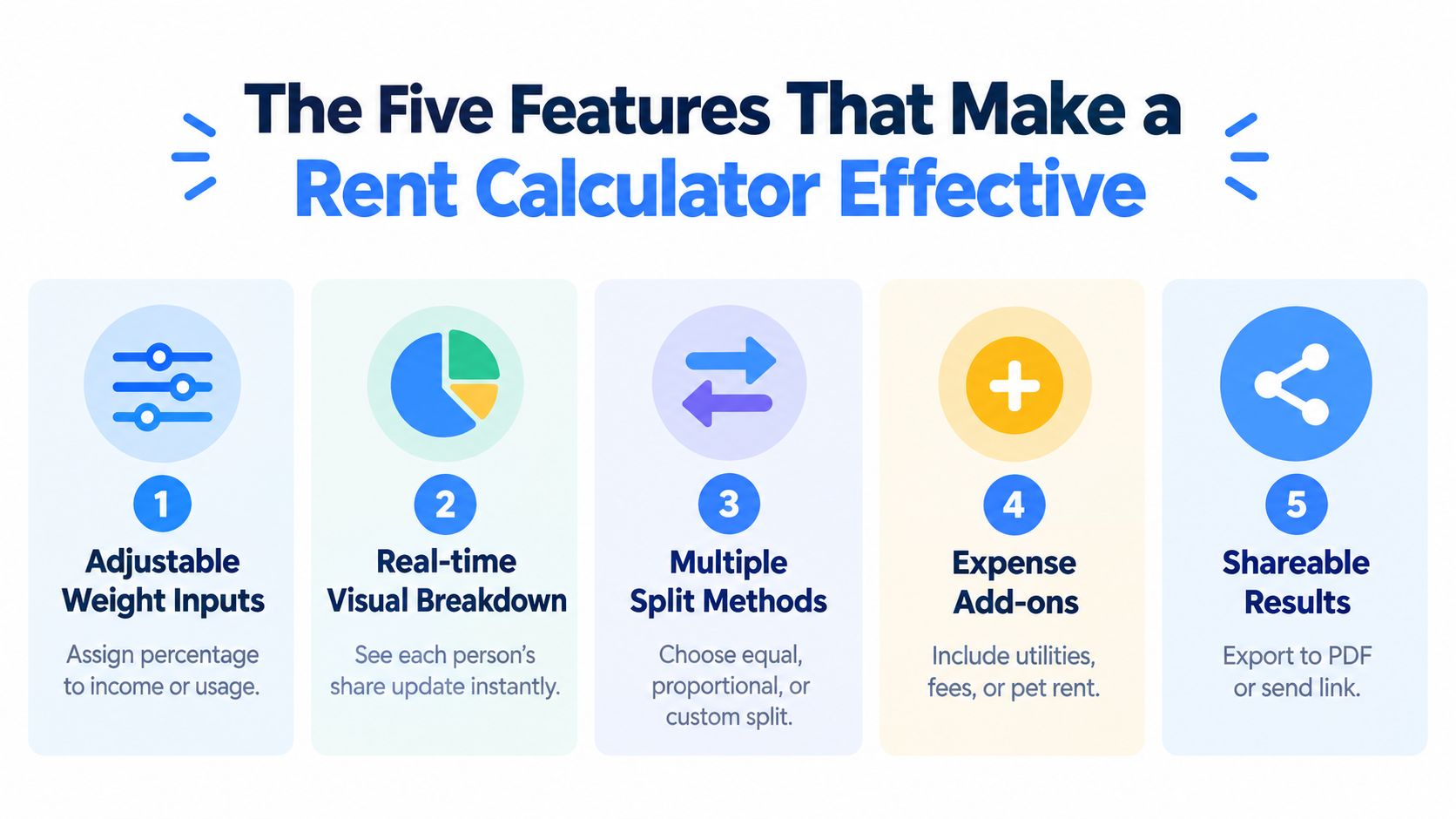
Normalized totals
Rounding can create a small but irritating gap. A reliable calculator normalizes the results so shares total exactly 100 percent and the dollar amounts allocate the full rent, with no unassigned remainder.
Visible reasoning
Every roommate should be able to see the rent total, each input, the selected method, the weights, and the resulting share. A black-box answer invites suspicion. A visible calculation gives people something concrete to question, such as whether a closet should count as an amenity or whether gross income is the right income measure.
A record everyone can keep
A shareable link, downloadable report, or PDF turns a conversation into a reference point. That record becomes useful when someone forgets the agreed method or when a new roommate replaces an old one.
For additional practical context, review this guide on using a rent calculator effectively. You can also compare the calculator approach with a broader cost-sharing app workflow when rent sits alongside utilities, subscriptions, and shared purchases.
Choosing the Fairest Split Method for Your Household
The right method depends on what the household is trying to equalize. An equal split equalizes dollars. An income-weighted split adjusts for ability to pay. A room-size-weighted split charges more for private space that offers more value.
Consider $2,400 in monthly rent shared by Roommate A and Roommate B. If the rooms are comparable and incomes are similar, an equal split produces $1,200 each. That answer is simple and may be perfectly fair for a short-term arrangement with matched expectations.
If Roommate A earns twice as much as Roommate B and both people agree that contributions should track income, an income-weighted model assigns shares according to their agreed income ratio. The exact result depends on the incomes entered, but the principle is clear: the higher earner pays a larger portion rather than automatically paying half.
A room-size model works differently. If Roommate A chooses the larger bedroom with a private bathroom, A pays more because A receives more private value. Roommate B pays the remainder. The group must decide how much the size difference and amenities matter, rather than assuming square footage alone captures everything.
| Method | Best For | Worked Example, Roommate A / B at $2,400 |
|---|---|---|
| Equal split | Similar incomes and comparable rooms | $1,200 / $1,200 |
| Income-weighted | Partners or roommates with materially different incomes | Each person's share follows the agreed income ratio |
| Room-size-weighted | Bedrooms with clear differences in space or amenities | The larger or better-equipped room receives the higher share |
| Blended split | Households balancing affordability and private-space value | One agreed portion follows income, another follows room factors |
A hybrid method can be more realistic. For example, roommates might assign one agreed weight to income and another to room size, then combine the two results. Tools described in how to divide bills based on income can help frame that discussion, but the people sharing the home still need to choose the weights.
One roommate may also use a common area more heavily, work from home, or supply furniture for a shared room. Those issues may justify a custom adjustment, but switching methods halfway through a lease can create more relationship damage than it solves. Set a review date, document the method, and change it only through a clear group decision.
How to Use Divvy's Rent Split Calculator Step by Step
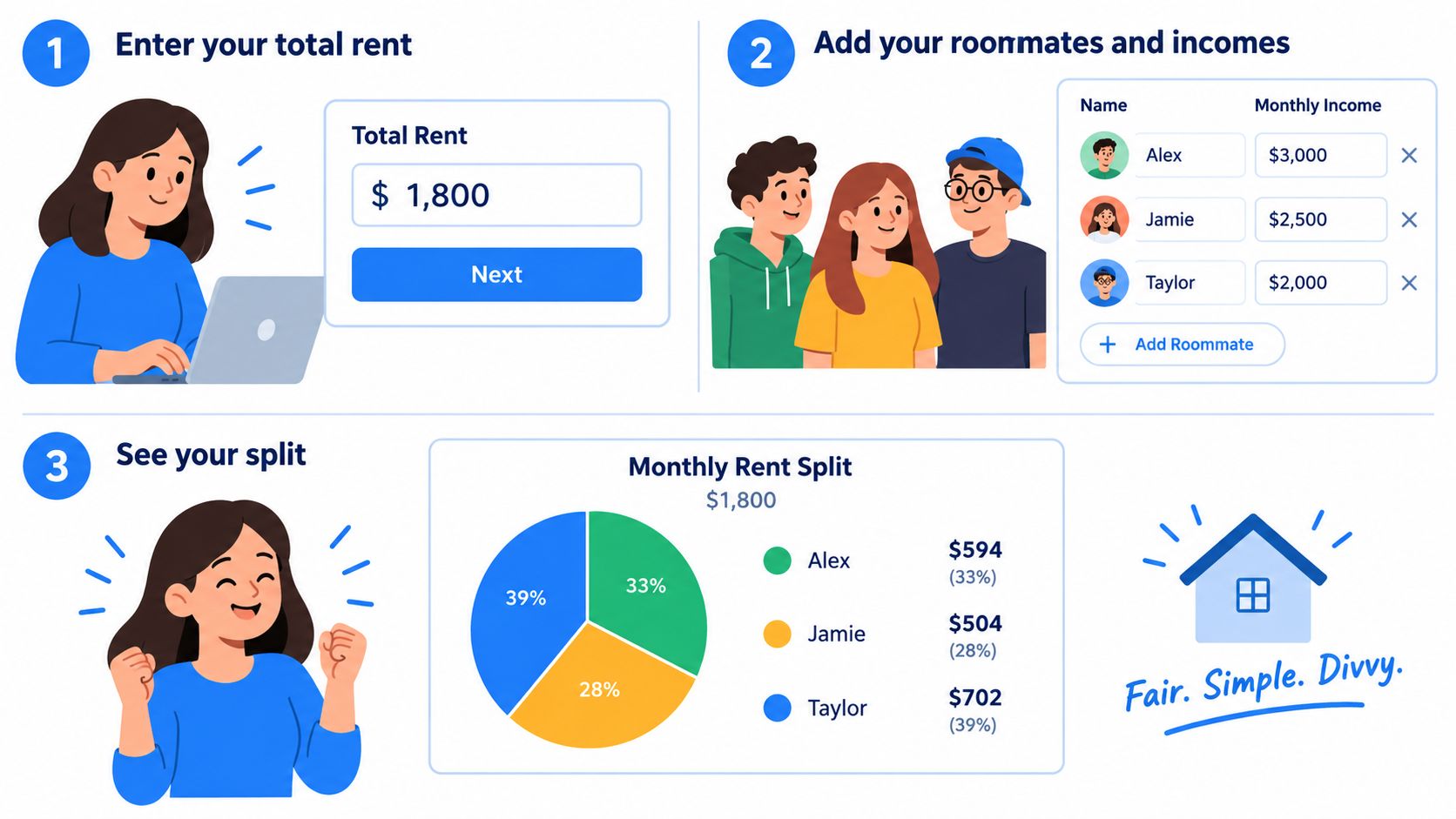
Start with the full monthly rent, not the amount one roommate hopes to pay. Enter the total that the household needs to cover, then add each roommate's name so the output has a clear owner for every share.
Next, enter each person's monthly gross income if you're considering an income-weighted split. Use the same definition for everyone. Mixing take-home pay for one roommate with gross pay for another will make the result look precise while comparing different inputs.
If room size matters, add each bedroom's square footage. Include relevant differences in the discussion, such as an en-suite bathroom or a walk-in closet. Square footage can provide a useful baseline, but it doesn't automatically measure every amenity.
Select a method and inspect the result
Choose whether the split should use income, room size, or a blended approach. If the household hasn't agreed on that choice, stop before generating a final number. The tool can calculate a model, but it can't tell you whether the model reflects your agreement.
The result should show each roommate's percentage and dollar share. Read both outputs. The percentage explains the logic, while the dollar figure tells everyone what to transfer or budget.
You can use the Divvy Rent Split Calculator as one option for producing that table. Afterward, check that the amounts sum to the full rent total and that the same rent figure was used for every roommate. Consistent inputs prevent rounding gaps and accidental under-allocation.
Save the agreement
Income and housing arrangements change. Update the calculator when a roommate's income changes, when someone moves into a different room, or when the household adds a material amenity. Save or screenshot the agreed output and attach it to a short roommate agreement covering due dates, utilities, deposits, and move-out changes.
Divvy Versus a Spreadsheet for Rent Sharing
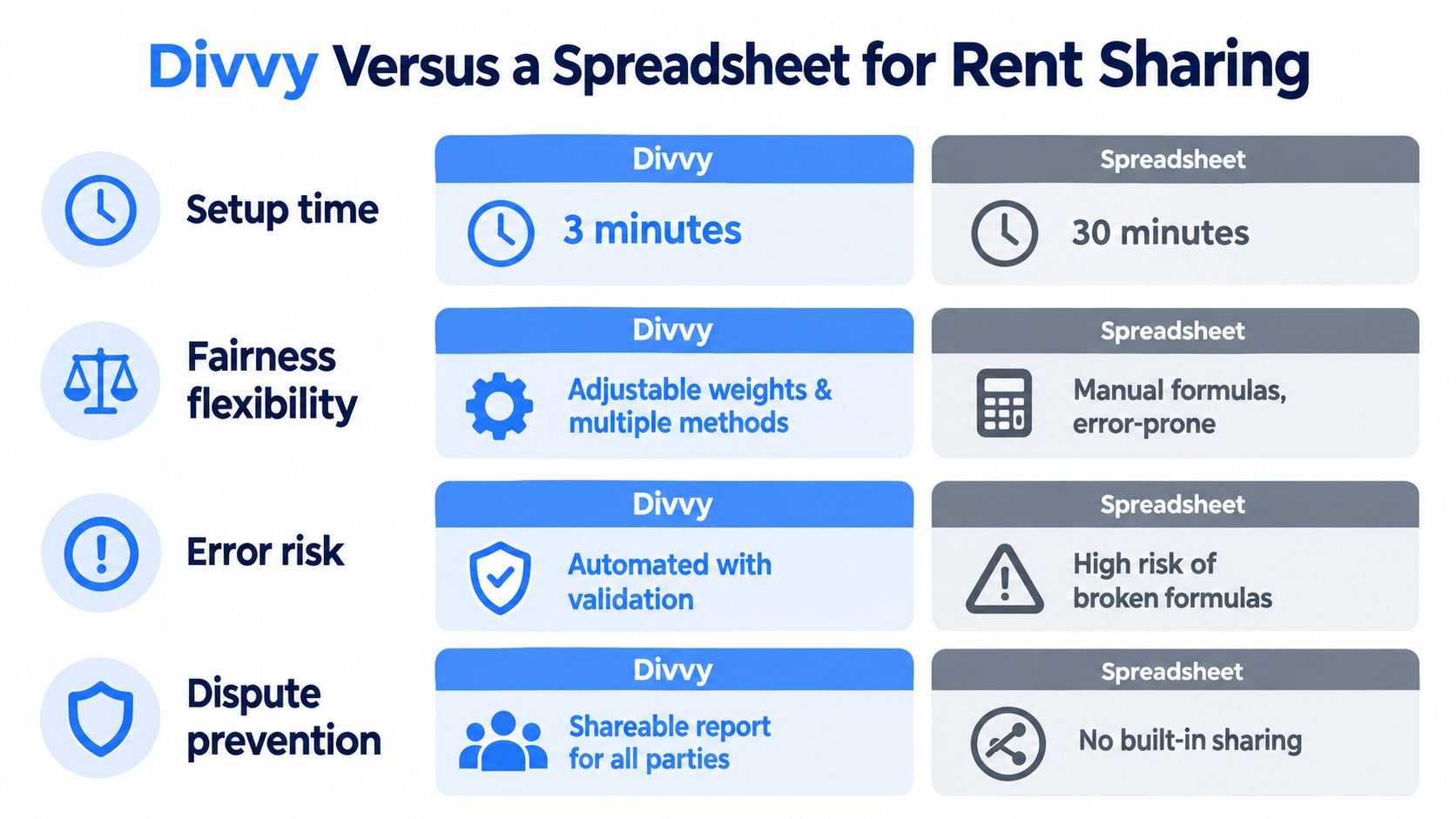
A spreadsheet gives you control. You can build separate tabs for base rent, utilities, subscriptions, deposits, furniture, and one-time charges. Someone comfortable with formulas can also create custom deductions for a shared office, a parking spot, or a roommate who travels frequently.
That flexibility creates a responsibility. Every formula must be correct, every cell must be updated, and everyone must understand which version is final. A broken reference or an old income figure can change the result without making the error obvious.
Choose based on the household
A calculator is usually the easier starting point for new roommates who need a neutral result quickly. It also suits blended households that want adjustable income and room-size inputs without designing formulas from scratch.
A spreadsheet may be preferable for property managers, larger shared houses, or households tracking many categories beyond rent. It can preserve a detailed audit trail, especially when one person is responsible for maintaining the file.
| Criterion | Calculator | Spreadsheet |
|---|---|---|
| Setup | Guided inputs and a ready result | Manual structure and formulas |
| Flexibility | Built-in split methods and weights | Broad customization if formulas are maintained |
| Error control | Validation and normalization may be built in | Depends on the creator's checks |
| Dispute prevention | Easy to share a consistent output | Transparent when everyone sees the same file |
| Best fit | Roommates deciding base-rent shares | Detailed household accounting |
A practical compromise often works well. Use a calculator for the base-rent decision, then use a spreadsheet for utilities and irregular expenses. That separation keeps the central fairness question understandable while preserving the spreadsheet's flexibility for costs that don't fit a simple rent model.
The key is shared visibility. Whether the result lives in a tool or a workbook, every roommate should be able to inspect the inputs and keep a copy of the agreed version.
Common Mistakes That Undermine Even a Good Calculator
A correct formula can still produce a poor household outcome. The most common problems happen before or after the calculation.
- Leaving out household costs: Add utilities, shared subscriptions, parking, pet rent, and other recurring charges as separate lines. Base rent and total housing cost aren't always the same thing.
- Treating partial months as full months: If someone moves in or out during a month, agree on a daily proration method before assigning that month's amount.
- Skipping a written agreement: Put the method, due date, deposit treatment, late-payment process, and move-out rule in a short document. A calculator result isn't a substitute for shared terms.
- Choosing the method after seeing the answer: Decide whether the household values equal contributions, income capacity, room value, or a blend before running the numbers. Otherwise, people may select the method that produces the lowest personal share.
- Using stale inputs: Update income, room assignments, and amenity information when circumstances change. A quarterly review provides a predictable opportunity to check the assumptions.
Partial move-ins deserve special care because a rent calculator may assume a complete billing period. The household must decide whether the departing roommate, arriving roommate, or both share responsibility for overlapping days and whether utilities follow the same rule.
A calculator can verify arithmetic. It can't verify consent.
That distinction prevents a common misunderstanding. Tool accuracy and outcome fairness are separate tests. The first asks whether the formula was applied correctly. The second asks whether everyone agreed that the inputs and method represented the household.
Building a Rent Sharing Habit That Actually Lasts
Fair rent sharing works better as a routine than as a dramatic annual negotiation. Before the next payment is due, each roommate can run a short check:
- Confirm the inputs: Review income, room assignment, square footage, and agreed amenities.
- Itemize extras: List utilities, subscriptions, parking, pet charges, and other shared costs separately.
- Confirm the method: Keep the income-weighted, room-size-weighted, equal, or blended method in writing.
- Run the calculation: Use the agreed calculator or spreadsheet and check that the shares equal the full rent.
- Save the output: Keep the result with the roommate agreement so everyone has the same reference.
- Schedule a review: Revisit the arrangement after a defined period, such as a 90-day review, rather than reopening the debate during a stressful payment week.
The review shouldn't automatically change anyone's share. Its purpose is to ask whether the rooms, incomes, expenses, and expectations still match the original agreement. A roommate who receives a raise may not want income to determine the split anymore, while another roommate may have taken over a private amenity or common workspace.
The most stable households separate calculation from negotiation. They discuss values first, enter consistent data second, and preserve the result third. That simple sequence prevents the recurring awkwardness of guessing who is subsidizing whom.
Income and room size are useful settings to revisit because they address different kinds of fairness. One reflects ability to contribute, while the other reflects private housing value. If the household agrees to combine them, write down the weights and keep them unchanged until the next review.
An effective rent calculator becomes useful when it supports that habit. The number is only the beginning. The agreement, update routine, and shared record are what make the split livable.
Divvy offers a Rent Split Calculator for dividing household rent evenly, by income, or by room size, along with bill-splitting tools for itemized shared expenses. Visit Divvy to create a transparent starting point for your next roommate rent discussion and keep the resulting shares easy to review.