Divvy
DivvyHow to Split Rent with a Couple: A Fair Guide
By The Divvy Team · September 7, 2026 · 15 min read
You've found a home that works on paper: a spare bedroom, manageable rent, and a friend whose partner is moving in too. Then the lease conversation turns awkward. Do you charge the couple twice as much because there are two people, or split by bedroom because there are only two rooms? What happens when one person earns much more, one bedroom has a private bathroom, or the couple uses the kitchen and living room more often?
There isn't one formula that settles every household. How to split rent with a couple depends on headcount, private space, income, amenities, and the values everyone brings to the conversation. The strongest arrangements make those assumptions visible before anyone unpacks a box.
Table of Contents
- The Awkward Money Talk Before You Unpack
- Four Common Methods for Splitting the Rent
- Putting the Methods into Practice with Real Numbers
- How to Choose the Right Method for Your Household
- Beyond the Math, Tips for a Peaceful Household
- Finding a Fair Split That Works for Everyone
The Awkward Money Talk Before You Unpack
A common version of this situation starts innocently. Alex agrees to share a two-bedroom apartment with Ben, then learns that Ben's partner, Chloe, will be living there too. Everyone likes each other, and nobody wants to sound petty. Alex suggests splitting rent in half, Ben says that seems reasonable, and Chloe wonders whether two people using one bedroom should pay more than one person using the other.
That silence is where future resentment begins. Rent reflects more than bedrooms. It also pays for access to the kitchen, bathroom, lounge, storage, parking, laundry, internet, and the general wear that comes with another resident. At the same time, charging a couple the full per-person amount can feel excessive if they share one bedroom and use less private space than two separate roommates.

Equal contributions and fair contributions aren't always the same thing. A 2023 survey reported that half of couples don't split mortgage or rent equally, while 37% felt their relationship was financially unequal. That finding, reported by CNBC's coverage of fair cost-sharing in relationships, matters in shared housing too. Even the couple may already be negotiating how they divide their portion.
Start with questions, not a proposed percentage:
- Who has exclusive control of which space? Identify bedrooms, bathrooms, closets, balconies, offices, and storage.
- Who uses shared areas, and how often? A couple working from home may occupy the living room differently from two people who are rarely there.
- What does fairness mean here? Some households value equal dollars, others value equal financial effort, and others value payment for the space used.
- What changes the agreement? Discuss guests, a partner moving out, a job loss, a new home office, or a bedroom swap.
Put the arrangement beside the lease, utility setup, and renter responsibilities. If you're still organizing household paperwork, a practical Mai & Associates guide for California renters can help you think through renter-related protections alongside the money conversation. The aim isn't to win a negotiation. It's to make sure everyone understands what they're paying for before the first due date arrives.
Four Common Methods for Splitting the Rent
The right model depends on what you're trying to equalize. Per-person splitting equalizes occupancy. Per-bedroom splitting equalizes private space. Income-proportional splitting equalizes financial effort. A hybrid model recognizes that a home contains both private and shared value.
Per-person splitting
Add every resident, divide the rent by the total number of people, and assign each person one share. The couple pays two shares, while the single roommate pays one.
This method is easy to explain and easy to administer. It works best when everyone has similar access to the home, similar incomes, and comparable expectations about shared facilities. It can also be sensible when the apartment has limited common space or when utilities are bundled into rent.
The drawback is that it can overcharge or undercharge people based on private-space differences. A couple sharing one modest bedroom may feel they're paying for occupancy twice while receiving one bedroom. A single roommate with the larger bedroom and private bathroom may receive more exclusive value without a corresponding premium.
Per-bedroom splitting
Divide rent according to bedrooms rather than residents. Each bedroom receives a portion of the total, and the couple divides its bedroom share between them privately.
This model recognizes that a bedroom is often the most valuable private asset in the home. It's straightforward when rooms are similar and the couple occupies one room. It becomes less convincing when one bedroom is much larger, includes an ensuite, or has a balcony.
Bedroom splitting also leaves shared-space usage unresolved. Two people still use the kitchen, lounge, hallways, and possibly the only bathroom. You'll need a separate agreement for utilities and household purchases.
Income-proportional splitting
Calculate each person's share based on income, then apply those proportions to rent. The method treats housing as a shared obligation while recognizing that the same dollar amount can create very different pressure for different earners.
Housing policy commonly treats renters as cost-burdened when housing costs exceed 30% of income. In 2023, 22.6 million U.S. renter households, or 49.5% of renter households, met that definition, while 12.1 million were severely cost-burdened because they spent more than 50% of income on housing, according to the Harvard Joint Center for Housing Studies rental affordability report. Those figures support using income as a risk check, not as an automatic answer.
Income-based rent can protect a lower earner from being stretched beyond a sustainable budget. It can also feel intrusive if roommates don't want to disclose salaries, or unfair if one person chose a more expensive home that another person couldn't comfortably afford. Agree in advance whether you'll use gross income, take-home pay, or a private income band.
For a worked approach to this calculation, use this income-based bill division guide as a planning reference.
The hybrid model
A hybrid split separates the home into private-space value and shared-space value. Price bedrooms and exclusive amenities first, then divide common areas according to an agreed rule, often equally or by resident count.
This is usually the most defensible option when the apartment has meaningful differences. It lets a couple receive recognition for sharing one bedroom while still contributing for two people's access to common facilities. It also gives roommates a way to account for an ensuite, home office, balcony, larger closet, or better natural light without pretending every room has identical value.
The model takes more discussion, but that work pays off. Write down the assumptions, the calculation, and the review point. A spreadsheet is enough. The formula matters less than whether everyone can explain why it produces a fair result.
| Method | How It Works | Pros | Cons |
|---|---|---|---|
| Per-person | Divide rent by the number of residents | Simple and recognizes shared occupancy | Can ignore bedroom and amenity differences |
| Per-bedroom | Assign rent by bedroom, then divide the couple's share | Reflects private sleeping space | May undercount common-space use |
| Income-proportional | Allocate rent according to agreed income proportions | Reduces strain from unequal earnings | Requires financial transparency and agreement |
| Hybrid | Price private space, then divide shared space separately | Handles couples, room differences, and amenities | Requires more calculation and documentation |
Putting the Methods into Practice with Real Numbers
Use one consistent example to see how sharply the outcomes can differ. The apartment costs $3,000 per month, has two bedrooms and two bathrooms, and houses Alex, who lives alone, plus Ben and Chloe, who share one bedroom.
Per-person calculation
There are three residents. Divide $3,000 by three, producing $1,000 per person. Alex pays one share, while Ben and Chloe pay two shares together.
Result: Alex pays $1,000. Ben and Chloe pay $2,000 together, or $1,000 each.
This is clean, but it assumes each person receives similar value from the apartment. If Alex has the larger bedroom or private bathroom, the simplicity may conceal an imbalance.
Per-bedroom calculation
Assign one-half of the rent to each bedroom. Each bedroom therefore carries $1,500. Alex pays the full amount for the single-occupant room, while Ben and Chloe divide the couple's room share between themselves.
Result: Alex pays $1,500. Ben and Chloe pay $1,500 together, or $750 each.
This outcome may feel attractive to the couple, but it assumes both bedrooms have comparable value and that two residents create no extra pressure on common facilities.
A free rent calculator can help you compare alternative assumptions without rebuilding the arithmetic each time.
Income-proportional calculation
Suppose the household agrees to an illustrative income allocation of 40% for Alex and 60% for Ben and Chloe as a household. Apply those proportions to $3,000.
Result: Alex pays $1,200. Ben and Chloe pay $1,800 together.
The couple must still decide how to divide its $1,800. They might split it equally, or one partner might contribute more based on their private agreement. This method protects the lower-earning household member, but it doesn't account for bedroom size or amenity value on its own.
Hybrid calculation
Assign half the rent to private bedrooms and half to common space. The private-space bucket is $1,500, so each bedroom starts with $750. The shared-space bucket is $1,500, divided among three residents at $500 each.
Result: Alex pays $1,250. Ben and Chloe pay $1,750 together, or $875 each if they divide their share equally.
The hybrid method is strongest when the bedrooms differ or when the couple shares one room but contributes as two people to common areas. Experts commonly recommend this two-bucket model, valuing private space by area or amenities and then dividing common space evenly, as described in this expert guide to splitting rent with roommates.
The numbers are not a verdict. They're negotiation tools. If Alex has the ensuite, increase Alex's private-space share. If Ben and Chloe have the smaller room, reduce their private-space burden. Make the adjustment visible rather than arguing over an unexplained percentage.
How to Choose the Right Method for Your Household
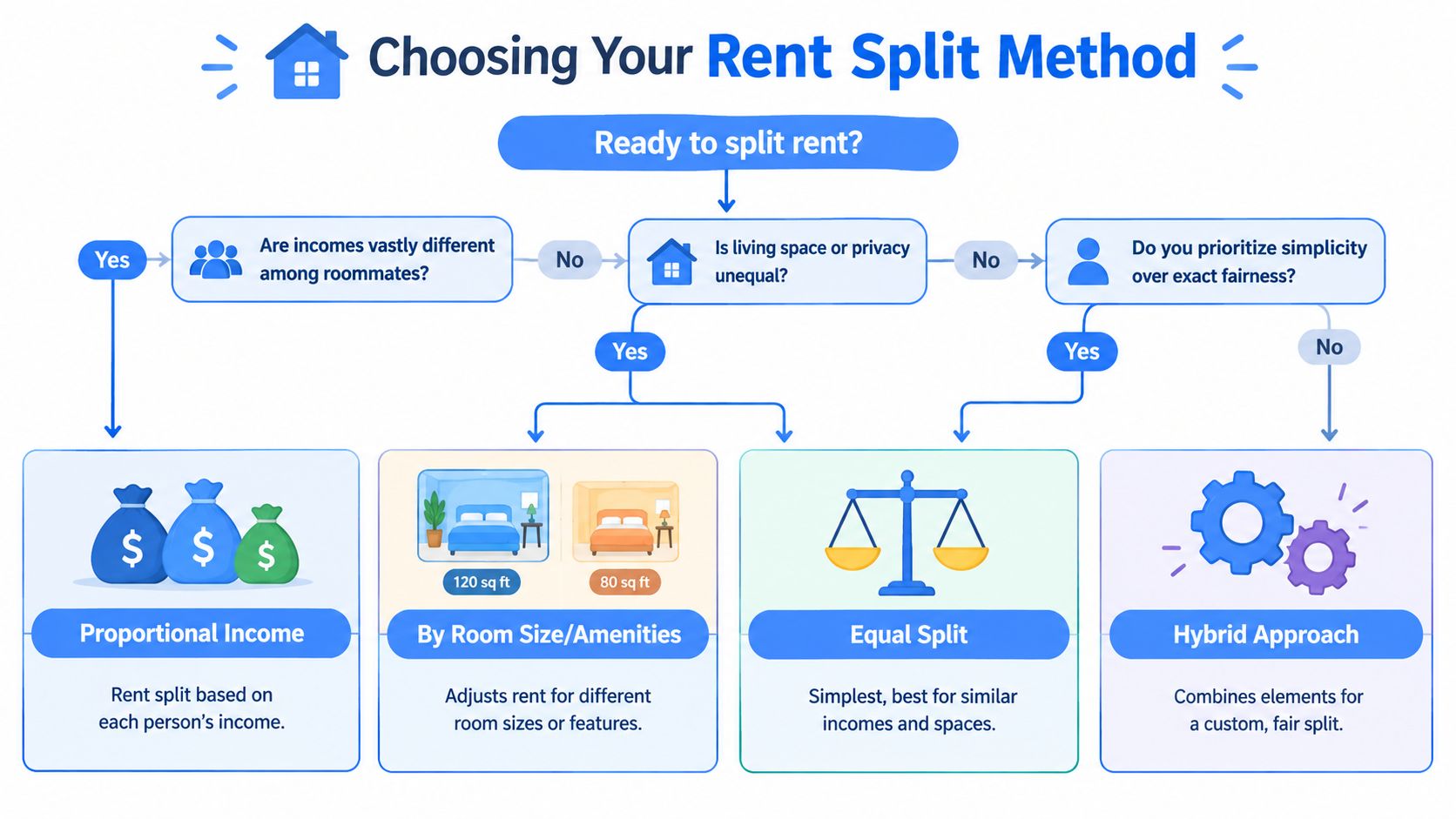
The fairest formula depends on what each resident receives and what each resident can reasonably pay. Similar rooms and incomes may justify a simple split. A larger bedroom, private bathroom, balcony, or dedicated work area can make an equal share feel unfair to the person who does not use it.
Start the discussion before anyone unpacks. Compare three areas:
- Private space. Measure bedrooms, check bathroom access, and list meaningful features such as closets, windows, balconies, and offices.
- Shared access. Count the regular users of the kitchen, lounge, laundry, parking, and storage. A couple may occupy one bedroom but still use common facilities as two people.
- Financial capacity. Ask whether the proposed payment would create unreasonable pressure. Share only the financial information needed to make a workable decision.
When equal splitting works
A per-person split suits households with similar incomes, comparable rooms, and a shared preference for low-maintenance arrangements. It also fits a household that treats rent mainly as payment for occupancy, rather than as a precise price for private square footage.
A per-bedroom split can work for a couple and a single roommate if the bedrooms are similar and common-area use feels balanced. Agree separately on utilities, guests, and whether a second bathroom is private or shared. Those details can change whether the headline rent split still feels fair.
When proportional splitting is safer
Income-proportional rent makes sense when equal payments would leave one person struggling while another has substantial room in their budget. Housing affordability research has found that married couples without children can face a lower housing burden than other renter household types, showing why household structure and earning capacity may affect flexibility, as reported in this Harvard rental affordability research.
Use that finding as context, not as a rule for your home. Debt, savings, transportation costs, caregiving, and job stability may matter more than relationship status. The aim is a payment each person can sustain without turning private finances into a test.
When hybrid is the honest compromise
Choose a hybrid method when privacy value is unequal. One common arrangement has the couple paying more than a singleton, but less than two separate roommates, with examples around 55/45 or 60/40, depending on the space and agreement, as discussed in this guide to sharing rent with a couple.
Treat these ratios as starting points. Have each resident explain what the payment covers, then review the result against bedroom value, shared access, income, and household responsibilities. A short review after living together can catch problems before frustration becomes an argument.
Beyond the Math, Tips for a Peaceful Household
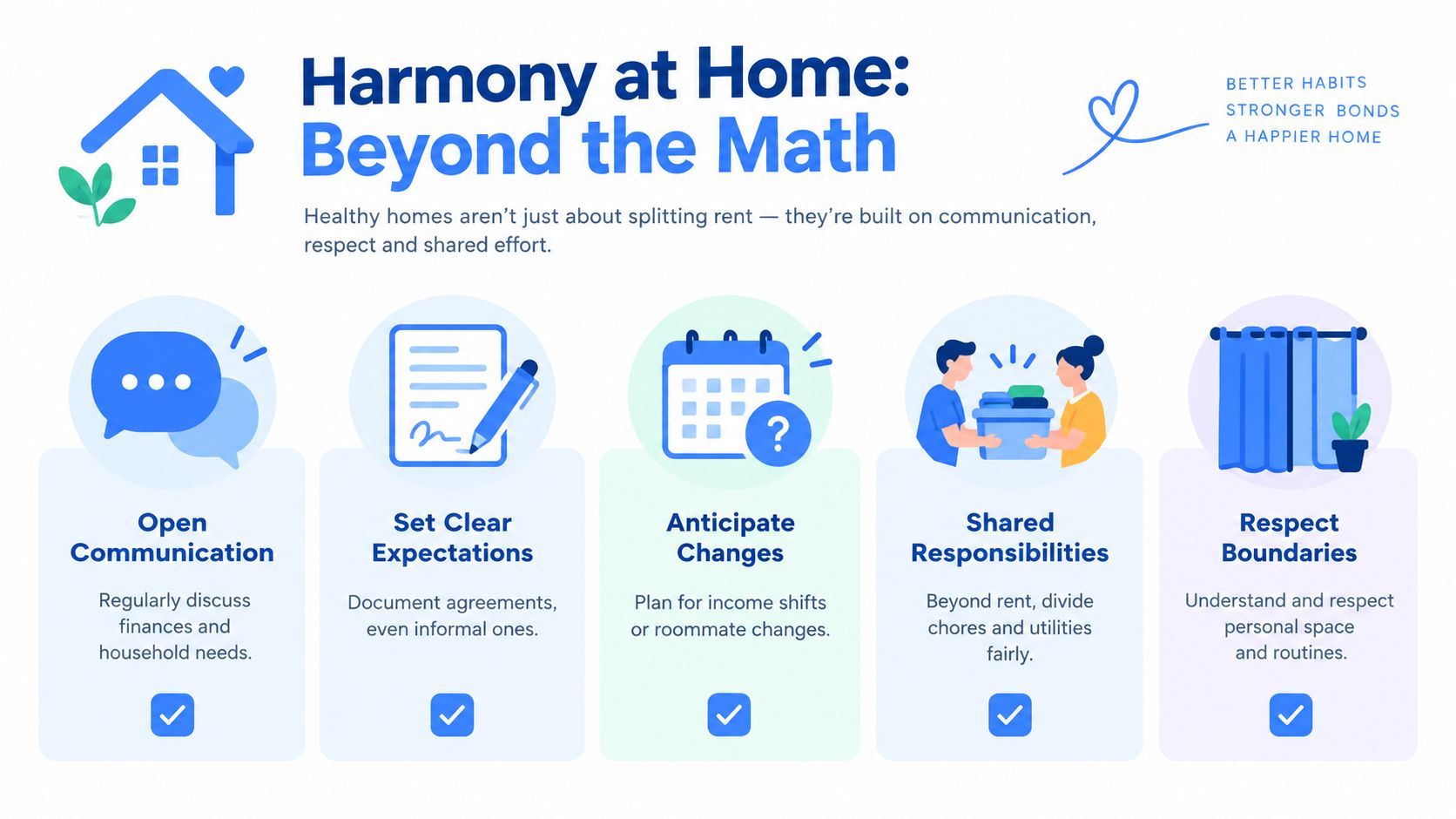
A rent formula can be mathematically consistent and still produce daily frustration. The household needs operating rules for payment timing, guests, noise, chores, groceries, utilities, repairs, and what happens if someone leaves.
Put the agreement in writing before move-in. A shared email or document should state each person's monthly rent, the due date, the payment recipient, the utility method, the treatment of one-off purchases, and the process for changing the arrangement. Written clarity isn't hostile. It gives friends something neutral to consult when memories differ.
Separate rent from variable costs
Rent is usually stable, but utilities and household spending fluctuate. Decide whether electricity, water, internet, and shared subscriptions are divided per person, by usage, or according to the same rent ratio. For a practical framework, use this guide to split utility bills with housemates.
Groceries need their own rule. Some households buy shared staples and keep personal food separate. Others use a rotating shopping list. Don't assume that a couple's shared grocery habits automatically include the single roommate, or that the single roommate should subsidize meals they don't eat.
Plan for changes before they happen
Agree on what happens if the couple separates, one partner moves out, someone loses income, or a roommate takes over a home office. Decide whether the rent is recalculated immediately, after notice, or at a scheduled review. Also clarify who remains responsible to the landlord, because an informal household agreement doesn't necessarily change the lease.
Keep receipts, lease documents, utility records, and the written split in one accessible place. A simple digital filing approach, similar to the organization described in these Standby Self Storage household file recommendations, can prevent a payment dispute from becoming a search through old messages.
Protect the relationship with regular check-ins
Schedule a calm review after everyone has lived together long enough to understand the routine, then revisit the arrangement whenever space, income, or household composition changes. The point isn't to renegotiate constantly. It's to catch a small mismatch before it becomes a personal accusation.
A strict 50/50 arrangement can create hidden strain when incomes differ, which is why financial guidance increasingly frames rent discussions as risk management, not just arithmetic. The Experian guidance on splitting rent with a partner supports considering income-based or hybrid arrangements when equal payments would make one person disproportionately vulnerable.
Finding a Fair Split That Works for Everyone
A fair split connects payment with space, use, and ability to pay. Per-person sharing reflects occupancy, per-bedroom sharing reflects private space, and income-proportional sharing reflects financial capacity. A hybrid approach can balance these factors when rooms, amenities, or incomes differ.
The formula matters less than the conversation behind it. Explain the assumptions, ask what feels unfair, and agree on how to handle changes before anyone moves in. Put the decision in writing, including who pays for shared areas and how you will review the arrangement. A short, honest discussion now can prevent months of quiet resentment.
Equal payments are not always equitable payments. The strongest agreement is one everyone can explain, afford, and accept. Treat rent as a household negotiation, not a friendship test.
Divvy lets roommates compare rent splits by income, room size, or an even arrangement. Its iPhone app can itemize shared bills and send payment requests through familiar payment services. Visit Divvy to explore its rent calculator and organize shared household costs before the next payment is due.