Divvy
DivvyDepreciation Calculator for Furniture Guide
By The Divvy Team · September 20, 2026 · 17 min read
A lot of furniture arguments start the same way. One roommate is moving out, someone else wants to keep the sofa, and suddenly the conversation turns into a debate about what “fair” means. One person points to the original receipt. Another points to a few scratches, flattened cushions, or the fact that nobody would pay close to retail for a used sectional picked up from a third-floor walk-up.
That's where a depreciation calculator for furniture stops the conversation from drifting into feelings and selective memory. It gives you a repeatable way to estimate current value, whether you're dividing a shared apartment, winding down a small office, or sorting out who should reimburse whom for household pieces everyone used.
Table of Contents
- Why Furniture Valuation Causes Group Disputes
- Core Inputs for Accurate Furniture Depreciation
- Choosing the Right Calculation Method
- Running the Numbers on a Shared Living Room Set
- Dividing the Value and Settling the Bill
- Tax Rules and Common Valuation Mistakes
Why Furniture Valuation Causes Group Disputes
A roommate moves out on Saturday. By Sunday, the argument is no longer about the sofa. It is about whose number counts.
The receipt feels concrete, so people reach for it first. That usually makes the buyout too high for the people keeping the furniture. A quick scan of Facebook Marketplace or Craigslist creates a different problem. Asking prices are easy to cherry-pick, and they rarely reflect what used furniture sells for after haggling, pickup hassles, and visible wear.
Why receipts don't settle the argument
Shared furniture sits in an awkward space between accounting logic and lived reality. On paper, the group has an original cost. In real life, the item has been used by multiple people, dragged through moves, exposed to spills, and judged by whatever a local buyer is willing to pay this week.
Take a shared sofa. Three roommates split the cost when they moved in. Two years later, one person leaves and wants to be bought out. If the group uses the original receipt, the payout ignores two years of wear. If the group uses the highest resale listing anyone can find, the payout rests on an asking price, not a completed sale.
Neither number is neutral. Each one favors a different person.
Practical rule: Purchase price is evidence of what the item cost. It is not evidence of what another roommate should pay today.
This is why valuation disputes drag on. Tax-style depreciation gives people a structured starting point, but household settlements are messier than a fixed asset schedule. A landlord does not care who vacuumed the sectional. A roommate leaving the apartment often does.
Book value and resale reality pull in different directions
Most group fights over furniture mix up two separate questions:
- What is the remaining value under a consistent depreciation method?
- What would this item likely sell for in its current condition?
Those answers are often close, but they are not identical. A straight-line calculation may produce a clean book value, while the market discounts a piece because of stains, sagging cushions, missing hardware, or the simple fact that bulky furniture is hard to move. The reverse happens too. A well-kept solid wood table can hold up better in the resale market than a simple schedule would suggest.
That gap matters. Small business owners run into it when closing a shared office. Roommates run into it when one person keeps the furniture and the others want cash. In both cases, the cleanest settlement usually starts with a depreciation method and then adjusts, if needed, for obvious condition issues.
Why groups need a tiebreaker
Furniture disputes get personal fast because shared use blurs ownership. The person who found the item may feel attached to the original price. The person who maintained it may feel they added value. The person moving out usually wants a quick, defensible number. The people staying want to avoid overpaying for something that is already halfway through its useful life.
A calculator will not remove every disagreement. It does set a rule before personalities take over. That is usually the difference between a short settlement and a week of texts about a sofa nobody even wants that much anymore.
Core Inputs for Accurate Furniture Depreciation
A reliable depreciation result depends less on the calculator itself and more on the inputs you feed it. Garbage in, garbage out applies here.
Start with the cost basis
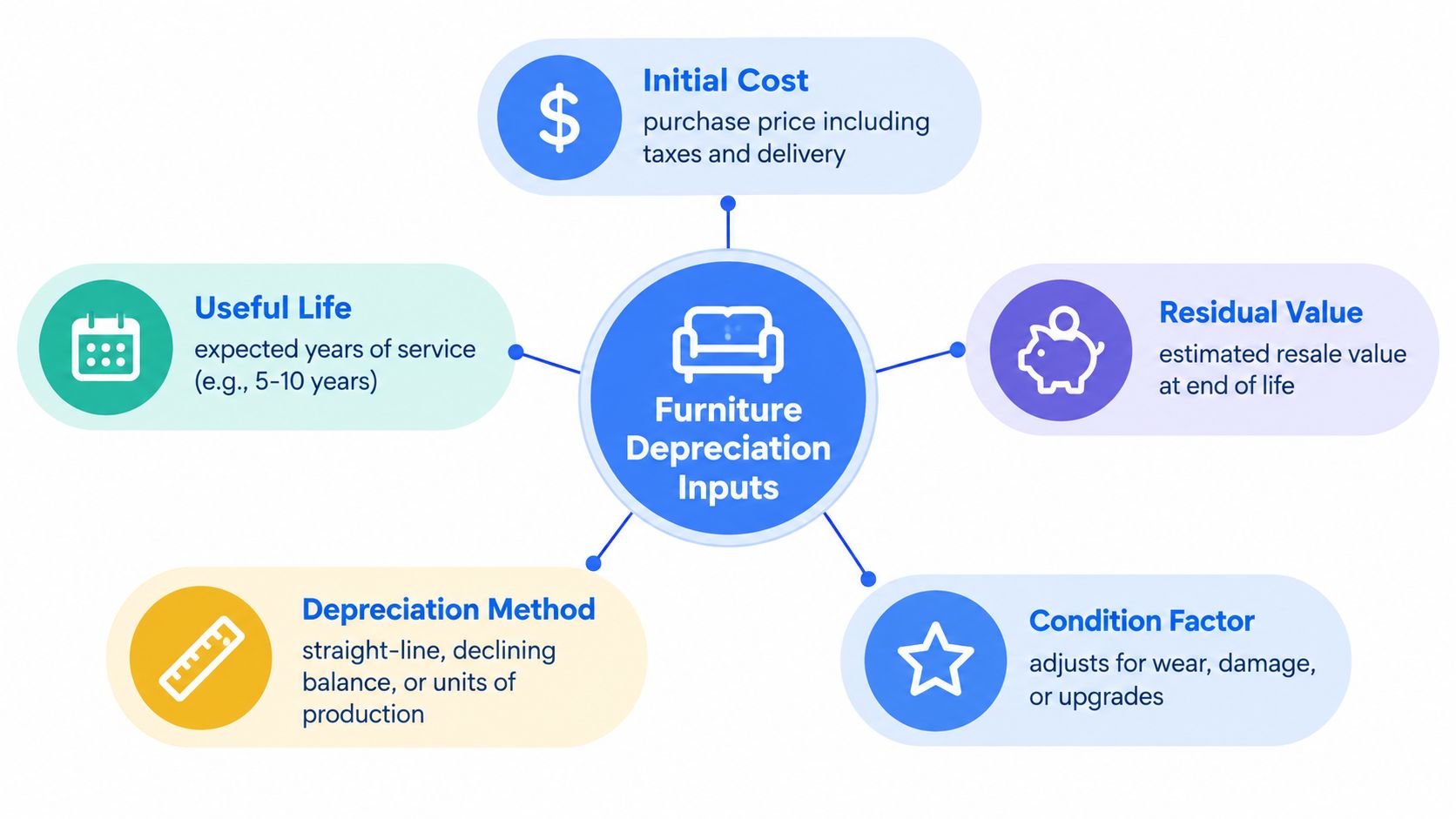
For practical use, the first number should reflect what it took to get the furniture into service. That usually means more than the sticker price. If you paid for delivery, assembly, or required setup, include those costs if they were part of acquiring the item.
Then gather the four inputs that matter most:
- Original cost: Use the receipt if you have it. If you don't, use the best documented reconstruction you can.
- Age: Count from when the furniture was placed in service, not when someone first thought about buying it.
- Useful life: Many calculators oversimplify.
- Salvage value: Estimate what the piece might still be worth at the end of its useful life.
Useful life isn't one-size-fits-all
For benchmark inputs, furniture is often modeled with a 7-year useful life under U.S. General Depreciation System assumptions, while other guidance uses 10 years for general fittings and furniture and about 8 years for furniture in schools, theaters, and similar facilities, as summarized in B&S Advisors' discussion of furniture, fixtures, equipment, and depreciation.
That same source also notes that salvage values around 5% to 15% of original cost are common benchmarks, and that real-world lifespans vary materially by build quality and use intensity. That last point matters a lot. A solid office credenza in a low-traffic room ages differently than a bargain coffee table used daily in a crowded student apartment.
A calculator helps only when the assumptions resemble the furniture sitting in front of you.
Condition changes the baseline
People trip up. They enter the cost, pick a life, hit calculate, and treat the output like a verdict. It isn't. The number is a baseline that still needs a condition check.
Use a short adjustment review before you settle on any value:
- Surface wear: Scratches, stains, fading, chipped veneer.
- Structural condition: Loose legs, sagging cushions, unstable frames.
- Cleanliness and repair status: Deep cleaning or pending repairs can change practical resale appeal.
- Category fit: A sofa, desk, and dining chair set don't age the same way.
- Use intensity: Guest-room furniture often holds up better than daily-use pieces.
One more wrinkle matters in the practical world. A practical used-furniture calculator notes that most furniture loses 20% to 30% of its value in the first year alone, then declines more slowly afterward, as described in Asherfield's used furniture value calculator. That first-year drop explains why a clean item can still be worth far less than a buyer expects.
Choosing the Right Calculation Method
Not every valuation problem calls for the same depreciation method. The right choice depends on whether you're trying to create a tax schedule, estimate a roommate buyout, or mirror resale behavior.
Straight-line for consistency
For most furniture disputes, straight-line depreciation is the cleanest default. It spreads the depreciable amount evenly across the useful life. That makes it easy to explain and easy to audit later if someone questions the math.
The IRS describes the straight-line workflow as: determine adjusted basis, subtract estimated salvage value, divide the remaining depreciable amount by useful life, then apply the relevant year-of-service convention and reduce basis by depreciation already allowed or allowable in later years, as outlined in IRS Publication 946.
Straight-line works well when the goal is fairness and clarity. Everyone can see the formula. Nobody has to guess what happened between years.
Declining balance for resale reality
Roommate disputes often happen because used furniture doesn't lose value evenly. It usually drops fast once it stops being “new,” then levels out. That's why some people prefer a declining balance approach for personal resale estimates.
This method is often better when you're trying to approximate what a buyer on a resale platform might offer, especially for heavily used items or trend-sensitive furniture. It's less useful when the group wants something simple enough to check on a shared note or spreadsheet.
Units of production for unusual cases
Most household furniture doesn't fit a usage-output model neatly. But some commercial or event-use furnishings do. If wear depends more on intensity of use than age, a usage-based approach can be sensible.
If you want a refresher on when that framework makes sense, Allied Tax Advisors has a helpful guide to units-of-production method that lays out the logic clearly.
For household groups, though, this is usually too complicated to be worth the effort.
Depreciation Methods Compared
| Method | Best Used For | Value Curve |
|---|---|---|
| Straight-line | Tax schedules, roommate buyouts, simple office records | Even decline over time |
| Declining balance | Resale estimates for used furniture with sharp early value loss | Faster drop early, slower later |
| Units of production | Furniture tied to measurable usage in specialized settings | Decline based on use rather than time |
If your real problem is the settlement itself rather than the depreciation math, a separate split expenses calculator can help once you've agreed on the value number.
Use straight-line when you need everyone to understand the math quickly. Use a faster-loss method when you need the number to resemble resale behavior.
Running the Numbers on a Shared Living Room Set
The easiest way to turn theory into something useful is to run one clean example. Assume a shared living room set cost $2,000 and was bought three years ago. One roommate is leaving, and the group needs a buyout number.
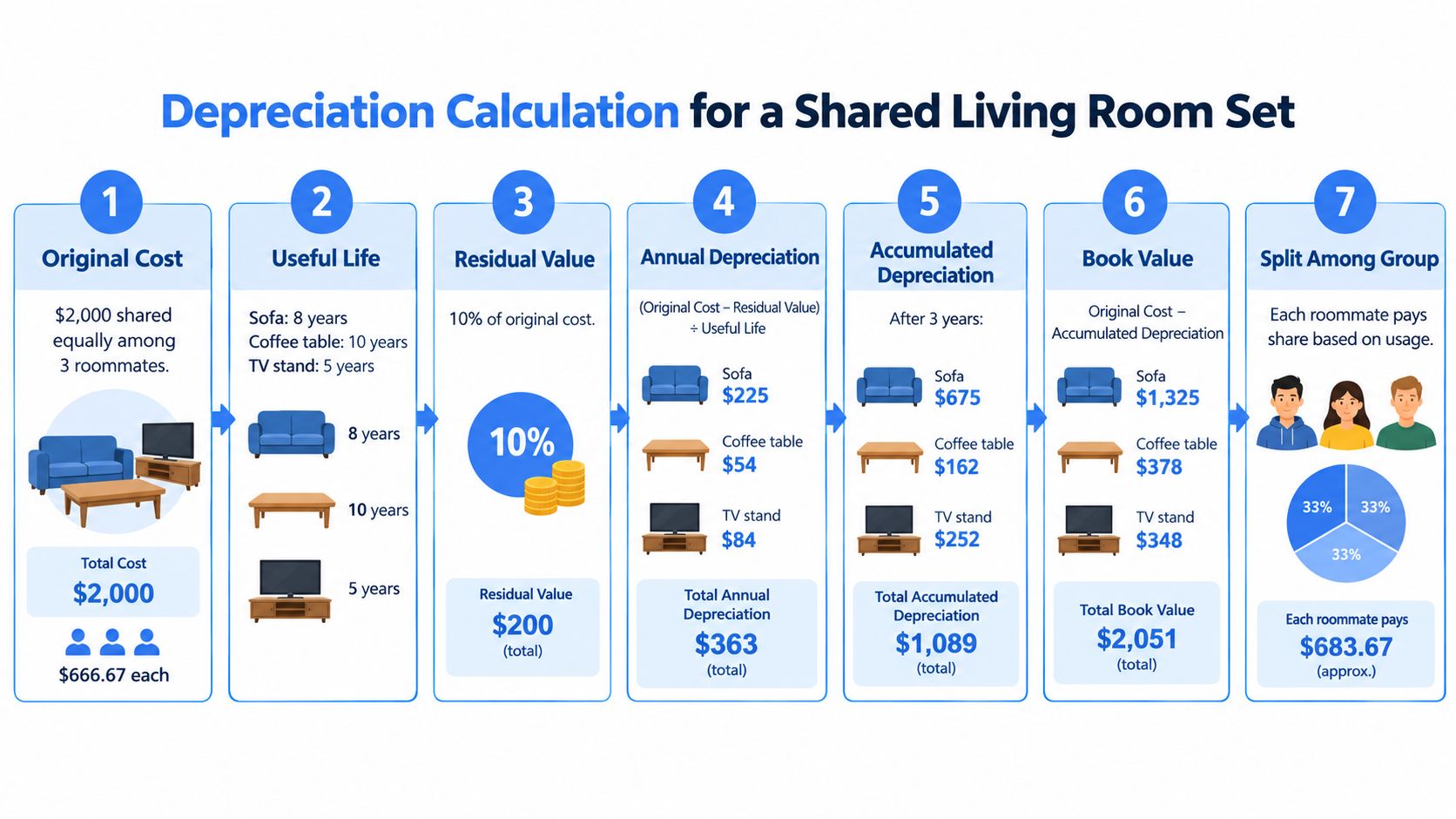
Use the straight-line framework
For a practical baseline, use the straight-line process:
- Start with original cost.
- Estimate salvage value.
- Subtract salvage value from cost to get the depreciable amount.
- Divide by useful life to get annual depreciation.
- Multiply annual depreciation by the number of years already used.
- Subtract accumulated depreciation from the original basis to get current book value.
Because the example infographic in this section includes assumptions for different items inside the set, you can treat the group in one of two ways. Either calculate each piece separately, or calculate the whole set using a common life if the group wants speed over precision.
A simple group-level example
Say the group agrees on these assumptions:
- Original cost: $2,000
- Estimated salvage value: 10% of original cost
- Useful life: a shared estimate based on how the set has been used
- Age today: 3 years
The straight-line formula is simple: subtract the salvage estimate from the original cost, then divide the remaining depreciable amount by the useful life. Once you have annual depreciation, multiply by three years to estimate accumulated depreciation.
That gives you a current book value to use as the starting point for a buyout.
The buyout number shouldn't be pulled from memory. It should come from a formula everyone agreed to before seeing the result.
When item-by-item is worth the hassle
If one roommate wants only the sofa and another wants the media console, item-level math is better than treating the room as one blob of value. Separate calculations prevent one person from overpaying for the premium piece while someone else walks off with the item that held value better.
That's also the point where settlement tools become more useful than a spreadsheet. If you need to divide the agreed values by item rather than by person, this guide on how to split a bill by item maps closely to the same logic you'd use for furniture buyouts.
A practical workflow looks like this:
- List each item separately: Sofa, coffee table, media console.
- Assign the agreed current value to each line: Don't lump them together if different people are keeping different pieces.
- Allocate ownership shares: Equal split if everyone paid equally, or weighted split if they didn't.
- Net the balances: The person keeping more value pays the others the difference.
This is also where accounting and reality can split. Book value may say one thing. Actual resale value may say another. For a private roommate settlement, I usually treat book value as the floor for discussion and then adjust for condition, convenience, and whether anyone wants to avoid the hassle of listing, storing, and moving the furniture.
Dividing the Value and Settling the Bill
Once the depreciation math is done, the social part starts. That's often harder than the formula.

Buyout versus sale
There are usually two practical paths.
The first is a buyout. One person keeps the furniture and pays the others based on the agreed current value and ownership shares. This is the cleanest option when the items are still useful and nobody wants to coordinate listings, pickups, and strangers showing up late.
The second is a sale. The group sells the pieces, then splits the cash after deducting agreed costs such as listing fees, cleaning, or moving help. This works better when nobody wants the furniture or the group doesn't trust internal buyout numbers.
For roommate households, I'd document the decision in writing before money moves:
- Who keeps what
- What value was assigned to each item
- Whether any fees reduce proceeds
- When payment is due
Turning agreed values into actual payments
A lot of groups backslide. They agree on value, then lose momentum because the final payment math gets messy. One person owes for the sofa, another is owed for the coffee table, and someone also fronted the moving van.
A practical way to avoid that is to itemize each furniture piece and then net out the balances in one pass. Tools built for splitting household costs can help with that. For example, roommate bill-splitting guidance is useful when furniture value, shared utility deposits, and move-out costs all need to be settled together. In the same category, Divvy's iPhone app can scan itemized receipts, assign line items to people, allocate shared amounts proportionally, and send payment requests through common payment apps. That's relevant when you're combining furniture buyouts with other move-out charges rather than settling each one manually.
Here's a simple settlement sequence that works:
- Lock the valuation first: No payment requests until everyone agrees on the numbers.
- Net shared charges and credits: Don't send five transfers when one will do.
- Use one written summary: Text thread, shared note, or email is enough if it's clear.
- Send requests immediately: Delay is what creates “I thought we settled that already” problems.
A short explainer can help groups think through the payment side before they finalize it:
When the dispute is bigger than roommates
Sometimes furniture is wrapped into a broader property dispute. That might happen after a breakup, separation, or business split where ownership wasn't documented well. In those cases, household furniture becomes part of a larger division question, and it can help to understand how property division is evaluated more broadly. If that's your situation, a Texas equitable distribution lawyer can provide context on how contested property gets approached when the issue moves beyond informal roommate math.
Tax Rules and Common Valuation Mistakes
Two roommates can agree that a couch has “depreciated” and still argue for an hour over what that means. One person is thinking about a tax-style schedule. The other is thinking about what a buyer would pay this weekend. Those are different valuation jobs, and mixing them usually creates the dispute.
Tax depreciation is rule-driven. A roommate buyout is market-driven. For business books and tax reporting, furniture is often assigned a useful life under a formal schedule, and the timing convention matters too. For a household settlement, the better question is simpler: what is the item worth today, in its current condition, to the people involved or to a realistic secondhand buyer?
For example, a desk used in a small business may be depreciated under an accounting method that has little resemblance to its Facebook Marketplace value. The same gap shows up in shared apartments. A sectional can be mostly depreciated on paper and still have decent resale value, or it can have years left on a schedule while stains, pet damage, or a sagging frame cut its real-world price hard.
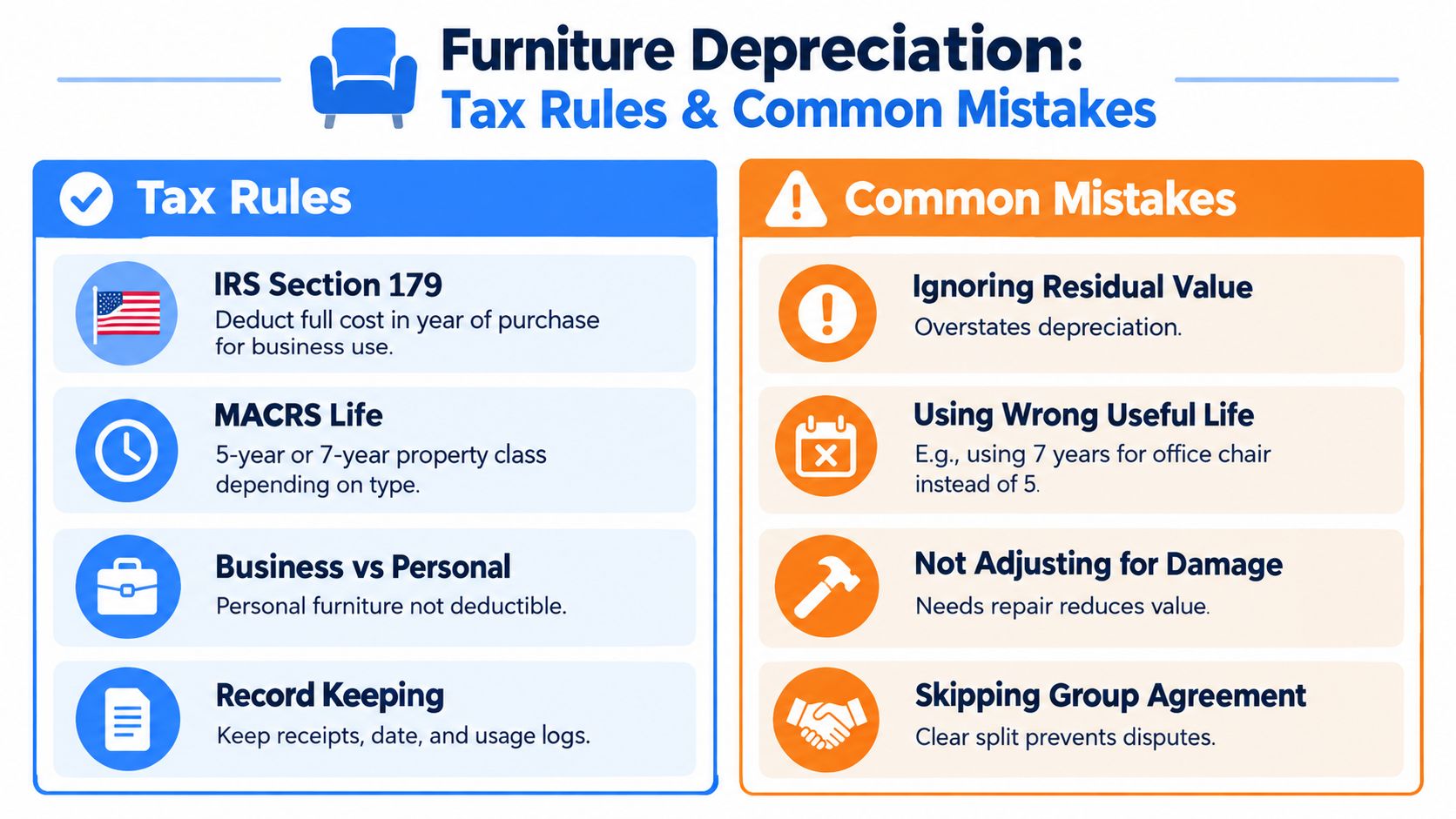
The valuation mistakes are usually predictable:
- Using original retail price as current value: Retail price is a starting reference, not the settlement number.
- Applying one useful life to every item: A dining table, office chair, and budget sofa age differently in both accounting and resale markets.
- Ignoring condition and local demand: Scratches, odors, missing hardware, and whether similar items are easy to replace all affect value.
- Using tax depreciation as a fairness shortcut: It feels objective, but it often overstates or understates what a co-owner should be paid.
- Skipping records: People remember contributions and condition very differently once move-out stress starts.
- Missing reporting rules when taxes are involved: If the number goes on a return or set of books, service dates, method, and convention matter.
I usually give clients one rule. Use one number for compliance and another for settlement when the purpose is different. Just label each clearly.
That keeps the conversation honest. The tax file can follow the required method. The roommate or group payout can reflect wear, resale friction, and the fact that used household furniture rarely sells at a clean formula price.
A practical file for either purpose is short: receipt or estimated purchase price, purchase date, photos, notes on repairs or defects, the method used, and the final agreed value. If several people share the asset, add each person's ownership percentage in writing. That one step prevents a lot of “I thought I paid for more of it” arguments later.
Divvy helps groups turn agreed numbers into actual settlements without reverting to a spreadsheet and a dozen payment requests. If you're splitting furniture buyouts alongside move-out costs or other shared household expenses, Divvy gives you itemized allocation, proportional shared-cost handling, and payment requests through the apps people already use.