Divvy
DivvyHow Much Does Food Delivery Cost in 2026
By The Divvy Team · October 14, 2026 · 14 min read
A standard fast-casual delivery meal typically costs about 40% more than the in-store menu price once delivery fees, service charges, and tip are added, before any menu markup is even counted. In some cases, the total lands far higher, which is why the answer to how much does food delivery cost depends on whether you're looking at the receipt, the app screen, or the final settlement among friends.
Table of Contents
- The True Price of a Delivered Meal
- Understanding Menu Price Inflation
- Decoding Platform Fees and Surcharges
- The Hidden Group Tax in Bill Splitting
- Calculating a Real Group Delivery Order
- Strategies to Lower Costs and Settle Fairly
The True Price of a Delivered Meal
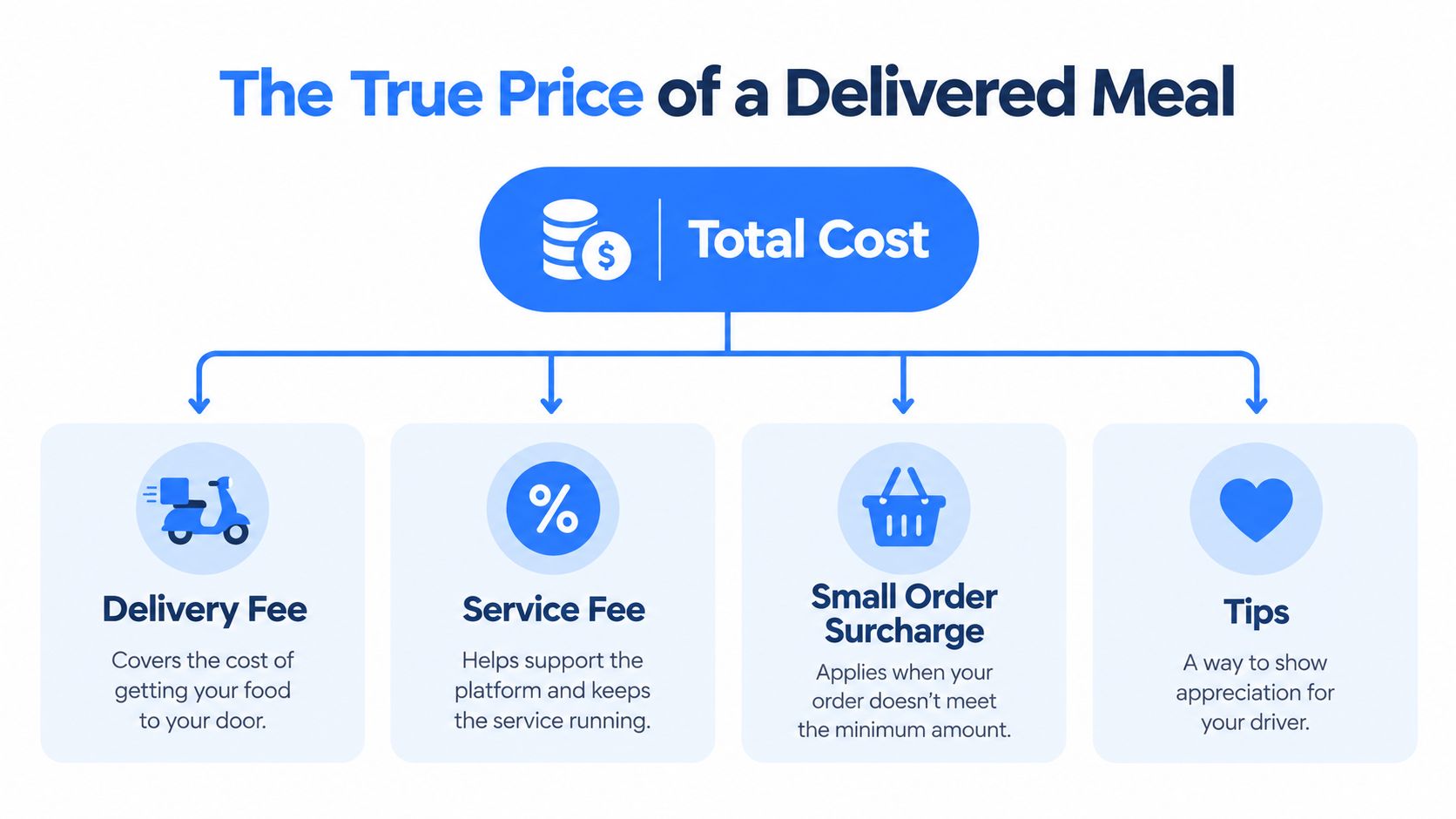
A delivery order is rarely one line on a receipt. It is a stack of charges, and each layer changes the total in a different way. A fast-casual meal listed at about $25 on a delivery platform can reach about $35 before tax once delivery, service charges, and tip are added, which is roughly a 40% increase (McKinsey).
The receipt is a bundle, not a single charge
Each line item serves a different purpose. A delivery fee pays for the trip, a service fee covers platform overhead, a small-order surcharge penalizes low basket values, and a tip is discretionary but usually expected. Looking only at the advertised delivery fee leaves out the part that usually drives the biggest surprise, the combined effect of all the add-ons.
Practical rule: treat the checkout screen as a preview, not the final price.
That matters even more in group orders. If a restaurant raises online menu prices and the platform adds its own charges, the person who ordered the cheapest item can end up subsidizing someone else's premium entrée when the bill gets split carelessly. For a quick explainer on gratuity in app-based orders, see do you have to tip on Uber Eats.
Restaurant pricing also shifts the baseline
The menu price itself may already be higher before platform fees appear. A 2024 CNBC analysis found delivery menu prices averaged about 20% higher than dine-in prices across 25 popular restaurants (CNBC). That means the subtotal often carries a built-in premium before the platform adds delivery-related charges.
The result is a two-layer bill. First comes the higher menu baseline, then the checkout fees on top. For customers splitting an order, that structure matters because it changes the fair starting point before anyone divides delivery or tip costs.
Understanding Menu Price Inflation
Delivery menu prices often start higher before any checkout fees appear. The app can show a burger, salad, or combo meal that looks ordinary, yet the listed price already reflects the cost of selling through a third-party channel.
Why app menus cost more
Restaurant pricing changes because marketplace commissions change the math. If a platform takes a cut of each order, the restaurant must either absorb that hit or recover part of it through higher delivery pricing. The customer sees a subtotal that looks familiar, but it is not the same as the dine-in price.
Consumer behavior shows that diners notice the gap. Technomic's 2024 Delivery & Takeout Consumer Trend Report found the share of consumers choosing third-party delivery instead of direct restaurant delivery rose from 15% in 2020 to 21% in 2024. Among consumers ordering less delivery, 41% cited high delivery fees and 48% cited inflated menu prices.
That split matters. People react to the full bill, not just the last fee line. When menu prices rise before checkout, the order starts from a higher base, and that affects any later split across a group.
Why item assignment matters before the fees
The mistake many groups make is treating the app subtotal as neutral. A person ordering a cheaper item from an inflated menu may already be paying above the in-store price, then gets asked to cover part of someone else's premium entrée through an even split. That turns a simple dinner into a quiet transfer between diners.
A fair split starts with the food, not the final total.
If one person orders expensive entrées and another orders sides, the useful comparison is who consumed what, not who paid more at checkout. The menu markup is already built in, so item-level tracking is the only clean way to keep the settlement honest.
A note on restaurant economics
The pressure does not affect every restaurant in the same way. Higher-volume chains can sometimes spread the cost differently than smaller independents, while categories with tighter margins may have less room to absorb commission pressure. That is why online markups are often uneven across restaurants, even within the same delivery app.
Industry estimates indicate restaurants may receive only about 55% of total customer spending after platform deductions (McKinsey). The customer's extra spend does not map neatly to restaurant revenue, which is why delivery menus often carry built-in inflation.
Decoding Platform Fees and Surcharges
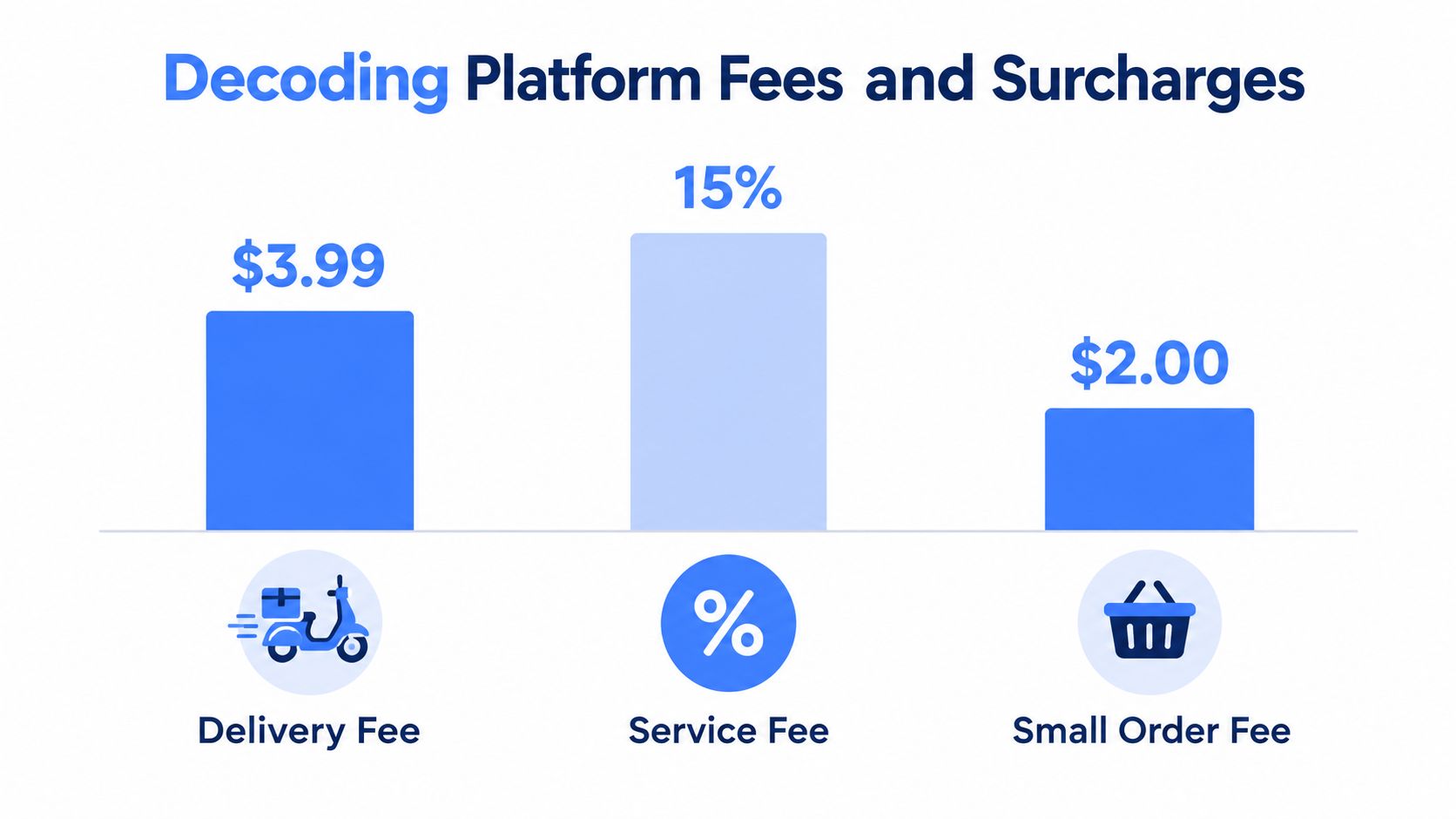
Once the food is in the cart, the platform starts adding its own charges. Many people underestimate the total at this stage, because the fees are often split across categories that sound similar but behave differently in the math. A fixed charge, a percentage fee, and a small-order surcharge should never be treated as interchangeable.
Fixed charges and percentage charges don't scale the same way
A flat delivery fee hits a small order much harder than a large one. That's simple dilution. If the delivery charge is fixed and the basket is tiny, the fee takes up a large share of the total. If the basket is larger, the same charge becomes less important as a percentage of the order.
That's why the structure matters more than the label. A service fee tied to the subtotal behaves differently from a flat delivery charge, and both behave differently from a discretionary tip. For a platform-specific breakdown of what goes into that charge, see what is a delivery fee.
Allocation rule: fixed charges should be split differently from percentage-based charges.
The practical result is straightforward. If the platform adds one delivery fee for the whole order, that fee should be assigned by a rule that reflects how much each person ordered, not divided blindly in equal shares. Percentage-based service fees and tips should follow the applicable subtotal after items are assigned.
Small-order charges punish thin baskets
Small-order fees exist because low-ticket orders are expensive to fulfill relative to the revenue they generate. In a group setting, that can create distortions if one diner orders a low-cost item and another orders a much more expensive one. The low-cost diner shouldn't be made to absorb the same fee burden as the heavy spender when the charge was triggered by the order structure, not by equal consumption.
Some platforms and restaurant systems also use distance-based pricing or location-based adjustments. Toast Delivery Services, for example, applies flat delivery fees that vary by provider and distance, and the service can add a delivery service charge to help offset the delivery cost (Toast). Those kinds of charges make the checkout total more sensitive to order context, which is exactly why the receipt, not the menu, should drive settlement.
For restaurants that want to understand the cost side of the equation, what restaurants pay for seating tools is a useful comparator for how software and service fees get layered into hospitality operations. The customer-facing bill and the restaurant's own operating stack often mirror each other more than people expect.
The Hidden Group Tax in Bill Splitting
Even when everyone agrees to “split it evenly,” somebody usually overpays. The problem isn't arithmetic, it's allocation. Equal splitting treats every dollar as if it benefited every person in the same way, which is almost never true once one person orders more food, one person orders a shared item, and the delivery fee sits on top of the whole basket.
Why equal splits create cross-subsidies
Suppose one person buys a salad and another orders a steak. If the group divides the final total by headcount, the salad diner is subsidizing the steak diner through both the food and the fees. The same distortion shows up with tips and service charges, because those are usually calculated from the order subtotal, not from individual consumption.
The cleanest method is a three-step allocation. First, assign each personal item. Second, split shared dishes evenly among the people who ate them. Third, allocate delivery, tax, service fees, and tip using the right base, fixed fees by a proportional rule, and percentage-based charges by subtotal share.
A fair bill split is item-based first, fee-based second.
That approach avoids hidden cross-subsidies. It also makes the receipt easier to defend in the group chat because each line can be traced to a person or a shared item. If someone ordered the cheap entrée, they should pay for the cheap entrée, not for an equal slice of a more expensive meal plus a proportion of someone else's extra charges.
The right base for each charge
Fixed charges belong in a separate bucket from percentage charges. A delivery fee should be assigned across diners according to their food share, while tips and service fees should follow the subtotal after items are allocated. Taxes should track the taxable amount in the same spirit. That keeps the math tied to the consumption pattern instead of the number of people at the table.
The result is more than fair, it's auditable. If anyone questions the split later, you can point to the receipt and show exactly why each person owes what they owe. That's the difference between a convenient split and a correct one.
Calculating a Real Group Delivery Order
A receipt-based split works only if the numbers are real. Here is a simple three-person order that shows how the group tax appears once shared items and receipt-level charges are allocated.
Step-by-step allocation
- Assign each personal entrée to the person who ordered it.
- Split the shared appetizer evenly between the two people who shared it.
- Sum each person's food subtotal.
- Allocate the fixed delivery fee by each person's share of the food subtotal.
- Allocate the service fee and tip by the same subtotal share.
For a broader framework on dividing shared expenses, calculate group expenses is the relevant reference point.
| Person | Food Subtotal | Fees & Tip Share | Final Total |
|---|---|---|---|
| Person A | $18.00, made up of a $12 entree plus $6 from the shared appetizer | $2.40 delivery fee, $1.80 service fee, $1.50 tip | $23.70 |
| Person B | $24.00, made up of an $18 entree plus $6 from the shared appetizer | $3.20 delivery fee, $2.40 service fee, $2.00 tip | $31.60 |
| Person C | $9.00 from one entree only | $1.20 delivery fee, $0.90 service fee, $0.75 tip | $11.85 |
The math is straightforward. The shared appetizer is a $12 item, so each of the two people who ate it absorbs $6. The combined food subtotal is $51, which sets the proportional split for the fixed delivery fee and the percentage-based charges. Person A pays 18/51 of the delivery fee, service fee, and tip. Person B pays 24/51. Person C pays 9/51.
That is the hidden cross-subsidy to watch for. If the group divided the receipt three ways, Person C would pay part of the shared appetizer, part of the larger order, and part of the overhead tied to food they did not consume. The proportional method keeps each charge attached to the right base.
Why this method holds up
An equal split is easier to say, but it distorts the receipt. Smaller orders end up subsidizing larger ones, and shared items can get counted twice if the group is not careful. The cleaner approach is to assign food first, then spread overhead in proportion to consumption.
That makes the bill easier to defend later. If someone wants to check the math, the receipt shows exactly how each charge was assigned, and the group can trace every dollar back to an item or a shared cost.
Strategies to Lower Costs and Settle Fairly
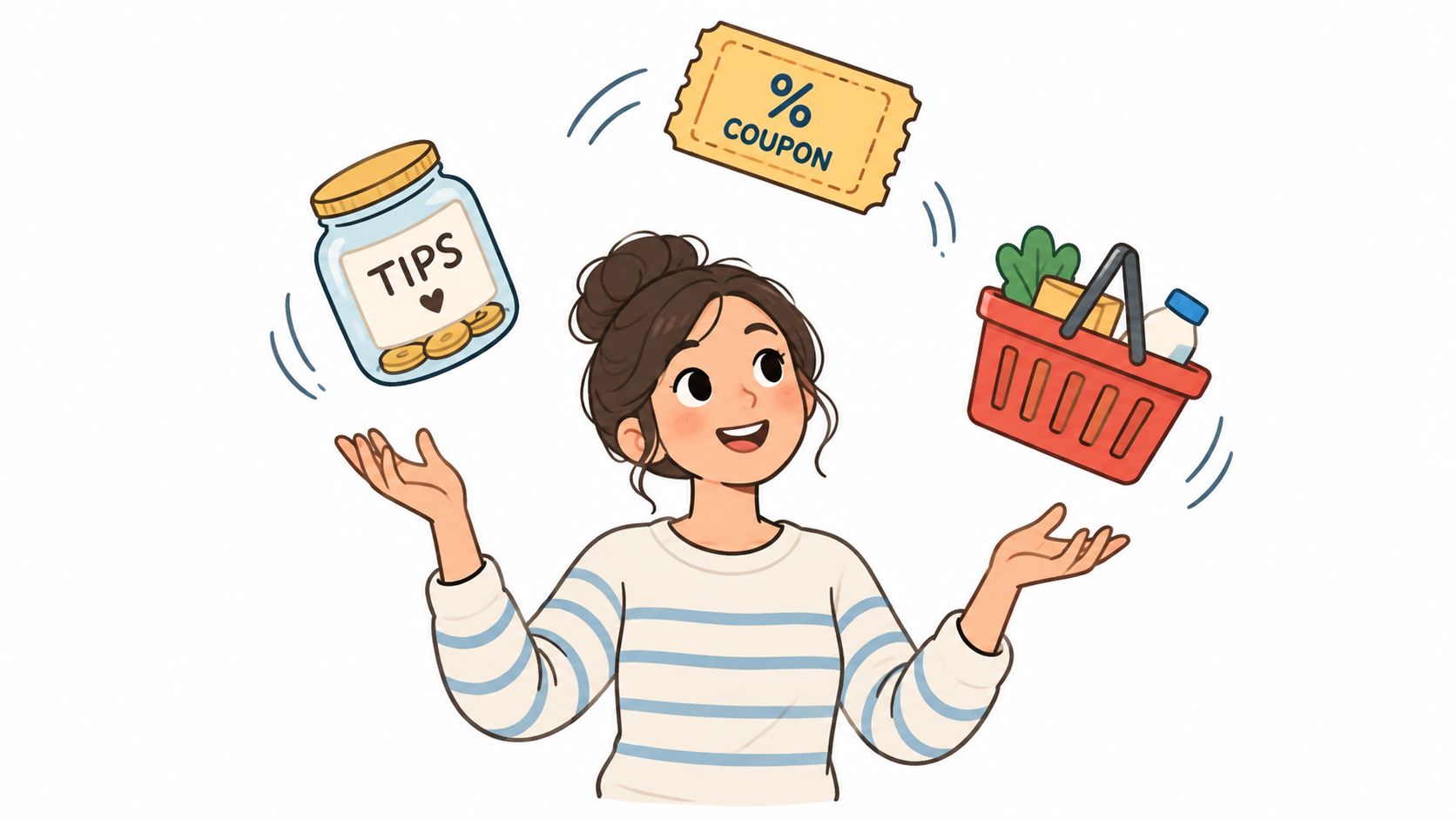
The fastest way to lower the bill is to reduce the number of layered charges before they hit the receipt. That means avoiding small baskets, comparing direct pickup against delivery when the distance is short, and being selective about when the group really needs a delivery platform instead of a pickup run. If the order doesn't clear the minimum comfortably, the per-person cost climbs fast because the fixed charges are spread across too little food.
Cut the bill before it starts
A group can also reduce waste by planning ahead. Meal planning lowers the chance of impulse ordering, which helps avoid the expensive middle of the evening when everyone is hungry and no one wants to calculate fees. If you want a practical way to organize those meals, save time with weekly meal prep is a useful place to start.
The cost logic is simple. Fewer spontaneous orders means fewer platform fees, fewer service charges, and fewer awkward settlement moments afterward. In other words, the cheapest delivery order is often the one you don't place.
Use tools when the split gets messy
When the receipt gets complicated, manual math is where mistakes creep in. A receipt-scanning tool like Divvy can read the line items, allocate tax and tip proportionally, and generate payment requests through common payment apps, which is useful when a group wants each person's true share without doing the arithmetic by hand.
The value is in the settlement, not just the scan. If the app can separate personal items from shared ones and then assign the overhead fairly, the group can move from “who owes what” to an actual request without dragging the conversation out after dinner. That's especially helpful when one person ordered a much bigger meal and the rest of the group doesn't want an awkward round of corrections.
Keep the rule simple
If you remember only one thing, keep it this one. Food items first, shared items second, fixed fees third, percentage fees last. That order keeps the split fair and keeps the group tax from hiding inside a lazy even split.
Divvy helps groups turn a messy delivery receipt into a clear per-person settlement by scanning the bill, assigning items, and allocating tax and tip proportionally. If you want a cleaner way to split delivery orders without manual math, visit Divvy and see how it handles the receipt line by line.