Divvy
DivvyVenmo vs Cash App: Which One Actually Wins in 2026
By The Divvy Team · September 21, 2026 · 20 min read
You're probably here because one person paid, five people swear they'll “send it in a sec,” and now the table has turned into a low-stakes accounting dispute. One friend had two cocktails, someone split an appetizer, somebody left early, and tax plus tip made the easy math useless.
That's why the Venmo vs Cash App debate matters. Not because one app has better branding, and not because a feature grid says one is “for social payments” and the other is “for banking.” What matters is whether your group can settle the bill without weird reminders, bad math, privacy headaches, or instant transfer fees eating into small reimbursements.
Compare these apps the wrong way. They ask which app has more features. The better question is simpler: which app fits the way your group settles money? Dinner splits, rent, shared groceries, group trips, concert tickets, bar tabs. Those are workflow problems first, payment problems second.
There's also a missing step ignore. Before anybody taps Venmo or Cash App, someone still has to figure out who owes what. That's the painful part. Once the amounts are correct, either payment app can do the last mile.
Table of Contents
- Why This Comparison Matters for Real Bill Splits
- Background and Scale of Each Platform
- Fees Transfer Speeds and Limits Compared
- Security Privacy and Buyer Protection
- Features Beyond Sending Money
- Real-World Bill Splitting Scenarios
- How Divvy Fits Into a Venmo or Cash App Workflow
- Which App Should You Choose and When
Why This Comparison Matters for Real Bill Splits

A clean split almost never starts clean. Seven friends go to dinner, one person puts the whole thing on a card, and suddenly the easy part is over. Now you're dealing with uneven entrees, shared plates, drinks only some people had, and the awkward question of whether tip gets split evenly or by what each person ordered.
That's where Venmo and Cash App stop being abstract finance apps and start becoming social tools. The wrong choice creates friction fast. You chase people manually. You send the wrong request amount. Someone instant-transfers money and loses a fee they didn't expect. Someone else leaves a public note on Venmo that makes a routine reimbursement feel like a callout.
The real problem is the messy middle
Most shared expenses have three separate steps:
- Figure out each person's share
- Request the right amount
- Collect without chasing people all week
Venmo and Cash App mostly handle step two and step three. They're payment rails. They don't solve the hardest part, which is assigning items fairly and rolling in tax and tip without manual math.
Practical rule: If your group argues about the amount before the payment request goes out, the payment app wasn't the real problem.
That's why bill-splitting tools now sit before either app. They handle the receipt, the itemization, and the tax-and-tip allocation first. Then Venmo or Cash App becomes what it should be: the fast final handoff.
The app choice still matters
Once the numbers are right, the app still affects how smooth the collection feels:
- For casual friend groups: privacy defaults, reminders, and how many people already use the app matter more than advanced finance features.
- For larger reimbursements: transfer fees and cash-out options matter more.
- For recurring splits: the best app is usually the one your group won't make you explain every month.
My blunt take: Venmo vs Cash App is a workflow decision, not a loyalty decision. If you choose based on the wrong criteria, you'll keep blaming the app for problems that started with the split itself.
Background and Scale of Each Platform
Scale matters for one practical reason. The app your friends already use is the app that gets you paid fastest after the split is figured out.
That is also why this choice starts earlier than Venmo or Cash App. If dinner, trip groceries, or bar tabs need item-by-item sorting first, use a bill-splitting tool before anyone sends a request. Divvy handles the receipt and allocation step. Venmo or Cash App handles the money movement after that.
Venmo vs Cash App at a glance
| Attribute | Venmo | Cash App |
|---|---|---|
| Parent company | PayPal | Block |
| Core identity | Social peer-to-peer wallet | Minimal wallet with broader finance features |
| Geographic availability in cited comparison | US only | US and UK |
| User scale reporting | Active accounts and user totals | Monthly active or monthly transacting actives |
| Social feed | Yes | No |
| Broader financial tools | More limited | Stocks, Bitcoin, direct deposit, debit card features |
Venmo has the wider default friend-group footprint
Venmo grew around one job: paying people you know. That focus still shows up in how groups use it. For birthdays, shared dinners, concert tickets, and routine pay-me-back requests, Venmo feels familiar because a lot of friend groups already built the habit there.
PayPal disclosed 83 million Venmo users in 2023, up from 3 million in 2015, and later reporting placed Venmo at roughly 95.4 million active accounts and over 100 million U.S. users by May 2026 according to Business of Apps' Venmo statistics roundup.
If you are the person organizing the split, that reach matters more than people admit. Less setup means fewer excuses, fewer "I need to download it" texts, and fewer payments stuck in limbo.
Cash App fits groups that want less social friction
Cash App feels more private and more utility-first. You open it, send the money, and move on. For roommates, couples, or friend groups that do not want a social feed attached to every reimbursement, that is a better workflow.
Its user base is smaller by the public numbers cited in recent comparisons, but still large enough to matter. In 2025 to 2026, Cash App was reported at 57 million monthly active users in Q1 2025 and 59 million monthly transacting actives by late 2025 and March 2026, with 9.7 million Primary Banking Actives also reported in that period, as summarized by SQ Magazine's Venmo vs Cash App statistics.
That same comparison cites a usage split that matters in practice. 57% of U.S. adults ages 18 to 29 reported using Venmo, while 59% of Black adults reported using Cash App in public survey data summarized there. The overlap is big, but the habits are not identical.
My advice is simple. Pick Venmo if your group already treats reimbursements as a social norm and you want the lowest resistance. Pick Cash App if your group wants faster, quieter money movement and does not care about the social layer. If you want a broader comparison beyond these two, this roundup of money sending apps gives the bigger picture.
Fees Transfer Speeds and Limits Compared
If you only care about splitting bills, fees matter in two places. First, when someone funds a payment in a costly way. Second, when somebody wants their money immediately instead of waiting for a standard bank transfer.
Fees, speed, and limits compared
| Factor | Venmo | Cash App |
|---|---|---|
| Bank account or debit card funded P2P transfer | Free | Free |
| Instant withdrawal fee | 1.75%, with $0.25 minimum and $25 maximum | Typically 0.5% to 1.75% |
| Instant fee predictability | Clear and capped | Can be cheaper at the low end, but less predictable from the cited comparison |
| Standard transfer timing | Not specified in verified data for this section | Not specified in verified data for this section |
| Credit-card-funded P2P | Avoid if possible for bill splits | Not covered in verified comparison data used here |
What those fees mean in real life
For normal friend-to-friend payments funded by a bank account or debit card, both apps are straightforward. No fee is the baseline on both. Divergence starts when somebody wants the money right now.
Venmo's instant transfer to a bank or debit card costs 1.75% with a $0.25 minimum and $25 maximum, based on the cited comparison in SurveySparrow's Venmo vs Cash App review. Cash App's instant withdrawal fee is typically 0.5% to 1.75% in that same comparison, with no widely published cap in the cited sources.
That leads to a simple conclusion. Cash App can be cheaper for urgent smaller withdrawals, and sometimes mid-sized ones. Venmo is easier to predict because the fee is capped.
If you cash out instantly often, don't ignore this. The app that feels “free” during dinner can still cost you later.
The better way to think about transfer cost
Don't judge based on one payment. Judge based on your group's habits.
- If your group sends and leaves the balance alone: either app works fine.
- If one person fronts bills and wants cash back fast: compare instant withdrawal costs.
- If people panic-transfer small amounts constantly: Cash App may feel lighter on fees in some cases.
A lot of people who compare payment tools also care about how Cash App fits into broader business or cross-border stacks. For that angle, OneSafe's take on Airwallex vs Cash App is worth reading because it frames Cash App against a different kind of money movement tool, not just another consumer app.
If your group already leans Cash App, this guide on sending money through Cash App is a practical companion for the final settlement step.
My opinion on fees
For everyday friend reimbursements, don't overthink transfer speed unless you need the cash immediately. Many don't. They just like the idea of instant access. If you're not cashing out right away, the fee debate matters a lot less.
But if you're the person who always fronts the dinner, the Airbnb, or the concert block, Cash App has the nicer fee story for urgent small reimbursements. Venmo has the cleaner ceiling if the amount gets bigger.
Security Privacy and Buyer Protection
People talk about security as if it's all encryption and login screens. In shared payments, the more important questions are uglier and more practical. Was the payment private? Can you reverse it? Are you protected if you sent money to the wrong person or paid a stranger?
Security and Protection Compared
| Feature | Venmo | Cash App |
|---|---|---|
| Default social visibility | Social feed is a core part of the product | More private by default |
| Buyer-style protection on P2P | Purchase protection applies only to eligible Goods & Services or business flows | No equivalent branded buyer-protection program for person-to-person transfers |
| Best use with strangers | Better only when eligible protected payment flow is used | Weaker for P2P stranger transactions |
| Best use with known friends | Fine, but watch privacy settings | Fine, and naturally more private |
Privacy is not a small detail
Venmo's social feed is famous because it's fun until it isn't. If you're splitting dinner with close friends, the public or social nature of the payment may feel harmless. If you're reimbursing a roommate, paying back a trip organizer, or handling a more sensitive expense, that same visibility can feel intrusive fast.
Cash App's private-by-default feel is one of its biggest practical advantages. You don't have to remember to sanitize the social layer because there mostly isn't one in the same way.
That alone makes Cash App easier for low-drama bill splits.
Protection is where the real difference shows up
The stronger distinction is not “which app is safer overall.” It's which payments get protection.
Recent comparison coverage notes that Venmo's purchase protection applies only to payments tagged as Goods & Services or made through eligible business flows, while Cash App does not offer an equivalent branded buyer-protection program for person-to-person transfers, according to OmniWatch's comparison of Cash App and Venmo.
That means Venmo has a clearer route when you're paying in a qualifying purchase context. It does not mean ordinary friend reimbursements are protected in the same way.
Sending money to a friend is not the same as buying from a seller. If you use the wrong payment type, you lose the protection you thought you had.
My rule on safety
Use either app freely with people you know for normal shared bills. Don't treat either one like a safety net for strangers. If the transaction involves uncertainty, refunds, or a seller you don't trust, the exact payment flow matters more than the logo on the app.
For friend groups, I'd put it this way:
- Choose Cash App for quieter, more private reimbursements
- Choose Venmo only if you're willing to manage privacy settings and you specifically need an eligible protected purchase flow
Features Beyond Sending Money
Most Venmo vs Cash App articles lose the plot. They list every extra feature as if more is automatically better. It isn't. A feature only matters if it reduces friction in your actual money routine.
Cash App is the broader finance tool
Cash App is the more expansive product. Comparison sources note stock investing with fractional shares, Bitcoin support, direct deposit, and a customizable Visa debit card, while Venmo stays more centered on social P2P behavior and a lighter investing setup, as outlined in Wise's Cash App vs Venmo comparison.
That matters if you want one app to do more than split dinner. If you like using a debit card tied to the same ecosystem where you receive reimbursements, Cash App has the stronger all-in-one feel.
The same broader shift shows up in recent product reporting. In 2026, Venmo expanded its rewards program with Stash and rolled out a redesign focused on shopping and money-management tabs, while Cash App reported 59 million monthly transacting actives and 9.7 million Primary Banking Actives in Q1 2026, along with features like Afterpay on the Cash App Card and lending growth, according to CoinLaw's statistics summary on Venmo vs Cash App.
Venmo's extras are narrower, but more social
Venmo still has a real advantage if your group likes social proof. Payment comments, reaction culture, and visible transactions create a lightweight accountability system. People see that others already paid. That can nudge the laggards without you sending another awkward message.
For some groups, that's useful. For others, it's annoying.
Here's how I'd separate signal from fluff:
- Useful for shared costs: debit cards, direct deposit links to the same balance, merchant acceptance, quick requests
- Useful only for certain users: investing, Bitcoin, rewards ecosystems
- Mostly cosmetic for bill splitting: social reactions, design customizations, novelty feed behavior
The feature winner depends on your habits
If you just want to settle up and move on, Cash App's broader toolset is nice but not decisive. If you already use one app as part of your daily money setup, that ecosystem matters more.
The best extra feature is the one that removes one more step from your routine. Everything else is app-store decoration.
My call: Cash App wins on functional depth. Venmo wins on social coordination. If your group needs accountability and familiarity, Venmo's quirks help. If you want one money app that can stretch beyond friend payments, Cash App is the stronger package.
Real-World Bill Splitting Scenarios
Abstract comparisons are fine, but real payment habits decide this. Three situations expose the difference fast: casual dinners, monthly rent, and group travel.

Dinner with friends
A dinner split is usually a speed problem, not a finance problem. People want to settle it before they forget, and nobody wants the social friction of broadcasting who still owes.
Cash App usually feels smoother here. Its privacy defaults are better for casual reimbursements, and the app gets out of the way. If one person pays and sends clean requests, nobody has to think about the social layer.
Venmo still works well for dinner if your group already lives there. In fact, it can work better if your friends need gentle public accountability. But that same visibility can make ordinary reimbursement feel louder than it needs to be.
Monthly rent with roommates
Rent changes the equation because the amounts are bigger, the rhythm is recurring, and mistakes create stress fast. For roommate houses where one person fronts the payment and collects from everyone else, predictability matters more than vibe.
Venmo often fits this better for one reason: reach. More people already have it, and for recurring household arrangements that matters. If your roommate rotation changes, discoverability and familiarity help. The social feed is less relevant here, but the app's widespread use still is.
Cash App works fine for rent too, especially if the household already uses it. I'd still choose based on what the whole house opens without being reminded twice.
Group trips
Trips are where both apps get exposed. The transfers themselves are easy. The accounting is not. One person covered the rental car, someone else paid for breakfast, two people skipped the museum, and now everyone is trying to reconstruct five days of spending from memory.
The deciding factor here usually isn't Venmo versus Cash App. It's whether the organizer can produce exact amounts without turning into the trip accountant from hell.
That's why this guide to splitting a bill on Venmo is useful only after the shares are already correct. The bottleneck comes earlier.
The painful step is upstream
Every one of these scenarios has the same failure point: nobody agrees on the number.
- At dinner: people dispute shared dishes and tip allocation.
- With rent: people argue over unequal rooms, utilities, or who covered the deposit.
- On trips: everybody forgets what they already paid for.
If you solve the amount first, either app becomes easy. If you don't, both apps just speed up confusion.
How Divvy Fits Into a Venmo or Cash App Workflow
The cleanest way to think about shared expenses is capture, calculate, collect.
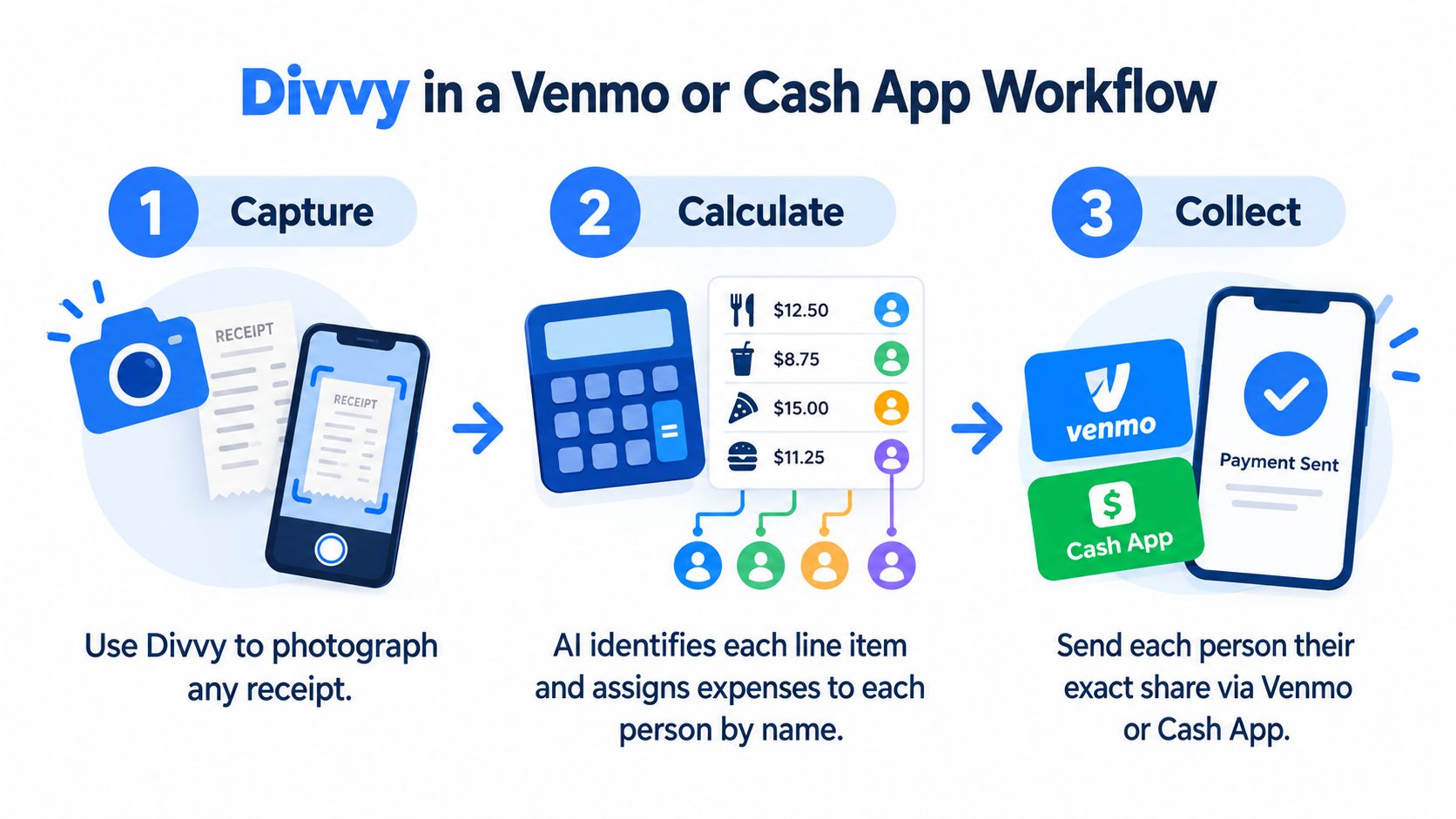
Capture
Start with the receipt, not the payment app. If one person paid the full tab, the first job is preserving the actual bill before people leave, forget, or start guessing. A receipt image gives you the raw record of every item, plus tax and tip.
That sounds basic, but it removes half the later arguments.
Calculate
Divvy fits. It's an iPhone app that scans a receipt, reads line items, lets you assign items to specific people, splits shared dishes, and allocates tax and tip proportionally. It can then create payment requests through Venmo or Cash App, which turns a messy group bill into exact per-person totals.
Here's the practical payoff. Instead of four friends debating whether the person who skipped drinks should still split tip evenly, you assign the items and let the math reflect what each person consumed.
Clean payment requests start with clean itemization. Otherwise you're just sending precise-looking guesses.
Collect
Once the breakdown is done, Venmo or Cash App handles the collection layer. At that point, the app choice matters for privacy, adoption, and cash-out preferences, not for the underlying fairness of the split.
That's the shift many miss. Venmo and Cash App are not really bill-splitting engines. They're settlement tools.
If you skip the calculation step, you end up with the classic mess:
- Manual errors: someone forgets tax or rounds badly
- Cross-subsidies: light spenders overpay for heavier orders
- Follow-up friction: people question the amount instead of just paying it
If you handle the receipt first, the requests become boring. That's exactly what you want.
Which App Should You Choose and When
Here's the plain answer. Venmo wins when adoption and social coordination matter more than clean privacy. Cash App wins when you want a quieter experience and a broader financial toolkit.
Neither app “wins” in every situation. Your group habits decide it.
Quick Decision Guide for Venmo or Cash App
| If You Need... | Pick | Why |
|---|---|---|
| The app most friends are likely to already have | Venmo | Its larger reported user reach makes it easier for broad U.S. friend groups |
| Private-feeling reimbursements without a social feed | Cash App | The experience is less public and more direct |
| A broader all-in-one money app | Cash App | It offers more finance features beyond P2P payments |
| Social visibility that nudges people to settle up | Venmo | The feed creates light accountability |
| Better fit for strangers or qualifying purchase flows | Venmo | It has a clearer purchase-protection framework in eligible cases |
| Faster-feeling casual friend settlements | Cash App | It's simpler and less performative for everyday requests |
My direct recommendation
Pick Venmo if most of your friends already use it, you split informal expenses often, and you don't mind the social layer. For college groups, big friend circles, and people who want reimbursements to feel familiar, it's still the easiest default.
Pick Cash App if you care more about privacy, you prefer a cleaner interface, or you want your payment app to also pull weight with investing, direct deposit, card usage, and a broader money ecosystem.
If you want my shortest answer, here it is:
- For friend-group ubiquity: Venmo
- For cleaner day-to-day utility: Cash App
- For fair item-level splits before either app: handle the receipt first
The transfer app should be the last step, not the whole system.
If you're tired of guessing shares and sending awkward corrected requests later, Divvy handles the part Venmo and Cash App don't. It scans the receipt, assigns items, splits tax and tip fairly, and lets you send the exact amount through the payment app your group already uses.