Divvy
DivvyCost of Rehearsal Dinner Explained and Budgeted Smartly
By The Divvy Team · September 16, 2026 · 15 min read
The average cost of a rehearsal dinner is $2,700, while most couples spend about $1,350 to $4,500, or roughly $55 to $150 per guest for a gathering of 30 to 50 people. The number depends less on decorative details than on guest count, venue structure, and what the quoted price includes.
You may be at the stage where the wedding venue is booked, the guest list is almost final, and a restaurant has sent over a rehearsal-dinner proposal that feels surprisingly large. A small pre-wedding meal can turn into a private room fee, catering minimum, bar package, service charge, and a list of extras you hadn't planned for.
That doesn't mean the event is out of control. It means the cost of rehearsal dinner planning works best as per-person math. Once you know how many people you're hosting and whether you're reserving tables or paying for an entire private space, the estimate becomes much easier to understand.
Table of Contents
- Introduction to Rehearsal Dinner Costs Today
- What Drives the Average Cost of a Rehearsal Dinner
- How Venue Type and Per Person Pricing Shape Your Total
- Building a Realistic Rehearsal Dinner Budget That Holds
- Who Pays and How to Handle Shared Costs Fairly
- Splitting and Collecting Rehearsal Dinner Costs Without the Math Headache
- Final Takeaways for Planning Your Rehearsal Dinner With Confidence
Introduction to Rehearsal Dinner Costs Today
A couple may start with a simple plan: dinner for the wedding party and immediate family after the rehearsal. Then partners, the officiant, traveling relatives, and early-arriving wedding guests join the list. Each addition changes the restaurant's quote, often because the bill follows the guest count rather than the original idea.
The dinner also serves a purpose beyond the meal. It gives the couple time to thank the people closest to them, lets families meet before the ceremony, and gives the wedding party space to relax together. A meaningful gathering does not require elaborate production, but its budget should match everyone receiving an invitation.
The clearest way to understand the cost of rehearsal dinner is to treat it as per-person math. Start with the number of guests, then identify how the venue charges. A restaurant may price each meal separately, while a private room may combine a food-and-beverage minimum, service charges, staffing, or room costs. Those structures can produce very different totals even with the same menu.
Why the guest list comes first
Guest count is the first figure to settle because food, drinks, seating, and staffing generally rise as attendance increases. A 30-person dinner and a 50-person dinner might use identical menus, yet the larger group creates more meal charges and may require additional space or staff.
Venue structure can change the calculation just as sharply. Reserving several tables during normal service works differently from buying out a dining room with dedicated staff and a required minimum. A smaller group in a private space may still need to meet that minimum, so the hosts could pay for capacity they do not use.
For a quick estimate, multiply the expected per-person charge by the number of guests, then add any room fee, minimum-spend gap, service charge, tax, or selected extras listed in the proposal. This separates the cost of feeding each person from the cost of securing the venue.
The same framework also helps when hosts invite people beyond the wedding party. Decide which guests the hosts will cover, identify any shared contribution, and explain the arrangement before deposits or final payments are due. That keeps the budget understandable and the conversation fair.
What Drives the Average Cost of a Rehearsal Dinner
A rehearsal dinner budget becomes easier to read when you treat it like a per-person math problem. Start with the guest count, then ask how the venue charges. A casual restaurant may bill each meal separately, while a private catered event may combine food, beverages, staffing, service charges, and room costs. The same menu can produce very different totals under those two structures.
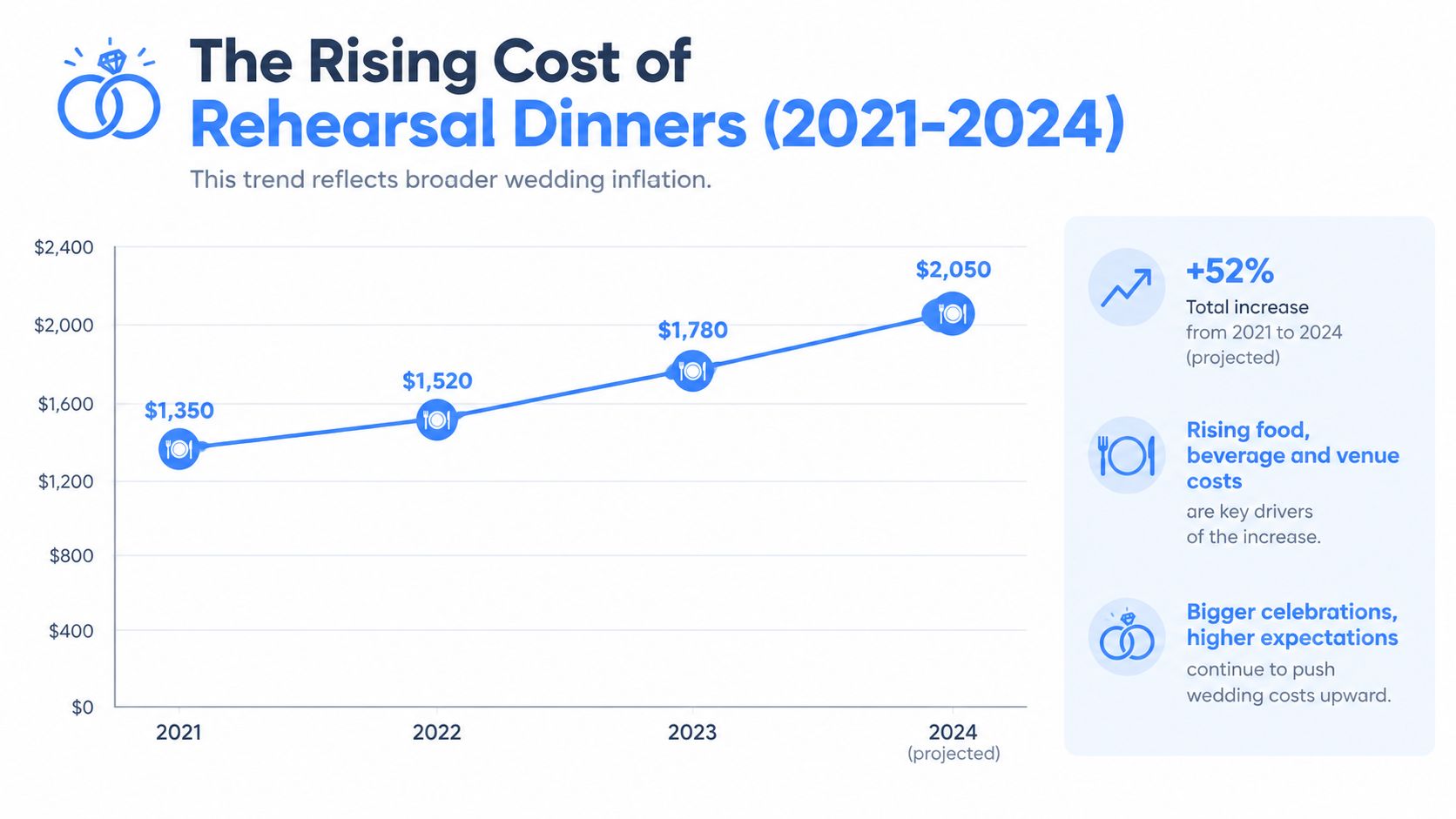
The national figures offer a useful reference point, not a quote for your event. Published data puts the average at $2,300 in 2021, $2,400 in 2022, and $2,700 in 2024, with the cost flat from 2023 to 2024. That represents an increase of about 17% from 2021 to 2024. The Knot's published data provides historical context, while your guest list and venue proposal determine the amount you will need.
Guest count changes the budget quickly
Party size creates the first major shift. Couples hosting 50 or fewer guests averaged $1,630, compared with $3,139 for couples hosting more than 100 guests. The $1,509 gap shows how attendance can change the total before you add menu upgrades or choose a different venue.
Use those figures as reference points. A smaller dinner may sit nearer the lower end, while a broad invitation list may require a budget closer to, or above, the national average. Venue minimums can push the total higher even when the guest count is modest.
Remember: The average is a planning anchor, not a quote. Guest count sets the number of meals and drinks, while venue structure determines which fixed costs appear beside them.
The guest list also defines the dinner's role. A gathering for the wedding party and close family can focus on conversation. Inviting a wider group may turn the evening into a welcome event, bringing a larger food and beverage commitment.
If hosts invite guests beyond the wedding party, decide early who they will cover and whether others will contribute. Explain that arrangement before deposits or final payments are due. For premium destination service or customized menus, this guide to catering a luxury Cannes wedding offers context on how catering style and venue expectations can shape a wedding-related event. Compare the service model, not only the menu wording.
How Venue Type and Per Person Pricing Shape Your Total
Venue structure explains why two restaurants can quote very different totals for the same guest count. A casual restaurant reservation usually means you're paying for meals and drinks while the restaurant continues serving other customers. A private dining room or catered space often includes exclusivity, dedicated staff, a room commitment, and a minimum spend.
Think of the difference as renting tables versus renting a whole room. If you reserve tables, your bill tends to track attendance more directly. If you reserve the room, the venue may charge for access and require a minimum before the first guest arrives. That creates a pricing step rather than a smooth increase.
For most couples, the national planning band is $1,350 to $4,500, or about $55 to $150 per person for 30 to 50 guests. The broad range reflects different formats and service expectations, rather than a single standard of quality. Paperlust's rehearsal dinner pricing guide explains how casual restaurant reservations commonly fall around $50 to $90 per person, while private dining rooms and catered spaces more often land around $75 to $175 per person.
Compare the format before comparing the menu
| Venue Format | Per Person Range | Total for 30-50 Guests |
|---|---|---|
| Casual restaurant reservation | $50-$90 | $1,500-$4,500 |
| Private dining room or catered space | $75-$175 | $2,250-$8,750 |
These totals are simple multiplication of the stated per-person ranges and guest counts. They don't necessarily represent a final invoice, because the venue may quote taxes, service charges, gratuity, rentals, or room fees separately. Ask for an all-in estimate before comparing proposals.
A city restaurant may offer a lower food price but require a room minimum. A hotel or resort may bundle staffing and equipment into a higher per-person rate. Neither is automatically the better choice. The right question is whether you're paying for features your guests will use.
When you're evaluating local options, a guide to booking rehearsal dinner venues in Austin can help you think through venue styles, private spaces, and practical booking questions. Before signing, ask whether the quote includes the room, food, beverages, staffing, table settings, and every mandatory fee.
For the food and beverage portion, a restaurant bill split calculator can also help families estimate how individual contributions might work after the final bill arrives.
Building a Realistic Rehearsal Dinner Budget That Holds
A rehearsal dinner budget becomes easier when you treat it like a simple equation. Start with the guest count, then match the venue structure to the event and the wider wedding budget. A favorite centerpiece can wait. The number of people affects nearly every other line.
A common planning framework sets the rehearsal dinner at 5% to 10% of the total wedding budget. The Wedding Planner List's 2026 planning guide presents that range as a rough guide, not a rule. Use it as a starting boundary, then discuss whether the dinner includes only the wedding party and close family or a wider group of guests.
Build the budget from the headcount
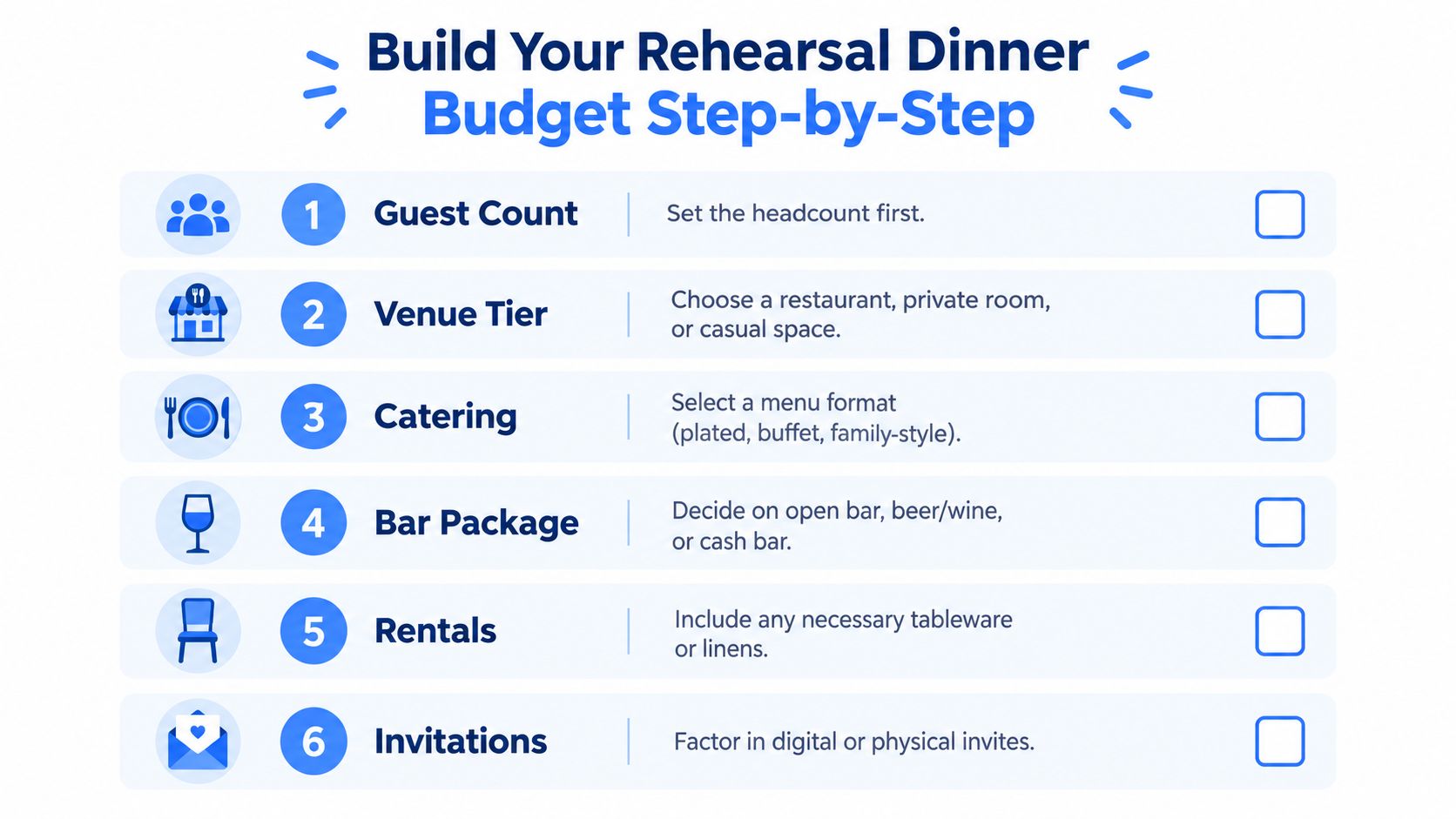
- Guest count: List invited guests, then allow for realistic last-minute additions.
- Venue tier: Compare a restaurant reservation, private dining room, catered home event, or another format.
- Food: Choose plated, buffet, family-style, or casual service. Multiply the quoted per-person price by the headcount.
- Beverages: Decide between an open bar, beer and wine, a limited selection, or nonalcoholic drinks.
- Extras: Include invitations, decor, rentals, room fees, transportation, and required vendor meals.
- Fees and protection: Confirm tax, service charges, gratuity expectations, and payment deadlines. Leave room for changes instead of using the full ceiling on the first quote.
Use this working formula:
Guest count × quoted per-person cost + fixed venue charges + extras + applicable fees = working total
The per-person price is only one piece of the bill. Ask the venue to separate included charges from later additions, such as staffing, room access, or beverage service. That breakdown makes proposals easier to compare and shows whether a lower menu price still fits the complete event.
Alcohol needs its own decision. A full bar may suit the occasion, but it also makes the final total less predictable. For a home gathering or mobile bar, the BeeHive Mobile Bar shopping list can help organize purchases around the guest list and event style.
Practical rule: Set the maximum total before choosing upgrades. A private room or premium bar then becomes a deliberate trade-off rather than an accidental overage.
Who Pays and How to Handle Shared Costs Fairly
Suppose one family invites the wedding party, close relatives, and several out-of-town guests. The bill now grows with every additional place setting, not with the size of the wedding. A fair payment plan starts by asking who controls the guest list, who wants the upgrades, and what each contributor can comfortably afford.
Tradition often assigns the rehearsal dinner to the groom's family, but couples use many arrangements today. The host may pay the full amount, families may share it, or the couple may include it in the wedding budget. Guests can contribute for a deliberately casual event, provided they know about that expectation before accepting the invitation.
Guest count should follow the payment conversation. If one family adds a large group of out-of-town guests, that family may reasonably offer to cover the extra meals and hospitality. If the couple chooses a hotel or resort, agree whether the higher venue cost is a shared wedding expense or a personal preference. Treat each added guest like another tile in a floor: one tile may seem small, but a larger area changes the whole project.
Destination events make this discussion more important because travel, hotel logistics, and a broader welcome invitation can widen the scope. Destination rehearsal dinners can carry a substantially higher total than local gatherings, so the hosts should confirm who is paying before invitations go out.

Choose a contribution model openly
Several structures are practical:
- One host pays: A family or the couple accepts the full responsibility and controls the scope.
- Families contribute: Each family agrees to a fixed amount or takes responsibility for a defined category.
- The couple pays: The couple funds the dinner within its overall wedding plan.
- Guests contribute: This suits a casual event when guests receive clear notice in advance.
Fixed contributions work better than vague promises to “help with the dinner.” Record the amount, payment deadline, and whether the contribution covers only the base event or later upgrades. This written agreement gives the budget a clear boundary.
If the budget supports only a smaller gathering, host a separate casual welcome moment rather than presenting it as the same hosted dinner. Families can also use this guide to splitting bills fairly to compare equal, proportional, or category-based contributions before agreeing on a method.
Splitting and Collecting Rehearsal Dinner Costs Without the Math Headache
Once the budget is approved, the remaining challenge is execution. A rehearsal dinner bill may include shared appetizers, individual meals, a common beverage package, tax, tip, and a room fee. Dividing it evenly can feel simple, but it may be unfair when some people aren't attending, don't drink, or are paying on behalf of a family.
Start by separating the bill into three categories:
- Individual items: Assign each person's meal, drinks, or other clearly identified purchases.
- Shared items: Divide appetizers, family-style dishes, or group desserts among the people who shared them.
- Group charges: Allocate tax, tip, service charges, and fixed fees according to the agreed contribution method.
The calculation should follow the arrangement you made before dinner. If families agreed to cover categories, assign those categories directly. If attendees are reimbursing the hosts, item-level assignment is more transparent than asking everyone to pay an identical amount without seeing the underlying logic.
A practical collection workflow
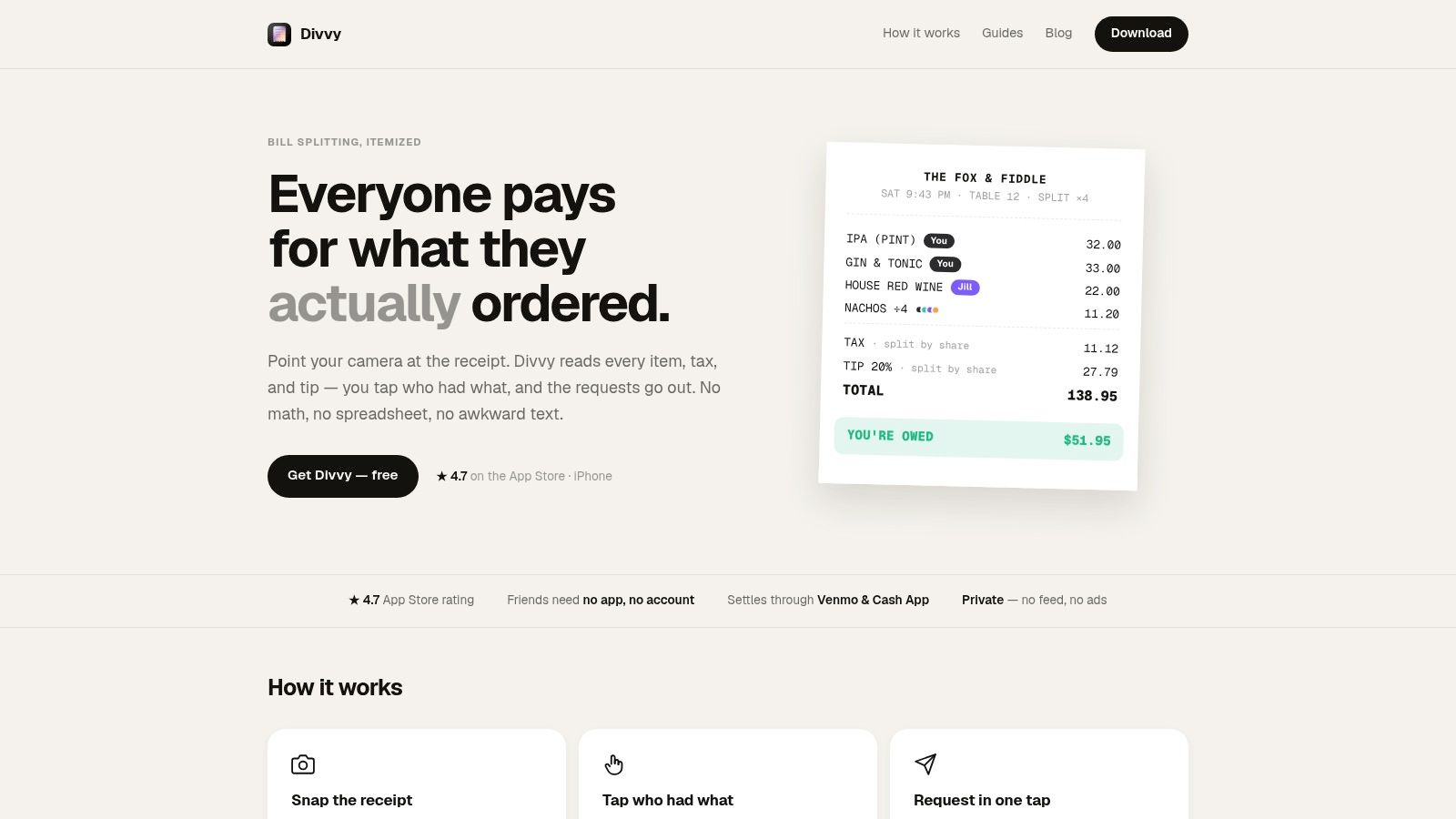
Take a clear photo of the receipt, check every line, and assign individual or shared items. Then allocate tax and tip proportionally to each person's share, unless the group has already agreed on another method. Before sending requests, show each contributor what the amount includes.
The publisher's app Divvy can scan a receipt with AI, identify line items, assign items to specific people, split shared dishes, and allocate tax and tip proportionally. It can create payment requests through Apple Pay, Venmo, or Cash App, and friends don't need to install the app or create accounts to pay. Its workflow focuses on settling one bill immediately rather than maintaining a running group ledger.
If you prefer a spreadsheet, create columns for the person, assigned items, shared portion, tax, tip, and final amount. A split expenses calculator can provide another way to check the arithmetic before collecting payments.
Send requests soon after the dinner, while the receipt is still familiar. Automated reminders can reduce follow-up work, but a clear note about what each request covers is still courteous. The aim is not only mathematical accuracy. It's making every contributor feel that the arrangement was visible and agreed upon.
Final Takeaways for Planning Your Rehearsal Dinner With Confidence
The national planning anchor is $2,700, and most couples fall somewhere in the $1,350 to $4,500 range. For groups of 30 to 50, the typical planning level is about $55 to $150 per person, but those figures only become useful when you compare similar venue formats.
Guest count is the clearest lever. A smaller invitation list can protect both the budget and the intimate purpose of the dinner. A broader list may be generous, but it should come with a clear decision about who is hosting and how the added meals, drinks, and venue commitments will be funded.
Venue structure is the other major lever. Reserving tables at a casual restaurant usually behaves differently from committing to a private room or catered space. Ask for the full cost, including fixed charges and mandatory additions, instead of comparing menu prices alone.
Your final planning checklist
- Confirm the guest list before requesting final quotes.
- Choose the venue format before selecting upgrades.
- Multiply the per-person quote by the expected headcount.
- Add fixed fees, beverages, decor, invitations, rentals, tax, service charges, and gratuity.
- Keep the rehearsal dinner within the agreed share of the overall wedding budget.
- Decide whether contributions will be fixed, proportional, category-based, or self-funded.
- Record the payment agreement before invitations go out.
- Choose a receipt-sharing and collection method before the event.
A well-planned rehearsal dinner doesn't need to compete with the wedding. It needs to create time for gratitude, conversation, and connection without leaving the hosts or families confused about the bill. When you treat the cost as a per-person decision and make the contribution plan explicit, the evening can feel generous while remaining financially controlled.
Use Divvy to scan the rehearsal dinner receipt, assign individual and shared items, and calculate each person's proportional tax and tip. Set up the splitting method before the event so families and hosts can settle contributions clearly through familiar payment apps.