Divvy
DivvyTravel Budget Calculator: Plan Smarter, Split Bills Easier
By The Divvy Team · July 24, 2026 · 17 min read
You're standing in the middle of a trip chat right now. One friend says they'll handle the hotel, someone else offers to “figure out flights later,” and the group chat feels productive until the receipts start landing. That's exactly where a travel budget calculator earns its keep, because it turns vague promises into one clear number people can plan around, split, and settle without drama.
The best calculators don't just estimate a trip total. They break the trip into named cost buckets, convert those buckets into per-person and per-day figures, and make the tradeoffs visible before anyone books the wrong thing. That matters even more for group travel, where flights, lodging, meals, and activities don't all scale the same way.
Table of Contents
- Why a Travel Budget Calculator Changes the Trip
- The Essential Cost Categories Every Calculator Uses
- A Step-by-Step Calculation Example You Can Reuse
- Solo Trips, Couples, and Groups Calculate Differently
- Hidden Costs and Buffers Most Calculators Undercount
- Building a Contingency Plan You Will Actually Use
- Turning the Per-Person Number Into Real Settlements
- Quick Checklist Common Questions and Final Takeaways
Why a Travel Budget Calculator Changes the Trip
The mess usually starts before the trip even begins. Someone says, “We'll just split everything later,” and that sounds easy until one person books a pricier flight, another pays for the apartment, and a third keeps picking up small meals and rides. A travel budget calculator changes that dynamic by forcing the group to decide on the money shape of the trip first, not after the spending has already happened.
From one scary number to a workable plan
A solid calculator turns a trip from one intimidating lump sum into a set of understandable parts, transportation, accommodation, food, activities, and miscellaneous costs, then divides the total by group size and trip length so you can see what the trip means per person and per day. That structure isn't just tidy, it mirrors how travel money gets spent across the trip lifecycle, from getting there to moving around once you arrive, as outlined in the group-trip expense-splitting guide.
Practical rule: if you can't say the per-person number out loud, you don't really have a travel budget yet.
That shift matters because it makes tradeoffs visible early. A flight-heavy trip and a lodging-heavy trip can look similar in a vague conversation, but they feel very different once you separate the categories. A calculator helps the group see whether the primary pressure is airfare, the room rate, or the daily spend once you're there.
Why early math is cheaper than late math
The earlier you do the math, the fewer awkward reversals you'll need later. People can still choose comfort or splurge options, but they do it with eyes open and a shared number in mind. That usually leads to faster booking decisions, fewer surprises, and less resentment when it's time to settle up.
It also lowers the social friction of group travel. Instead of negotiating every receipt at the end, the group agrees on the budget logic first, then uses that same logic to collect money later. That's a lot easier than trying to remember who “sort of owed” what after a week away.
The Essential Cost Categories Every Calculator Uses
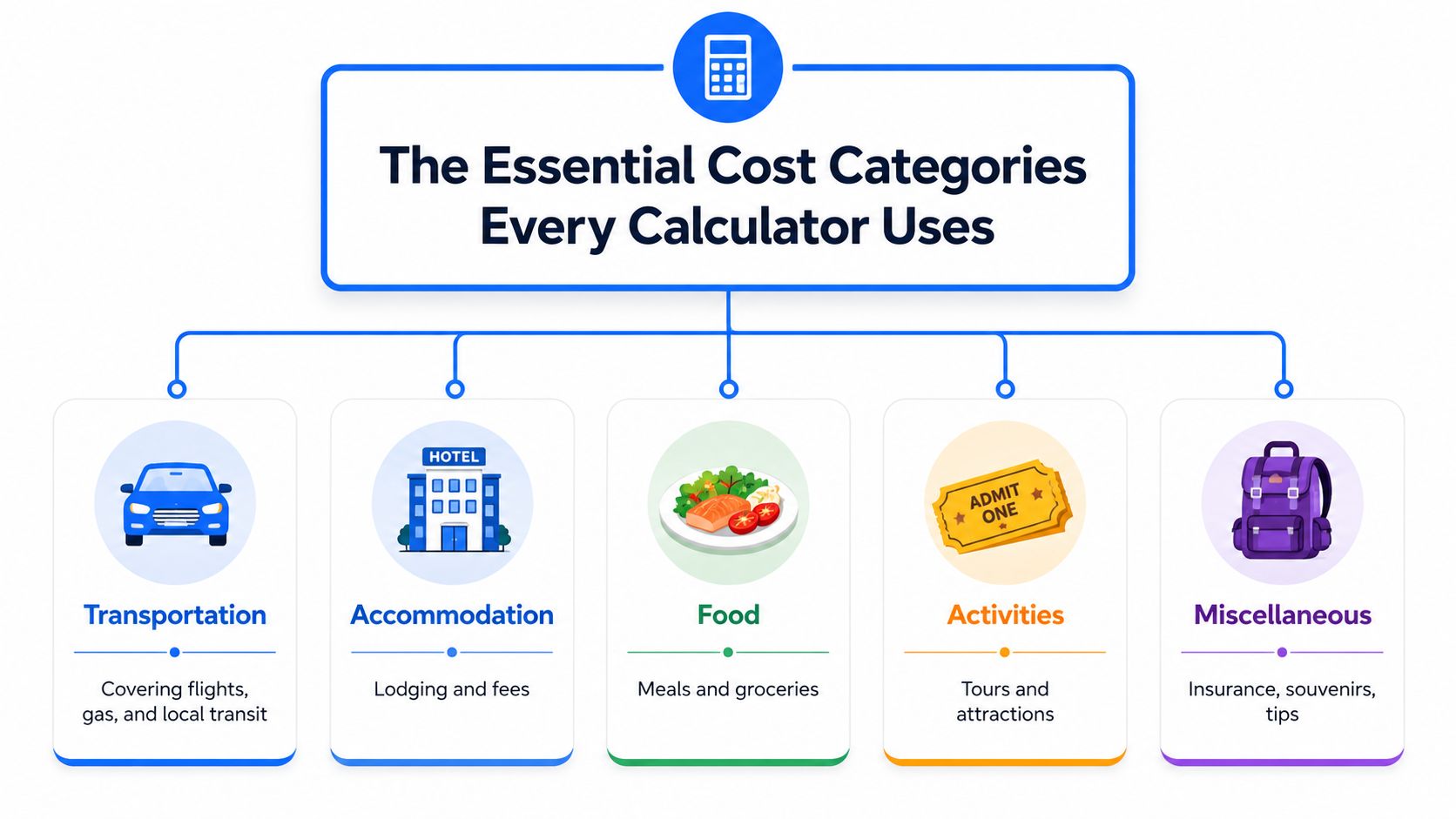
A travel budget calculator works best when it starts with the same five buckets, transportation, accommodation, food, activities, and miscellaneous. That structure matches how a trip pays out in real life, and it keeps fixed costs separate from the daily spending that grows as the trip goes on. A calculator that follows this structure produces a more useful estimate than a single all-purpose total.
What belongs in each bucket
Transportation covers flights, gas, train tickets, airport transfers, and local transit. Flights are usually charged per person, while rental cars or shuttles can be shared, so this is often the first place group budgets get skewed. A car that seems cheap on paper can become expensive once parking, fuel, and split costs enter the picture.
Accommodation is often the easiest category to misread because it is priced per night, not per trip. A room that looks expensive on a nightly basis may become reasonable when it is divided across several people, while a low nightly rate can become a weaker deal if it forces extra transit, longer walks, or more food spending. This is also the category that often changes the most when the group size changes.
Food includes restaurants, groceries, coffee, snacks, and the small purchases that fill up a travel day. Meals scale with both days and party size, so they need a different logic than airfare. A weekend city break and a long road trip can share the same group, but they rarely share the same food total.
Activities covers tours, museums, day trips, attraction tickets, and anything else tied to what you want to do on the trip. Some travelers build this bucket too high and then find there is less room for everyday spending, while others leave it too low and end up trimming the fun parts of the itinerary. A good calculator makes that tradeoff visible before anyone books.
Miscellaneous is the catch-all many people underweight. It should include insurance, tips, luggage fees, passports or visas if they apply, parking, and other small charges that do not feel major on their own but still change the final number.
Fixed versus variable costs
The cleanest calculator setup separates fixed, trip-level costs from variable, per-day costs. Flights and prebooked lodging are usually fixed. Food, local transport, and activities often vary by day, which is why they belong in a daily layer instead of getting buried inside one oversized total.
If a category changes when the trip gets longer, it belongs in the daily layer. If it does not, it belongs in the trip layer.
That split matters because it makes the group's per-person math easier to settle later. Once the calculator shows which costs are shared once and which costs repeat each day, you can turn the result into a fair per-person breakdown that bill-splitting tools can collect without confusion. It is the difference between guessing at the end and agreeing on the numbers before anyone starts paying.
A Step-by-Step Calculation Example You Can Reuse
A clear example turns budget math into something you can use. For a 2-week mid-range Europe trip, one planning band puts the total at $2,500–$4,500 per person including international flights, with flights at $500–$900, accommodation at $700–$1,200, food at $400–$700, local transport at $200–$400, and activities at $400–$700. The same source places budget travel at $75–$100 per day, mid-range travel at $150–$250 per day, and luxury travel at $400+ per day, and it recommends a 20% buffer because small costs add up during the trip (planning bands and Europe estimate).
Once you have that trip total, the next question is settlement. A travel budget calculator gives the group a number to work from, and a bill-split calculator turns that number into a per-person share that can be collected without confusion. That connection matters because the math is only useful if everyone can see what they owe.
A reusable way to lay out the math
Start by listing the trip categories one by one.
- Flights: choose the airfare range that matches the trip.
- Lodging: estimate the total stay cost across the full two weeks.
- Food: decide whether the trip leans restaurant-heavy or grocery-heavy.
- Local transport: include the rides between airports, stations, and neighborhoods.
- Activities: add the attractions or tours the group wants.
- Buffer: add the cushion at the end, not at the beginning.
Then total the categories, divide by the number of travelers, and divide again by the number of days if you want a per-person-per-day pace. That final number is the one that matters most when you are comparing the trip to a daily spending target, or when you need to tell each person what to send into the shared pot.
Simple planning habit: do not compare a trip estimate to your bank balance. Compare it to the pace you will spend at once you are there.
Why the buffer belongs in the last line
The buffer is not there to make the budget look prettier. It is there because small costs accumulate in ways that are hard to feel in the moment. A calculator that ends with a cushion gives you a budget that can survive normal travel friction, not just the perfect version of the trip.
A useful way to think about it is this. The budget tells you what the trip costs on paper. The buffer tells you what it costs in practice, after the second coffee, the extra taxi, and the spontaneous stop you did not plan for. If you want a number that will not collapse mid-trip, the buffer has to be part of the math from the start.
Solo Trips, Couples, and Groups Calculate Differently
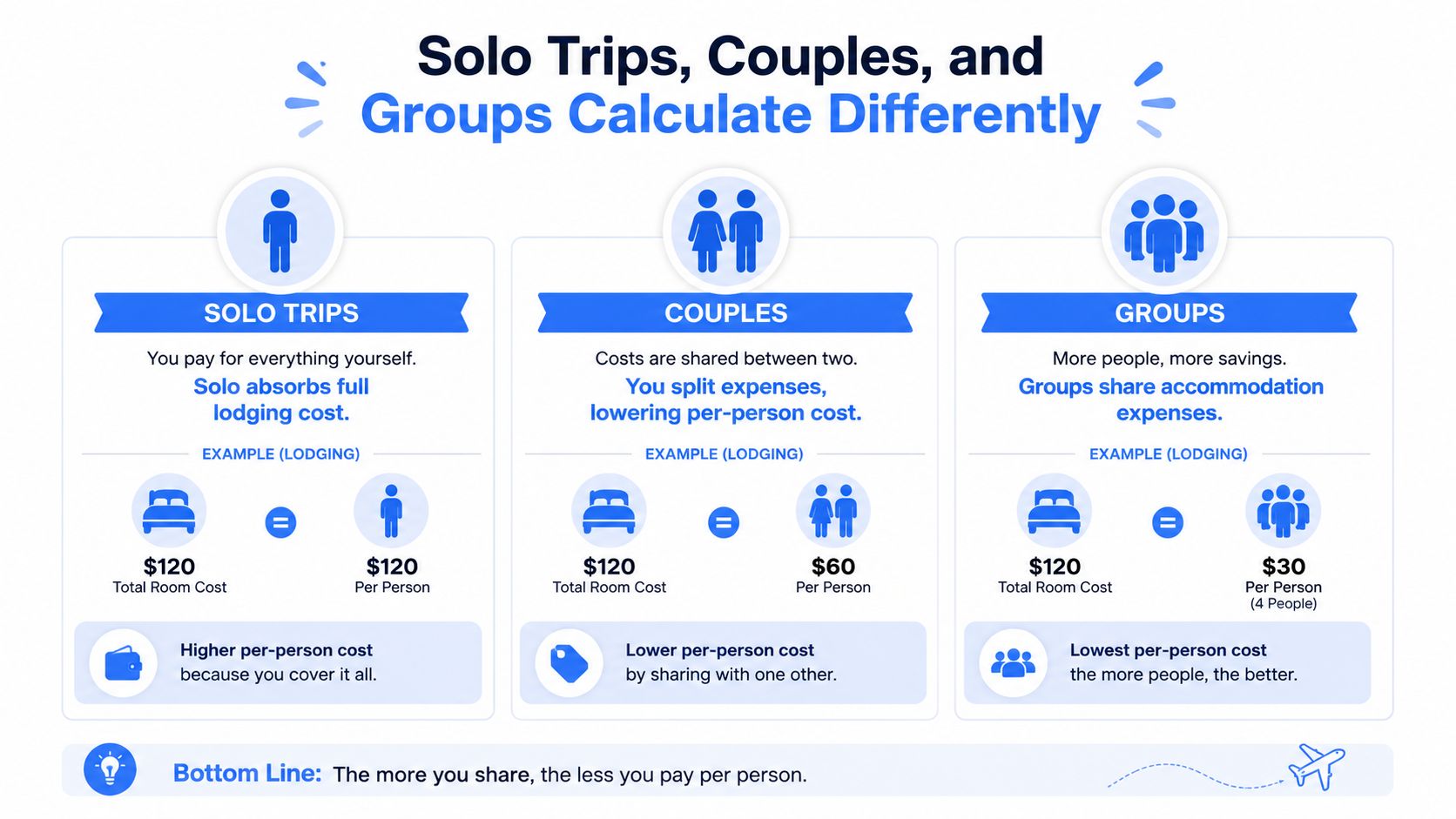
The same itinerary can produce very different numbers depending on who's going. A solo traveler carries the full weight of room costs and transport choices, while a couple can soften lodging costs but still pays nearly the same on flights and many meals. Groups usually get the biggest benefit from shared lodging and shared transit, but only if the trip length is long enough for those fixed costs to spread out.
What gets cheaper when the group gets bigger
Some categories scale down nicely with more people. Lodging often does, especially when a group can share an apartment or book a larger room. Grocery runs can also become efficient because the same kitchen supports more meals.
Other categories barely budge. Flights are still usually tied to each traveler. Attraction tickets, individual insurance, and some transport costs also stay personal, so adding people doesn't always change the whole picture.
| Travel setup | What usually improves | What stays stubborn |
|---|---|---|
| Solo | Fewer coordination costs | Lodging, transport, meals |
| Couple | Shared room, shared groceries | Flights, tickets, many daily costs |
| Group | Split lodging, shared transfers, shared pantry staples | Individual airfare, personal extras |
Why trip length changes the math
Group savings become more visible when the trip runs long enough for fixed costs to spread out. A short stay can make shared lodging feel only a little better than solo lodging, while a longer stay gives the shared room or apartment more time to pay off. That's why a calculator should always show both total and per-day figures.
A good rule is to ask which costs are shared and which are paid together. If one person books the apartment and everyone else reimburses later, that's still a shared cost. If one person wants a private room and another wants a couch, those are different budget choices and should be treated that way.
The group number gets cleaner when you separate “who benefits” from “who paid first.” Once you do that, the per-person estimate becomes a planning tool instead of a source of arguments.
Hidden Costs and Buffers Most Calculators Undercount
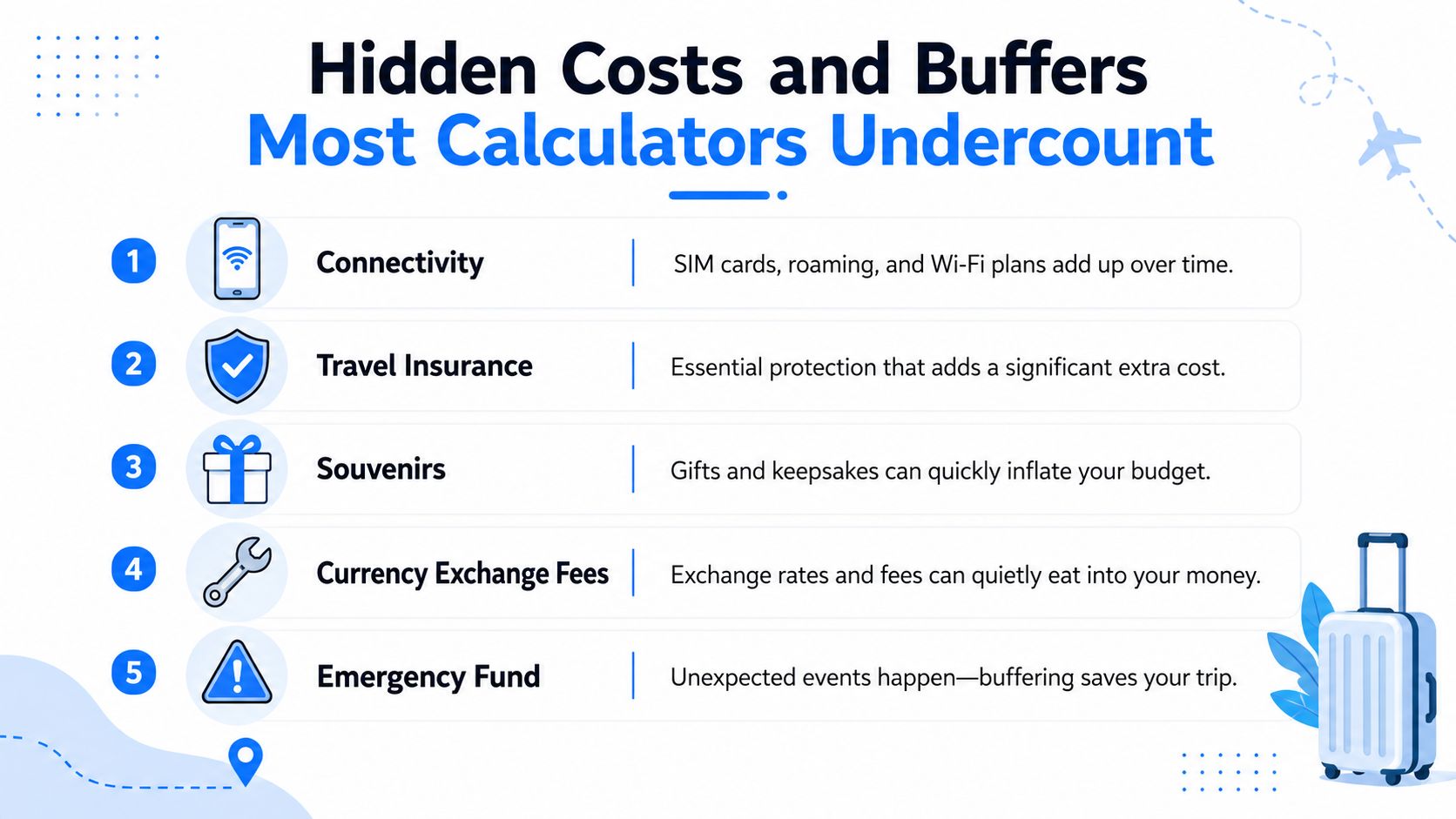
The standard five-category model is useful, but it doesn't catch everything. The biggest misses usually live in the stuff people don't mentally label as “trip cost” until they're already paying for it, things like baggage fees, parking, tips, insurance, visas, and small convenience purchases. One budgeting approach specifically warns that travelers need a cushion because small costs do not feel small by the end of the trip, and a 2026 Disney family example bundles Genie+, parking, and other extras into a 5-day budget of $3,800–$8,500 (MoneyFit's vacation budget notes).
The costs people leave out first
Parking is easy to forget when you're focused on the flight or hotel. Tips can expand a meal budget, especially on trips where service culture is different from home. Travel insurance and visa fees are rarely glamorous, but they're part of the trip price.
Then there are the tiny purchases that feel harmless in isolation. A transit ride here, a coffee there, a bag check, a quick snack, a last-minute ticket upgrade. None of them looks scary alone, but they all hit the same wallet.
Why some trips need a bigger cushion
A flat buffer is a good starting point, but not every trip needs the same reserve. Family travel, theme-park travel, luxury travel, and longer international trips usually deserve a larger cushion because there are more chances for add-ons and unexpected convenience spending. The Disney example shows how extras can reshape the budget in a way a plain lodging-and-food calculator won't catch.
Best practice: if a trip has a lot of paid convenience, assume the calculator is undercounting until you prove otherwise.
The answer isn't to abandon budgeting. It's to stop pretending the tidy categories are the whole story. When you add hidden costs on purpose, the final number becomes far more trustworthy, and you're less likely to hit the end of day three wondering where the money went.
Building a Contingency Plan You Will Actually Use
A contingency plan works best when it's boring and automatic. Don't make it one giant emergency pile that sits somewhere in your mind and never gets used. Break it into habits that are easy to follow before and during the trip.
Three separate safety nets
First, set aside a pre-trip savings reserve before you book anything major. That reserve protects you from having to raid rent or regular expenses to make the trip happen.
Second, add an in-trip buffer on top of the calculator total. This is the money for the world messiness of travel: delayed trains, extra meals, or a spontaneous add-on the group decides is worth it.
Third, keep a foreign-exchange cushion if you're heading somewhere where card acceptance is uneven or cash usage is common. That cushion stops small payment headaches from turning into budget problems.
Habits that keep the buffer useful
Round your estimates up instead of down. Book at least the first night in a flexible way if your arrival timing is uncertain. Keep one card reserved for real emergencies so you don't blur the line between “nice to have” and “need to fix now.”
A few travelers hate hard daily limits because they feel restrictive. In practice, a daily cap can make the trip calmer because every decision doesn't feel like a moral test. You already decided what the trip can absorb, so the rest becomes simple judgment, not guilt.
A budget that people can follow is better than a perfect budget nobody remembers.
That's the whole point of contingency. It's not about preparing for disaster. It's about making sure normal travel friction doesn't spill into the rest of your life after the trip ends.
Turning the Per-Person Number Into Real Settlements
The cleanest thing a calculator gives you is a per-person number. That number matters because it becomes the starting point for settlement, not just the planning stage. If everyone already agreed on the estimate up front, the end-of-trip math is much easier, because the group is settling against a shared baseline rather than reconstructing the whole story from receipts.
Planning math and payout math should match
A lot of trip tension comes from using one method to budget and a different method to settle. People estimate loosely, then try to split precisely, and the mismatch creates arguments. A better setup is to use the calculator to define the expected share, then use an itemized bill-splitting workflow to handle the actual receipts.
That's where receipt-based splitting tools become useful. They read line items, assign shared meals and transport correctly, and remove the manual work of deciding who owes what after every meal. The goal isn't just accuracy, it's cleanup without awkwardness.
What matters most in a settlement tool
Look for three things. First, item-level assignment, so one person's appetizer doesn't get treated like everyone's. Second, proportional tax and tip, so the final split reflects the complete bill instead of a rough guess. Third, a payment flow that sends requests through the apps people already use, so repayment doesn't get stuck in chat.
That's the practical bridge between a travel budget calculator and the end-of-trip settlement. The calculator sets the expectation. The bill-splitting tool collects the money in a way that matches that expectation.
When those two pieces line up, the trip feels more fair from start to finish. Nobody has to remember every dinner, every ride, or every grocery run by hand, because the system has already done the heavy lifting.
Quick Checklist Common Questions and Final Takeaways
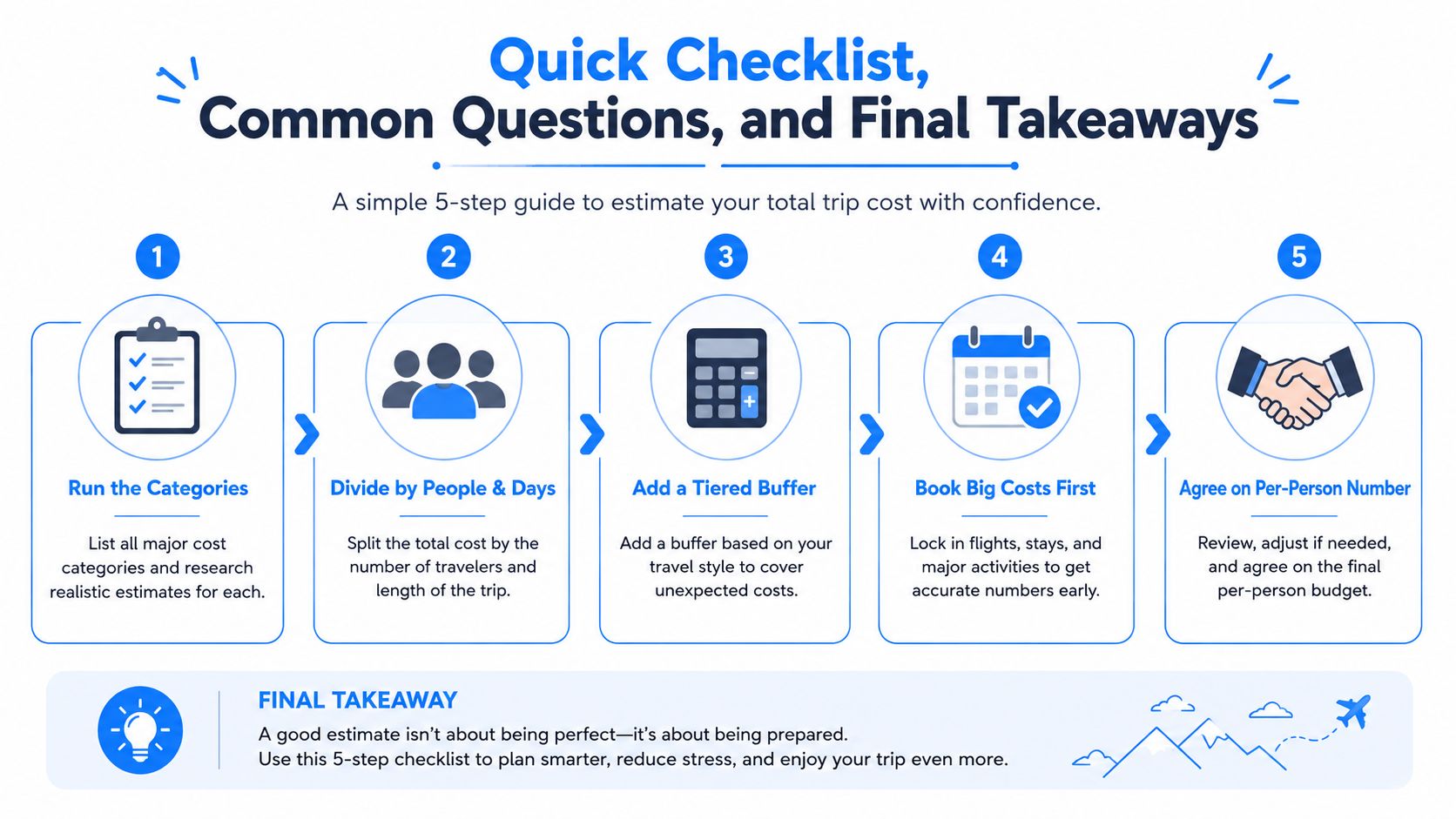
A trip budget gets far easier when you use the same sequence every time. Run the categories, divide by people and days, add a buffer, book the biggest costs first, and agree on the per-person number before anyone starts spending freely. That's the short version, and it works because it keeps the budget tied to actual decisions instead of vague hopes.
A quick checklist you can use today
- Run the categories: Put transportation, accommodation, food, activities, and miscellaneous into the estimate.
- Split by people and days: Turn the trip total into a per-person and per-day pace.
- Add a buffer: Give the budget room for the small things that always show up.
- Book big costs first: Lock in the items that drive the budget most.
- Agree on the number out loud: Make sure everyone hears the same figure before the trip starts.
Common questions travelers ask
What if the plan changes mid-trip? Re-run the calculator with the new dates or category mix, then reset the group's per-person expectation. That keeps the budget honest instead of pretending the original plan still applies.
When should I use a calculator instead of a spreadsheet? Use a dedicated calculator when the trip has multiple people, different cost buckets, or a lot of moving parts. A spreadsheet works for simple trips, but calculators are easier when you want fast per-person and per-day output.
Is a flat split always fair? Not always. A flat split works best when everyone uses the trip the same way. If one person consistently chooses more expensive options, the cleanest answer is to separate shared costs from personal upgrades.
The win here is confidence. Once you've done this a few times, you stop guessing and start planning like someone who knows where the money is going.
If you're planning a group trip right now, use a travel budget calculator to set the per-person number, then let Divvy handle the itemized settlement when the receipts start coming in.