Divvy
Calculating Percentage Rent: A Step-by-Step Guide
By The Divvy Team · October 17, 2026 · 15 min read
You open a lease email expecting the usual monthly rent, then a year-end reconciliation lands in your inbox with a number that doesn't feel small anymore. That's the moment percentage rent stops being a footnote and starts acting like a real cost of doing business, especially if sales have been stronger than you expected. A tenant who understands the math can sanity-check the bill, and a landlord who understands it can explain the charge without turning the conversation into a dispute. If the numbers still feel fuzzy, a forensic accountant for landlord disputes can help untangle the clause and the reporting trail, while a quick look at how rent per square foot is calculated gives you useful context for comparing one lease to another.
Table of Contents
- When a Tenant Owes More Than the Base Rent
- What Percentage Rent Is
- Finding the Natural Breakpoint
- How the Overage Is Calculated
- Natural Versus Artificial Breakpoints
- Running the Numbers Through a Full Year
- The Mistakes That Overstate the Bill
- Your Percentage Rent Checklist and Common Questions
When a Tenant Owes More Than the Base Rent
A coffee shop in a busy retail center can pay the same monthly rent for most of the year, then finish a strong holiday season and find that the reconciliation shows extra rent due. That surprise usually comes from percentage rent, a clause that ties part of the rent to sales once a threshold is crossed. The bill can feel sudden, but the logic is plain once you trace the lease terms.
Start with the consequence, not the formula
If you're the tenant, the first question is whether the extra charge came from the lease language or from a reading mistake. If you're the landlord, the first question is whether the sales reporting matched the clause, because that is where disputes usually begin. The lease decides the result, not a loose sense of what the rent “should” have been.
Practical rule: do not treat percentage rent as a penalty for strong sales. It is a negotiated sharing arrangement, and the sales definition matters as much as the rate itself.
A lease can also leave room for confusion when sales are defined one way in monthly reports and another way in the year-end true-up. That is why tenants and landlords should read the clause as a working set of instructions, not just a rate on a page. If the numbers still look off, a forensic accountant for landlord disputes can help trace whether the issue is in the clause, the reporting, or the reconciliation.
The rest of this guide breaks the clause into its moving parts, so you can read it like a worksheet instead of a mystery. You'll see what percentage rent is, how the breakpoint works, where the percentage applies, and why annual reconciliation can change what looked obvious month to month.
For a tenant or small-shop landlord, that matters because the clause can look harmless until sales rise, then become the line item everyone argues about. Once you know the structure, you can tell whether the bill matches the deal you signed or whether it needs a second look.
What Percentage Rent Is
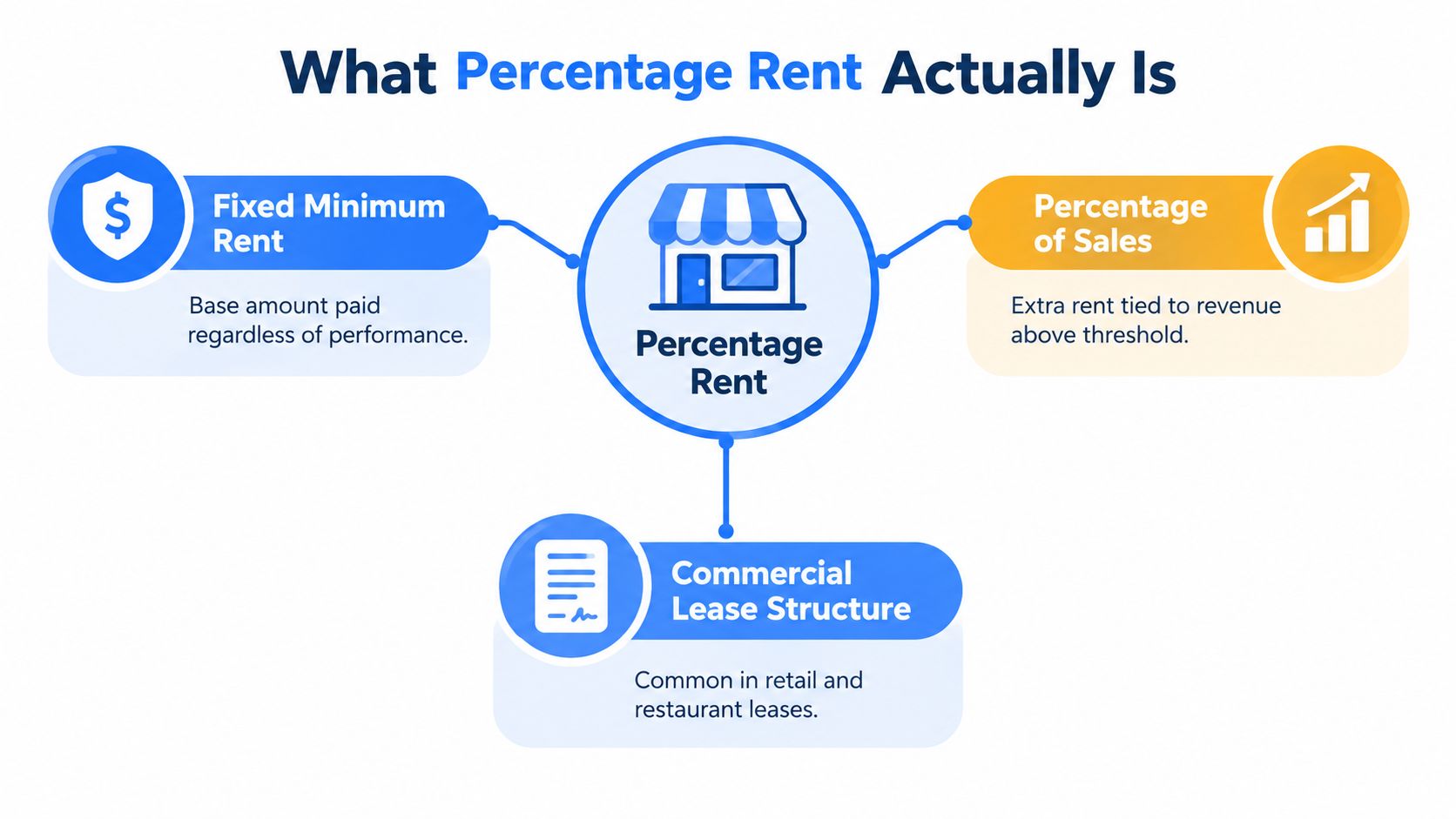
Percentage rent is a commercial lease structure where the tenant pays a fixed minimum rent, then owes extra rent only after sales pass a negotiated threshold. The fixed rent gives the landlord a floor. The sales-based portion gives the landlord upside when the tenant does well. That is why the clause appears most often in retail settings, where traffic and sales can be tracked at the store level.
Two moving parts, one clause
The two pieces are easy to confuse at first. Base rent is the minimum amount due under the lease, and the overage is the extra charge tied to sales above the breakpoint. If sales never rise above the threshold, the tenant still owes only the base rent.
A plain-English reading is simple. The landlord gets the minimum rent either way, then shares in sales only after the negotiated line is crossed. That is different from a pure revenue-share arrangement, where a percentage could apply to every dollar of sales. It is also different from a fixed-rent lease, where sales do not change the rent at all.
The question isn't whether the lease mentions a percentage, it's whether that percentage applies only after the breakpoint or to something broader.
Retail landlords use this structure because it preserves the occupancy floor while letting them participate in stronger years. Tenants accept it when the economics still work for the store and the location. Percentage rent is standard in mall and shopping-center leases, where sales reporting is already part of the landlord-tenant relationship.
A landlord or tenant should read the definition of gross sales before looking at the rate. A good clause says what counts, what does not, how often sales are reported, and whether the percentage applies only above the breakpoint. The RNC Group lease securing guide is a useful reference point for that negotiation mindset, because the math only works when the clause is written clearly.
Finding the Natural Breakpoint
The natural breakpoint is the sales level where base rent and percentage rent mathematically meet. The formula is straightforward: annual base rent divided by the percentage rate. If the lease says annual base rent is $100,000 and the rate is 5%, the natural breakpoint is $2,000,000 because $2,000,000 × 0.05 = $100,000 according to Nolo's explanation of percentage rent.
Work it step by step
Use the same logic every time. First, identify the annual base rent. Next, convert the percentage to a decimal for the calculation. Then divide the rent by the rate and you get the breakpoint where the base rent is “covered” by the sales figure.
If sales sit exactly at the natural breakpoint, the percentage component doesn't add anything beyond the base rent. If sales fall below it, the percentage component is still zero, because the overage hasn't started yet. That's the part many first-time readers miss, they assume the percentage applies immediately, but the clause usually waits until sales exceed the threshold.
A small business owner can think about this the same way they'd think about break-even in another context, only here the breakpoint is a lease term, not a business forecast. The mechanics are similar enough that a basic break even analysis explanation for UK businesses can help the idea click, even if the lease uses different language.
Useful shorthand: the natural breakpoint tells you when the landlord starts sharing in upside, not when rent begins.
The point of calculating percentage rent from the breakpoint is to separate the minimum obligation from the variable part. Once you know that threshold, you can test any sales level against it without guessing. The next question is what happens when sales go above it, because that's where the overage shows up.
How the Overage Is Calculated
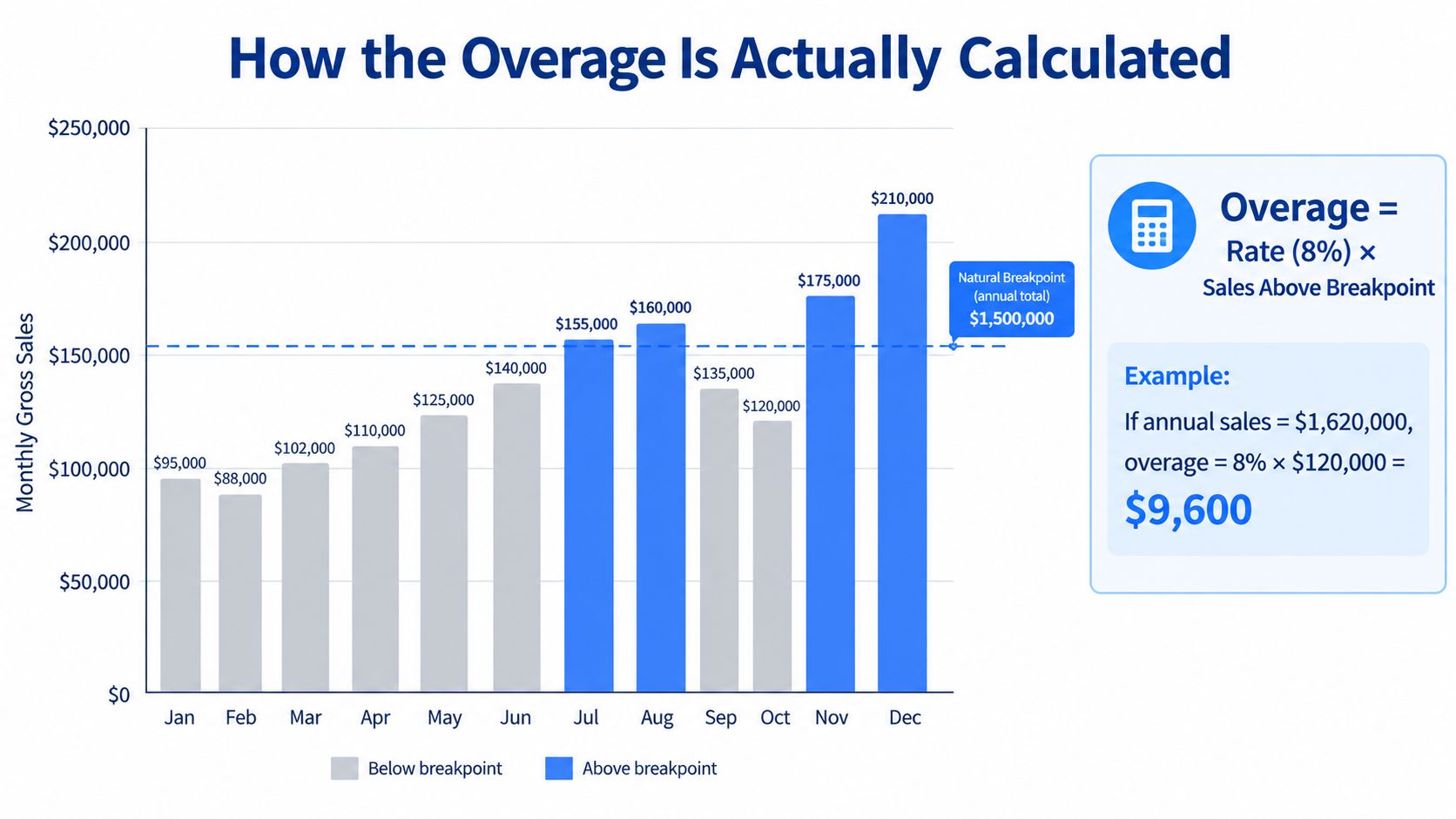
The overage formula is simple once you separate the pieces. Additional percentage rent = agreed rate × max(0, defined gross sales − breakpoint). Total rent is the base rent plus that extra amount. The max(0, ) part keeps the calculation from turning into a charge before sales cross the breakpoint.
The short walkthrough below shows the same excess-over-breakpoint math on a live set of numbers.
A worked example with different numbers
Use this example to see the sequence clearly. If annual base rent is $120,000 and the rate is 6%, the natural breakpoint is $2,000,000. If annual gross sales are $2,600,000, the amount above the breakpoint is $600,000.
Apply the rate only to that excess. The percentage rent is $36,000, and total annual rent becomes $156,000 after you add the base rent. If sales are $1,900,000, the breakpoint is not reached, so the percentage component is zero and the tenant still owes only the base rent.
That is different from taking 6% of all sales. If someone applied the rate to the full $2,600,000, the charge would be much higher, because that method ignores the breakpoint entirely. A percentage rent clause does not take a slice of every dollar sold, it takes a slice of the dollars above the threshold.
Why the zero floor matters
Reading the clause correctly makes budgeting easier. A tenant can model the base rent first, then add the overage only when sales clear the breakpoint. A landlord can also forecast variable income more accurately by watching sales above the threshold instead of total sales alone.
Read the clause for the sales above the breakpoint, not the gross sales headline by itself.
The practical rule is straightforward, calculate the excess first, then apply the rate. Reverse those steps and you will overstate the rent and misread the lease.
Natural Versus Artificial Breakpoints
A natural breakpoint follows the formula. An artificial breakpoint is negotiated separately, so the threshold can sit above or below the mathematical result. That one change can alter when percentage rent starts and how much of the tenant's sales get pulled into the overage.
| Scenario | Base Rent | Rate | Breakpoint | Sales | Sales Above Breakpoint | Percentage Rent | Total Annual Rent |
|---|---|---|---|---|---|---|---|
| Natural breakpoint | $200,000 | 7% | $2,857,142.86 | $3,200,000 | $342,857.14 | $24,000 | $224,000 |
| Artificial breakpoint | $200,000 | 7% | Negotiated above or below the natural level | $3,200,000 | Depends on the negotiated threshold | Depends on the negotiated threshold | Depends on the negotiated threshold |
Why the negotiated number matters
The lease may use an artificial breakpoint when one side wants to change the timing of the overage. A landlord might want the threshold lower, because that pulls percentage rent in sooner. A tenant might want it higher, because that delays or reduces the extra charge. The threshold then becomes a business term, not just a math result.
The mistake many beginners make is assuming the breakpoint must match the formula every time. It doesn't. The lease can set a threshold that has nothing to do with the natural breakpoint, and that's why the clause needs to be read carefully instead of mechanically.
A simple way to spot the difference is to check whether the clause defines the breakpoint in words or derives it from rent and rate. If it's defined by negotiation, treat it as artificial and model the deal using that exact number. If it follows the formula, treat it as natural and keep the calculation tied to base rent and rate.
This is also where validation matters most, because the breakpoint can't be assumed from the accounting ledger alone. The lease controls the rent base, not the store's revenue system. If the threshold is artificial, the rent outcome can shift materially even when sales and rate stay the same.
Running the Numbers Through a Full Year
A percentage-rent clause usually settles over a full reporting period, not in a single month. That means monthly sales reports build toward an annual reconciliation, and seasonality can make a tenant look quiet early in the year before a late surge changes the final bill. The annual picture matters more than any isolated month.
Why the monthly view can mislead
A store can trail the breakpoint for most of the year, then hit a busy stretch in the last quarter and owe overage anyway. That's why a property manager or tenant accountant should track the year-to-date total, not just the latest month. A store that looks safe in spring may still finish above the threshold once holiday sales come in.
The calculation engine should keep the breakpoint type, the sales period, the rate, and the lease-defined gross sales exclusions as separate fields. That prevents a spreadsheet from treating accounting revenue as if it were automatically reportable sales. The lease may define gross sales differently from the store's internal revenue categories, and that difference can change the result.
A practical reconciliation habit
- Track sales by reporting period: monthly reports help you see where the year is headed before the true-up arrives.
- Keep the breakpoint definition visible: natural and artificial breakpoints should never be lumped together.
- Separate lease sales from accounting revenue: the lease can exclude items that accounting still records.
- Reconcile at year-end: the final bill should match the annual lease period, not just a single month's snapshot.
The seasonal pattern is what confuses first-time readers. A rent system built on monthly data can still be governed by an annual threshold, so the end-of-year settlement is what matters. That's why the reconciliation notice often feels bigger than the monthly payments suggested.
The Mistakes That Overstate the Bill
The easiest way to overstate percentage rent is to apply the rate to all sales instead of only the amount above the breakpoint. Run the numbers yourself. With $120,000 of base rent, a 6% rate, and $2,500,000 of sales, the correct overage is $30,000. If someone applies 6% to the full sales total, the percentage rent becomes $150,000, which overstates the charge by $120,000.
The errors that show up most often
A second error is ignoring the lease definition of gross sales. The clause may exclude returns, discounts, or sales tied to a different location, and those exclusions change the rent base. If you skip that language, the calculation can look neat while still missing the lease terms.
Another mistake is assuming the breakpoint is always the natural one. The lease can set an artificial threshold, and that negotiated number may sit above or below the mathematical result.
A third mistake is forgetting that base rent still applies when sales are weak. Percentage rent is an addition, not a replacement. The minimum rent floor stays in place unless the lease says otherwise.
Read the clause before you trust the math. If the lease language is vague, even a clean calculation can point to the wrong bill.
A first-time tenant or a small landlord should read the reporting section with the same care as the rent section. An inflated bill may come from an overbroad sales definition or the wrong breakpoint assumption. Once those items are corrected, the charge often makes sense again.
Your Percentage Rent Checklist and Common Questions
Before you sign or pay a percentage-rent bill, confirm the sales period, the definition of gross sales, any exclusions, the breakpoint type, the percentage rate, the reporting requirements, and the timing of reconciliation. Those are the clauses that decide whether the math matches the lease, not the headline rent alone.
Quick questions people ask most
Is percentage rent negotiable? Yes. The breakpoint, the rate, the exclusions, and the reporting terms are all deal points, not fixed facts.
Does percentage rent replace base rent when sales are high? No. Base rent still sits underneath the overage unless the lease says something unusual.
How are online and delivery sales treated? The lease has to say. That category is often negotiated, because the location may not be the same as the channel that booked the sale.
What if the tenant opens mid-year? The lease should state how the reporting period works, because the reconciliation may need to reflect a partial year rather than a full twelve months.
The cleanest way to read the clause is to treat percentage rent as a shared variable, not a hidden surcharge. Once you know what counts as sales and when the overage starts, the clause becomes much easier to model. That's the mindset that keeps tenants from overpaying and helps landlords explain the bill with confidence.
If you want a simpler way to compare shared costs, split bills, and settle individual shares without spreadsheet guesswork, visit Divvy. It's built for the kind of precise item-by-item math that makes rent and reimbursement questions easier to handle. If you're already checking clauses and totals line by line, Divvy gives you a fast way to keep the numbers straight.