Divvy
Co-Parenting Shared Expenses List, Split With Real Receipts
By The Divvy Team · November 12, 2026 · 9 min read
A co parenting shared expenses list names the child costs that separated parents usually share: out-of-pocket medical, childcare, school costs, activities and sometimes travel. Each parent pays a ratio taken from their agreement, often 60/40 or 70/30, and the one who fronted the money submits a receipt to get paid back.
To be plain about it, this list is a co-parenting concept. It covers child costs between separated parents, and your dinner or Airbnb is not one of them. But the mechanics are the same ones you use when you front money for friends, and they are worth borrowing. Below are the numbers, line by line, then what carries over.
What goes on a co parenting shared expenses list
CustodyXChange says to include only common or expected expenses. The usual categories from the sources in this piece:
- Medical costs left after insurance, such as orthodontics and pharmacy receipts
- Childcare, including after-school care
- School costs, such as supplies
- Extracurriculars, which CustodyXChange says can include vacations, airfare and lodging
That last one is the closest overlap with trip costs. Airfare and lodging are exactly what an organizer fronts for a group.
The list tells you what is shared. The agreement tells you how much of each thing, and the agreement is where the real arguing happens.
The split is often not 50/50
OurFamilyWizard says the default is pro rata by income. A parent who earns 65% of the combined income pays 65% of the bill. Mediator Jennifer Warren Medwin puts it this way: fair does not always equal 50/50.
Parenting Path says most US custody orders use ratios like 60/40 or 70/30, because 45 states and DC follow the income-shares model.
Two rules keep this from turning into a fight:
- Take the percentage from the agreement, not from what feels fair (Co-Parenting Guide).
- Agree it in writing before the spending (CoParent Connect).
Worked example 1: subtract what insurance paid
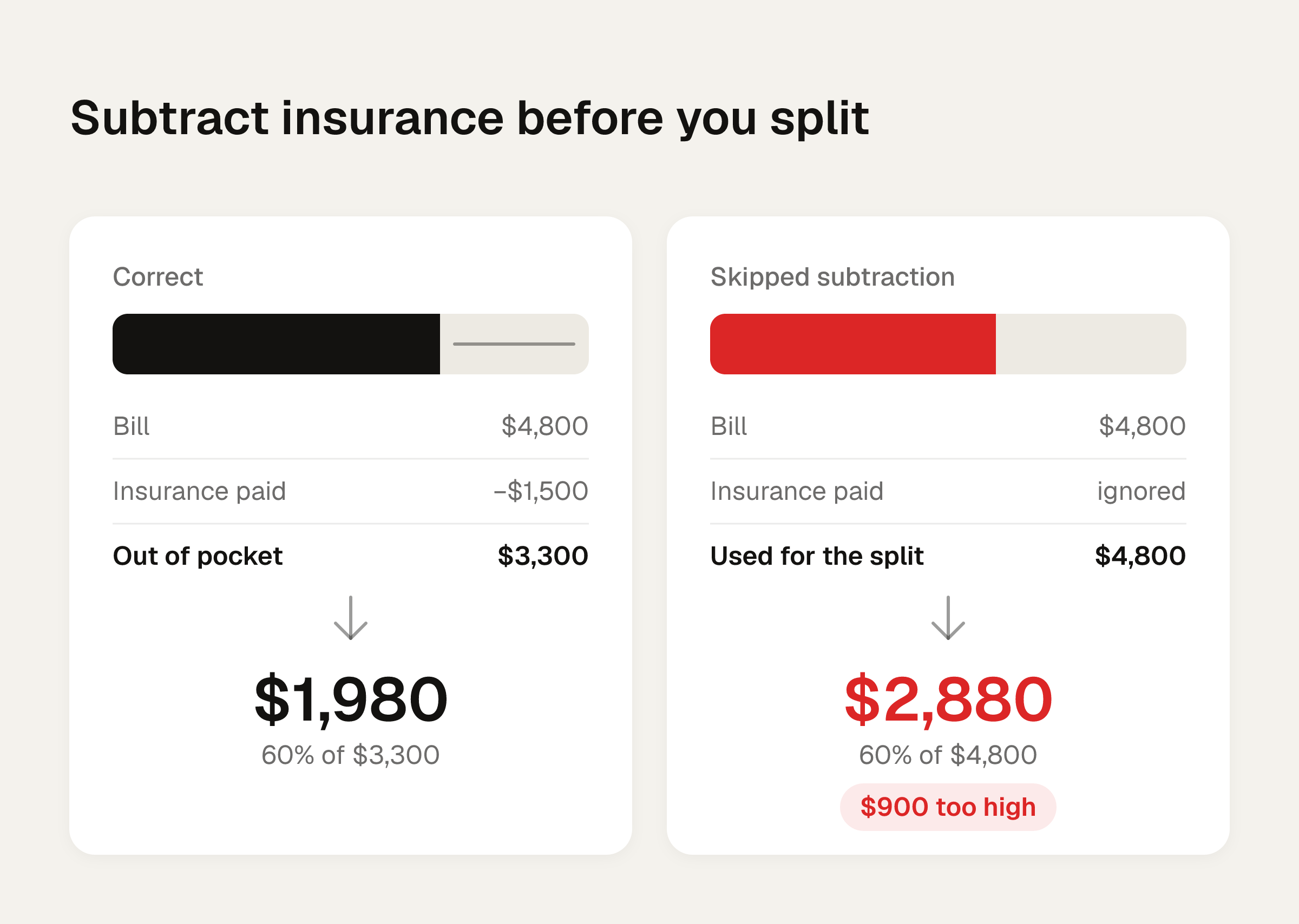
An orthodontic bill comes to $4,800. Insurance paid $1,500.
| Step | Amount |
|---|---|
| Bill | $4,800 |
| Less insurance | −$1,500 |
| Out of pocket | $3,300 |
| Co-parent's 60% | $1,980 |
The claim is $1,980 (this follows the Ardent Workshop example). If you skip the subtraction and take 60% of $4,800, you get $2,880. That overstates the claim by $900, and it is the kind of error that makes the other person stop trusting your math.
Ratio matters too. A flat 50/50 would have shifted the orthodontics share by $330 and the childcare share by $64. Small on one receipt, real over a year.
Worked example 2: one receipt, two ways
Parenting Path's example is a $48.48 pharmacy receipt at 60/40:
- Submitting parent: 60% of $48.48 = $29.09
- Co-parent: 40% of $48.48 = $19.39
The two shares add back to $48.48. That is your check every time.
Now the same arithmetic on a dinner. Maya fronted a $115.20 bill for three friends. Items were $90 before tax and tip, plus 8% tax ($7.20) and a 20% tip on the items ($18.00). The $12 appetizer was shared three ways, $4 each.
| Person | Items | Share of tax and tip ($25.20) | Total |
|---|---|---|---|
| Maya | $40 | $11.20 | $51.20 |
| Jon | $30 | $8.40 | $38.40 |
| Priya | $20 | $5.60 | $25.60 |
Tax and tip follow each person's share of the items. Maya ordered 40 of the 90 dollars, so she carries 40/90 of the $25.20. Priya, with the salad, carries less. The three totals add to $115.20. The split tax and tip guide covers the method in more detail.
Worked example 3: one invoice, two ratios
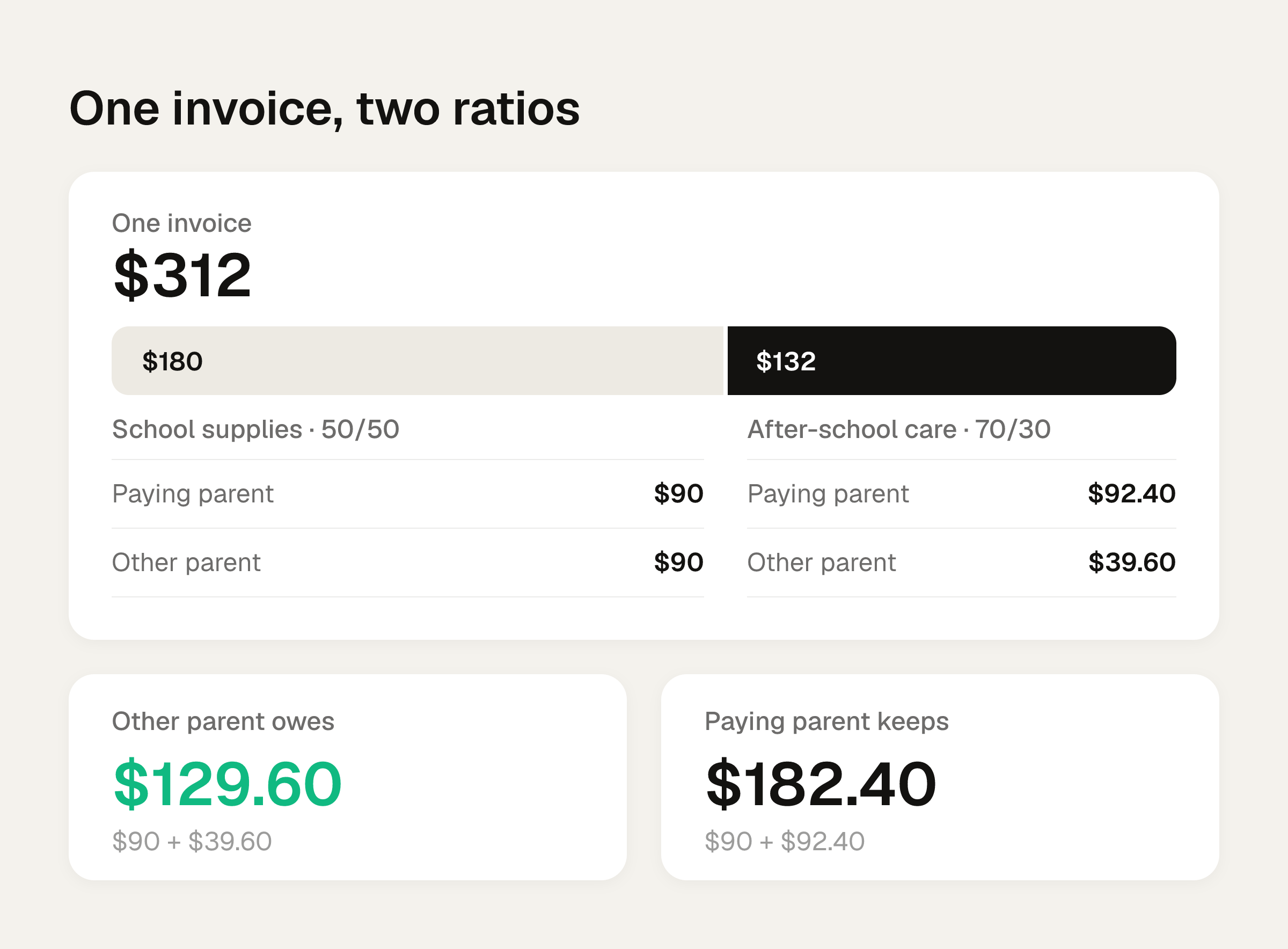
Not every receipt gets one ratio. Parenting Path's example is a $312 invoice with two kinds of cost:
- $180 of school supplies at 50/50: $90 each
- $132 of after-school care at 70/30
Say the parent who paid carries the 70%. Then the care splits $92.40 and $39.60. The other parent owes $90 + $39.60 = $129.60. The paying parent keeps $90 + $92.40 = $182.40. Together: $312.
The friend version is a grocery run. Jess pays $140 at the store. $100 is shared groceries, split four ways at $25. $40 is beer that only Sam and Lee drink, $20 each. Sam and Lee owe $45 each, Dana owes $25, and Jess's own share is $25. Split the receipt by line, then add up each person.
Settle in one transfer
Three expenses can net to a single balance. In the Ardent Workshop example, three expenses net to one $1,534 balance owed, so there is one payment rather than three. Parenting Path's running-balance example shows $146.22 owed across a month of submissions.
Here is the same idea on a trip. Four friends, one Airbnb:
- Jess fronted the $1,200 Airbnb, $300 each.
- Sam fronted the $140 grocery run above.
- Shares: Jess $325, Sam $345, Lee $345, Dana $325. Total $1,340.
| Person | Fronted | Share | Net |
|---|---|---|---|
| Jess | $1,200 | $325 | Is owed $875 |
| Sam | $140 | $345 | Owes $205 |
| Lee | $0 | $345 | Owes $345 |
| Dana | $0 | $325 | Owes $325 |
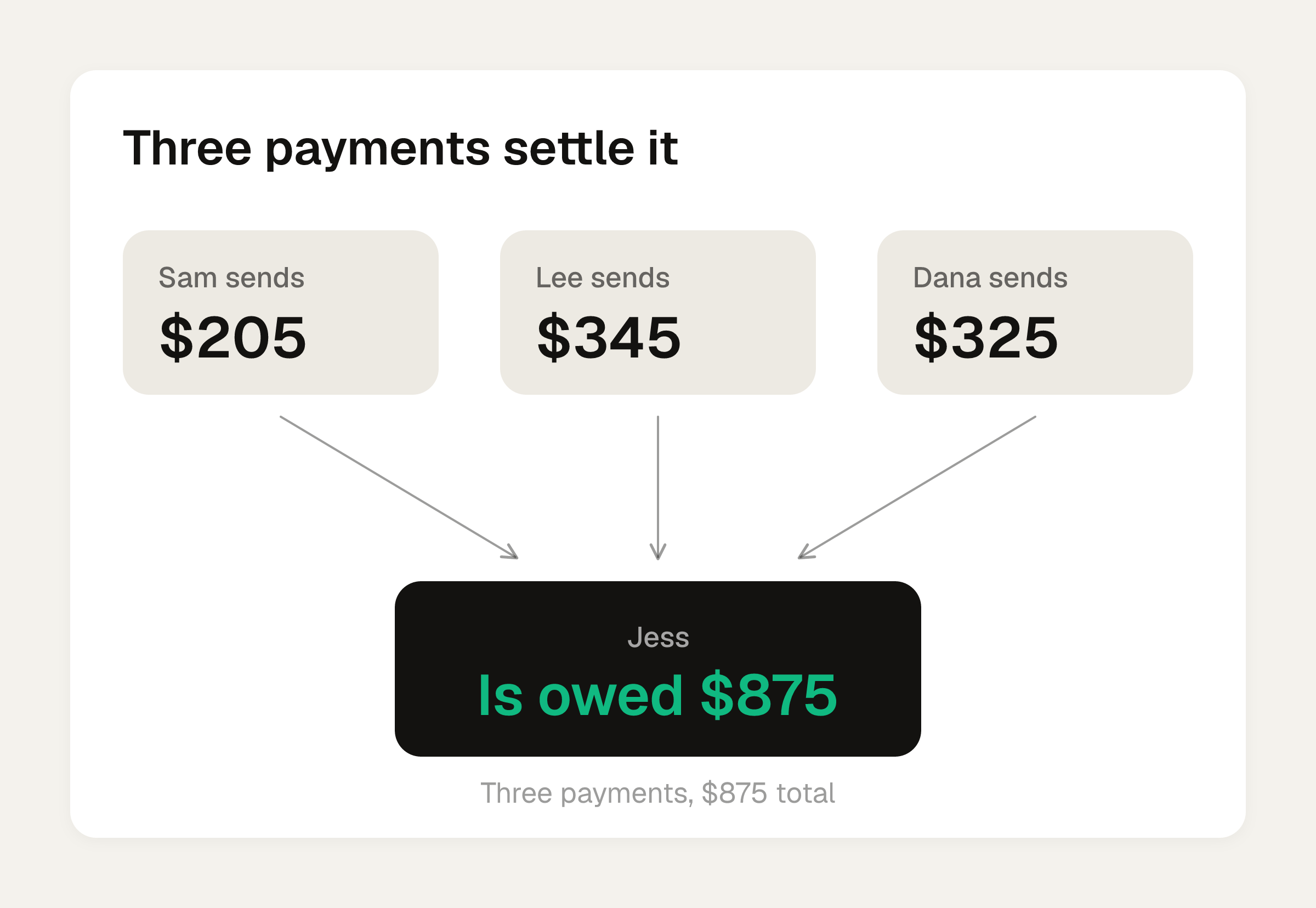
Sam, Lee and Dana send Jess $205, $345 and $325. That is $875 in three payments. Sam does not send Jess $345 while Jess sends back $140, which would be more transfers for the same result. See how to split Airbnb costs for the lodging side.
Rules that stop the awkward ask
Co-parents write these into agreements. You can steal them as a text to the group chat.
Ask before big spending. The sample clause in Co-Parenting Guide requires written agreement before a shared expense over $150, except in a medical emergency. Ardent Workshop says a non-emergency expense paid before asking is the one most likely to be refused. CustodyXChange suggests asking for approval before an uncertain purchase and setting spending limits. For friends: anything over $150 gets a message first. Book the $900 rental house after the group says yes, not before.
Set deadlines. The sample rule says to submit the receipt within 30 days of payment, and the other parent reimburses within 14 days of receiving it (Co-Parenting Guide). CoParent Connect says most orders set a deadline, often 30 days, to present a receipt and another to pay. For friends, tighter is easier. A week to post the receipt and a week to pay is my suggestion, and it keeps the memory fresh.
Keep one record. OurFamilyWizard says any method should record dates, descriptions and amounts spent. CustodyXChange says to keep a record of payments and repayments. CoParent Connect says a dated, timestamped log in one shared place carries more weight than screenshots assembled after a dispute. The shared expense tracker app roundup compares ways to keep that record for fronted money.
Send one request, with the paperwork. CoParent Connect says most disputes come down to no receipt, no agreed split, or a reimbursement request that arrived as an accusation. Ardent Workshop says to send one written request with the paperwork, then log the repayment against that expense. One message, receipt attached, amount stated, due date named.
Two co-parent extras, kept short. Medwin often advises a dedicated fund that both co-parents contribute to for big-ticket costs. CustodyXChange suggests mediation before court for disputes.
What carries over to your own shared costs
| Co-parent step | Friend, roommate or trip version |
|---|---|
| Agree the ratio in writing | Agree even, by item or by income before the booking |
| Subtract what others paid | Remove deposits, credits and refunds before dividing |
| Pre-approval over $150 | Ask the group before the big booking |
| 30 days to submit, 14 to pay | A week each, or whatever the group sets |
| One net balance | One transfer per person, not one per receipt |
Roommates with an uneven split can see the percentage math in split 60/40.
Doing the math without a spreadsheet
The bill split calculator splits a bill evenly or by item, with tip. Try your own bill in it to check the arithmetic before you send the request.
If you front money often, Divvy bill splitting is an iPhone app for this. Point the camera at a receipt and it reads every line item, the tax and the tip. Tap a name on each item to assign it, and a shared item can be split between people. Tax and tip are split by each person's share of the items, so whoever ordered more pays more of both.
Each person's share becomes a Venmo or Cash App request in one tap, with reminders until it's paid. Friends don't need the app or an account. They open a share link, see what they owe, and pay. For a trip, a group keeps a running balance of who owes whom across many receipts, which is the one-transfer step from earlier.
Before your next booking, send the group one message with the split, the cutoff for receipts and the date payment is due.
Frequently asked questions
Do co-parents have to split everything 50/50?
No. Many agreements use a ratio like 60/40 or 70/30, often based on each parent's income. Use the percentage written in your agreement for each type of expense.
What if my co-parent refuses to pay a shared expense?
Check the agreement first: was the split written down, did you send the receipt, and did the cost need approval? CustodyXChange suggests mediation before court for disputes. This is general information, not legal advice.
Is a medical emergency treated differently from other expenses?
The sample clause in Co-Parenting Guide requires written agreement before a shared expense over $150, except in a medical emergency. Your own order or agreement is what counts.
Can roommates use the same steps for shared household costs?
Yes. Agree the split first, set a deadline for receipts, and settle the net balance in one payment. The shared expenses list itself is a co-parenting idea, but the steps carry over.
How long should I keep receipts and payment records?
The sources here only say to record dates, descriptions, amounts and repayments in one shared place. How long to keep them depends on your agreement, so ask your mediator or attorney if it matters.
Sources
- Co-Parenting Shared Expenses: The Complete List + Tracker
- Co-Parenting Shared Expenses List: What's Usually Split
- Co-Parenting Shared Expenses 101: Full List of Child Expenses, Budget Templates and Expert Tips
- How to Split Extraordinary Expenses With a Co-Parent
- Splitting Co-Parenting Expenses When It Isn't 50/50
- How Co-Parents Split Child Expenses in Colorado (2026 Guide)