Divvy
Joint Account for Shared Expenses: Setup, Math and Risks
By The Divvy Team · November 8, 2026 · 8 min read
Yes, a joint account works well for recurring shared bills like rent and utilities. Each person deposits an agreed amount, and the bills get paid from the pool. It is a poor fit for one-off dinners and trips, and the risks below apply to friends and roommates as much as to couples.
This post walks through one $1,000 rent bill both ways. First, a joint account funded in proportion to income. Then the one-off version, where one person fronts the money and everyone settles up once.
Worked example: $1,000 rent through a joint account
Worked example: two people share a $1,000 monthly rent. One earns $60,000 a year, the other $40,000.
Incomes split 60/40, so the rent splits 60/40 too:
- The $60,000 earner deposits $600.
- The $40,000 earner deposits $400.
A straight 50/50 split would be $500 each. That looks fair on paper. Per month, the $60,000 earner makes $5,000 before tax and the $40,000 earner makes about $3,333. At $500 each, the first person spends 10% of income on rent and the second spends 15%. At $600 and $400, both spend 12%.
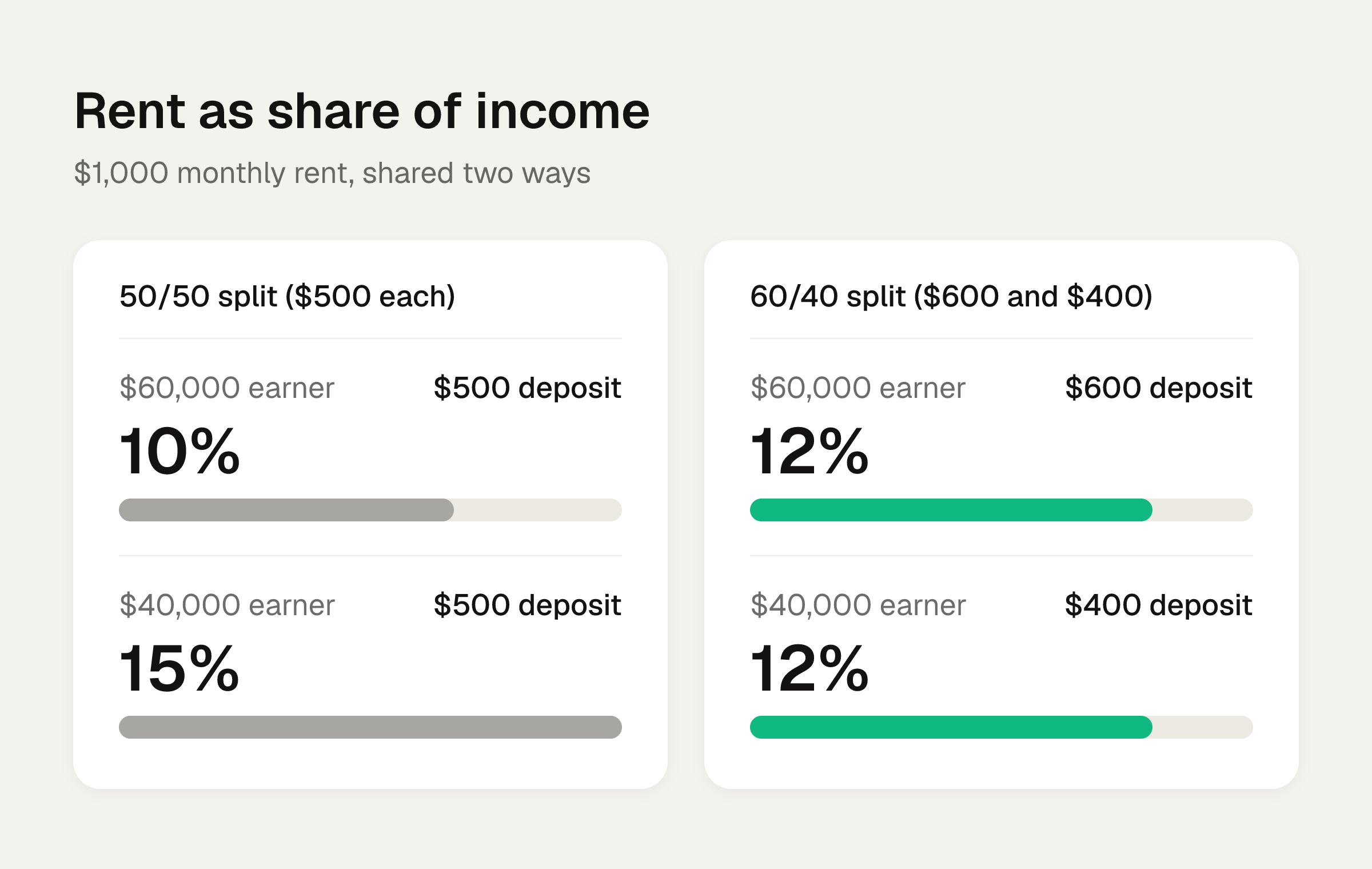
The California DFPI warns that 50-50 can cause problems later when incomes differ a lot. A CPA quoted by HerMoney puts it well: "Fair doesn't necessarily mean equal." If your incomes are close, though, 50/50 is fine and faster. (Our 60/40 split guide has the line-by-line math for other ratios.)
Add a 5–10% buffer
Rent is the easy bill. Electric goes up in August and the internet company raises its rate. A buffer covers it. Freetoolarena suggests putting an extra 5–10% into the shared pot each month and rolling over whatever goes unused.
On $1,000 of monthly bills, that is $50–$100 extra. Split 60/40:
| Rent share | 5% buffer ($50) | 10% buffer ($100) | Monthly deposit | |
|---|---|---|---|---|
| $60,000 earner | $600 | $30 | $60 | $630 to $660 |
| $40,000 earner | $400 | $20 | $40 | $420 to $440 |
HerMoney also suggests keeping reserve money in personal accounts, so an unexpected overage doesn't land on the shared account.
For other ratios, the rent split calculator splits evenly, by income or by room size.
Who can open a joint account for shared expenses
Anyone can open one, including friends and roommates (Money Instructor, BECU). Rules differ by bank. At Huntington, at least one holder must be 18.
Expect to bring:
- Government-issued photo ID for both people
- A Social Security number for both
- A funding deposit, which varies by bank
An existing individual account can usually be converted by adding a co-owner. BECU notes that opening typically triggers a soft pull on both people.
How to set one up and fund it
- List the shared expenses first. Housing, taxes, insurance, utilities. Add groceries or internet if you share them.
- Decide each person's contribution and how often. Equal, or a percentage of income, as in the $600 and $400 example.
- Let the bills set the minimum balance. The account should never dip below what the month's bills need.
- Set automatic monthly deposits from each person's own account into the joint one.
- Put rent and bills on autopay from the joint account (Huntington, HerMoney and BECU all describe this setup).
The common couples setup, per freetoolarena and HerMoney, is two individual accounts plus one joint account for shared costs. DFPI suggests a joint checking account for household bills and a joint savings account for shared goals like a wedding or a home. Keep separate accounts for individual purchases so nobody has to ask permission.
The risks, stated plainly
A joint account runs on trust, and the bank enforces none of it.
- Equal rights. Every holder has equal rights, and no permission is needed for any transaction (Money Instructor).
- Full withdrawal. Either person can usually withdraw all the funds at any time.
- Shared liability. Both of you are responsible if the account is overdrawn, whoever spent the money.
- Creditors. If one holder has an unpaid judgment, creditors may be able to garnish the joint account even if the other person deposited the money.
- Privacy. The other holder sees your spending.
BECU gives a sharp overdraft example. One partner spends $10,000 from a joint account holding $5,000. The institution could take the missing $5,000 from the other partner's individual account.
An unpaid negative balance may go to collections. It is reported to the three credit bureaus for both owners and can stay on a credit report for up to seven years. If the bank closes the account for unpaid balances, it goes to ChexSystems and can make it harder for both owners to open a new account for up to five years. Disputes over joint funds have to be settled by an attorney in court.
Open one with someone whose habits you already know.
Ground rules to agree on first
- One person manages the statements and transactions, but shouldn't be the only one who knows the balance (HerMoney).
- Fixed automatic deposits, so nobody has to remember.
- A purchase threshold. Agree on an amount above which you talk first. BECU gives no figure, so pick one that fits your budget.
- A monthly look at the bank statement and incoming bills.
- Regular money meetings, weekly, monthly or quarterly.
- A 20-minute talk at the start of any shared living or travel arrangement, with the terms written in a shared note.
- A short review twice a year (freetoolarena).
Equal, proportional or itemized
Freetoolarena compares three methods:
| Method | Best when | Catch |
|---|---|---|
| Equal split | Incomes and usage are similar | Unfair if one person earns much more |
| Proportional split | One person earns significantly more | Needs a percentage everyone agrees on |
| Itemized split | Everyone ordered or used different amounts | Most accurate, most work |
Rent and utilities usually suit equal or proportional. A dinner or a trip suits itemized.
When a joint account is overkill
Take a dinner for three. Opening a bank account for it would be silly. Someone fronts the card and everyone settles up once.
Freetoolarena's advice for housemates and trips: settle once a month, or once per trip, not on every transaction. Decide in advance whether variable costs go in a common pot or get tracked individually. Whoever paid the most gets money back from everyone else in one transfer, with the reason in the transfer memo.
Here is the dinner. Sam fronts the whole bill, and each person pays for what they ordered.
| Item | Who | Price |
|---|---|---|
| Steak | Sam | $34.00 |
| Wine | Sam | $14.00 |
| Pasta | Jo | $22.00 |
| Salad | Lee | $14.00 |
| Appetizer, shared three ways | Sam, Jo, Lee | $12.00 |
The subtotal is $96.00. Tax at 8% is $7.68. A 20% tip on the subtotal is $19.20. Sam fronts $122.88.
Tax and tip are split by each person's share of the items:
| Person | Items | Tax | Tip | Total |
|---|---|---|---|---|
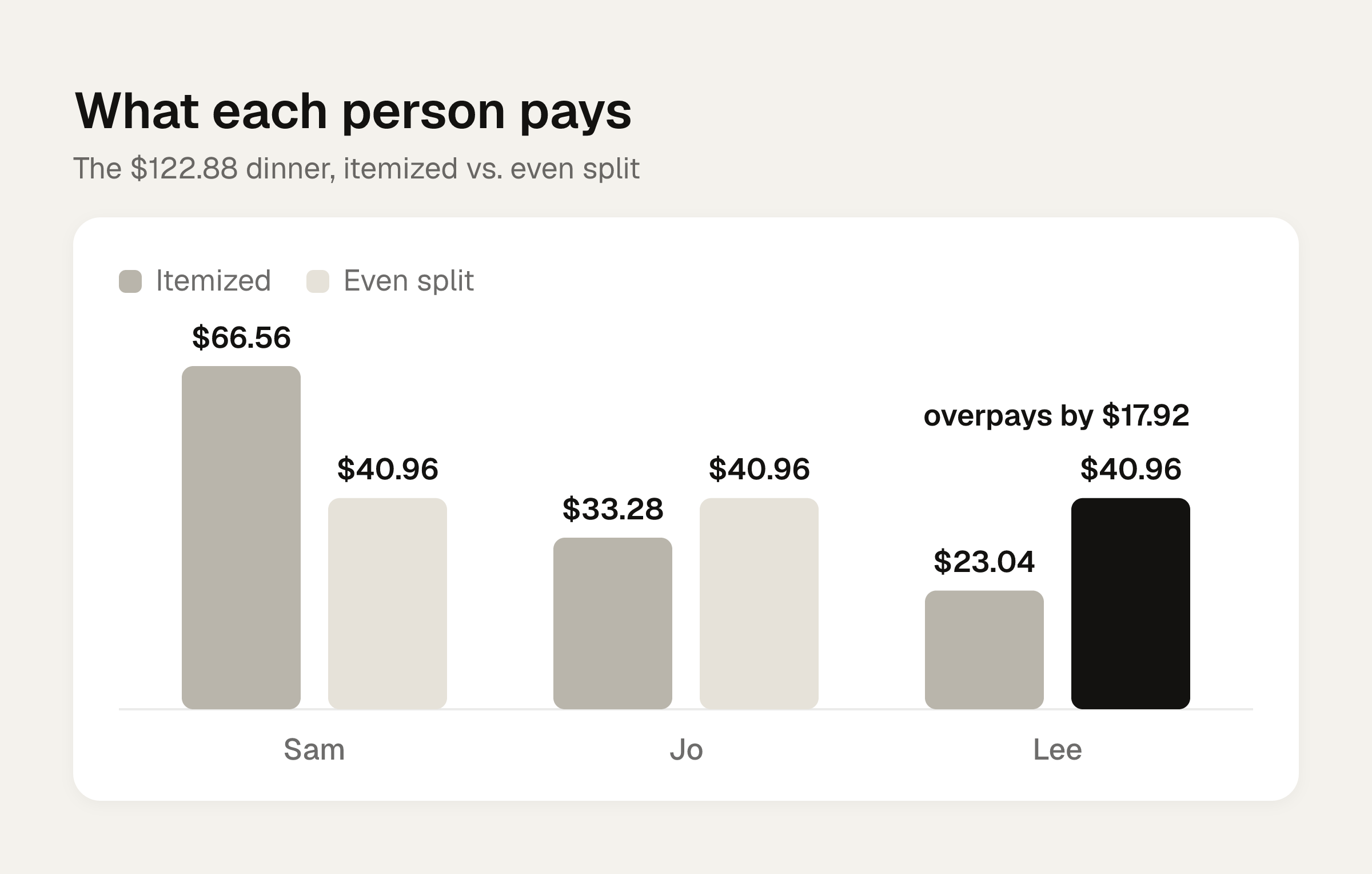
| Sam | $52.00 | $4.16 | $10.40 | $66.56 |
| Jo | $26.00 | $2.08 | $5.20 | $33.28 |
| Lee | $18.00 | $1.44 | $3.60 | $23.04 |
Sam's own share is $66.56, so Jo sends $33.28 and Lee sends $23.04. Sam gets back $56.32 in total. An even split would be $40.96 each, and Lee would overpay by $17.92 for a salad. For the method behind the table, see how to split tax and tip fairly. The bill split calculator does the same itemized math, with tip.
Getting paid back for the one-off costs
This is where Divvy bill splitting fits. Point the camera at the receipt and Divvy reads every line item, the tax and the tip. Tap a name on each item to assign it, and split a shared item between people. Tax and tip are split by each person's share of the items, so the table above comes out the same way.
Each person's share becomes a Venmo or Cash App request in one tap, with reminders until it's paid. Friends don't need the app or an account: they open a share link, see what they owe, and pay.
The app is for iPhone and needs iOS 17 or later.
If you also want to track what a group owes across many receipts, our list of shared expense tracker apps compares the options. Before you open any account, though, have the 20-minute talk and write the terms down.
Frequently asked questions
Does opening a joint account affect my credit?
Opening one typically triggers a soft pull on both people, according to BECU. The bigger credit risk comes later: an unpaid negative balance can go to collections and be reported to the credit bureaus for both owners.
Should roommates use a joint account or just split bills each month?
A joint account suits bills that repeat, such as rent and utilities, because autopay and fixed deposits remove the chasing. For irregular costs, many housemates skip the account and settle once a month in a single transfer.
Do we still need separate accounts if we have a joint one?
Yes. Couples commonly keep two individual accounts plus one joint account for shared costs. Separate accounts cover personal purchases, so nobody has to ask permission, and they hold reserve money for overages.
What happens if one of us spends too much from the joint account?
Both holders are responsible for an overdrawn balance, whoever spent the money. BECU's example is a $10,000 spend from a $5,000 account, where the bank could take the missing $5,000 from the other person's individual account.
How often should we review a shared account?
Look at the statement and incoming bills monthly, hold a money meeting weekly, monthly or quarterly, and do a short review twice a year to check that the deposit amounts still fit.
Sources
- Personal Finance for Couples: Managing Joint Finances - DFPI
- How Should Couples Split Finances? The Complete Breakdown
- Joint Bank Accounts: How They Work, Rights, and What to Watch Out For
- Joint Accounts: Pros and Cons for Couples
- Split Expenses Fairly — Methods Roommates Actually Use
- Joint bank accounts: How they work & how to open one