Divvy
Receipt Breakdown: Split Tax and Tip on a $185.22 Dinner
By The Divvy Team · November 22, 2026 · 9 min read
A receipt breakdown starts with the subtotal, which is the food and drink before anything else, plus every separately named charge that rides on it: tax, service charge, card surcharge, automatic gratuity and tip. Split those charges in proportion to what each person ordered, because dividing by headcount makes the lightest orderer pay for the heaviest.
Below is one real-sized dinner, broken down line by line, with the equal split next to the by-item split. If you fronted the money, this is the math that lets you ask for a number nobody argues with.
A receipt breakdown, line by line
Most receipts have the same few lines, in the same order.
- Subtotal: the price of what was ordered, before tax. This is the number every other charge is built on.
- Tax: a percentage of the subtotal, set by the city or state.
- Service charge or automatic gratuity: a percentage some restaurants add, often for large parties. Treat it like tip.
- Card surcharge: a small fee some places add for paying by card.
- Tip: what you add for the server.
- Total: what actually left your card.
Sometimes the receipt shows only a total and you need to work backward. Tax is the total paid minus the pre-tax subtotal. The pre-tax subtotal is the total paid divided by (1 plus the tax rate).
A Dallas example: $48.00 of food, 8.25% tax of $3.96, total $51.96. Going backward, $51.96 ÷ 1.0825 gives $48.00 back. To find the rate from a receipt, divide the tax line by the subtotal. $3.96 ÷ $48.00 is 0.0825.
For more on how restaurants label these extra charges, see what a service charge is and how to split it.
Worked example: a $185.22 dinner for four
Four people, one check. Ana, Ben, Cara and Dan ordered, and Cara's card paid the bill.
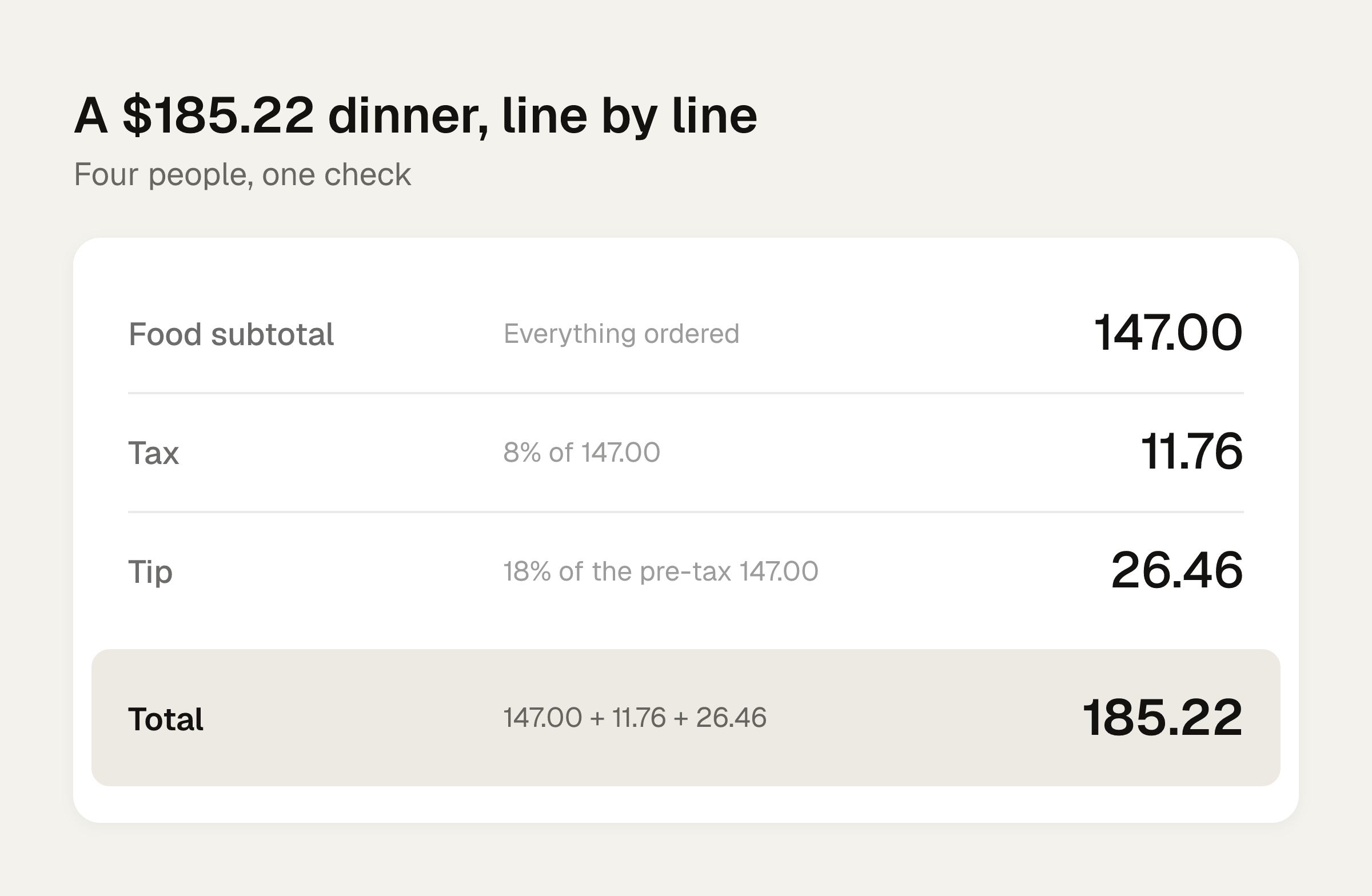
| Line | How it's figured | Amount |
|---|---|---|
| Food subtotal | Everything ordered | 147.00 |
| Tax | 8% of 147.00 | 11.76 |
| Tip | 18% of the pre-tax 147.00 | 26.46 |
| Total | 147.00 + 11.76 + 26.46 | 185.22 |
Here is what each person ordered:
- Ana: 14.00
- Ben: 33.00
- Cara: 64.00
- Dan: 36.00
Those add up to 147.00.
The equal split
185.22 ÷ 4 = 46.305, which rounds to 46.31 each. Ana ordered 14.00 of food and would pay 46.31. That is over three times her food bill. Splitting the total evenly overcharges whoever ordered least.
The by-item split
Use one multiplier. Divide the bill total by the subtotal: 185.22 ÷ 147.00 = 1.26. That 1.26 covers the food itself, the 8% tax and the 18% tip in one step. Each person's food times 1.26 is their share.
| Person | Food | Equal split | By item (food × 1.26) | Equal split vs. by item |
|---|---|---|---|---|
| Ana | 14.00 | 46.31 | 17.64 | pays 28.67 too much |
| Ben | 33.00 | 46.31 | 41.58 | pays 4.73 too much |
| Cara | 64.00 | 46.31 | 80.64 | pays 34.33 too little |
| Dan | 36.00 | 46.31 | 45.36 | pays 0.95 too much |
The by-item shares add up to 185.22 exactly: 17.64 + 41.58 + 80.64 + 45.36. (Four shares of 46.31 come to 185.24, two cents over, because 46.305 had to round somewhere.)
Cara fronted the whole bill. By item, she gets back 104.58 from the other three. On an equal split she would have asked for 138.93 and Ana would have been quietly out 28.67.
Splitting only tax and tip evenly still misses
A common shortcut: everyone pays their own food, then tax and tip are divided equally. Tax and tip together are 11.76 + 26.46 = 38.22, or 9.56 each across four people.
Check it against each person's fair share, which is their food × 0.26:
- Ana's fair tax and tip is 3.64. She pays 9.56, which is 5.92 too much.
- Ben's is 8.58. He pays 0.98 too much.
- Dan's is 9.36. He pays 0.20 too much.
- Cara's is 16.64. She pays 7.08 too little.
It is a smaller error than the full equal split, but it still lands on the same person. Our guide to splitting tax and tip fairly covers the proportional method in more detail.
A second, smaller check
Run it on $80.00 of food, $7.20 tax and a $14.40 tip (18%). The total is $101.60. Tax and tip come to $21.60, which is 27% of the food, so the multiplier is 1.27.
- Anna ordered $30.00 and pays $38.10.
- Ben ordered $28.00 and pays $35.56.
- Chloe ordered $22.00 and pays $27.94.
Their slices of the tax and tip are 37.5%, 35% and 27.5%, and the three shares add up to $101.60.
Which number the tip is based on
Tip on the pre-tax subtotal. On the 147.00 bill, an 18% tip on the taxed amount (158.76) is 28.58. That is about 2.12 more than the 26.46 above. On a $100 meal with 15% tax, a 20% tip is $20. Figuring it on the taxed $115 gives $23.
A tip you add after the bill is presented is not taxed, so it sits outside the subtotal-times-rate math. It still gets split in proportion to food.
Service charges and automatic gratuity
A percentage-based service charge or automatic gratuity (a compulsory 18% for a big party, say) is split proportionally, the same as tip. A flat-dollar service charge follows the flat-fee rule: split it evenly, or among whoever it covers.
Take a $200 subtotal. At about 9% tax, that is $18. A 20% service charge is $40. The bill before any extra tip is $258, and an even split is $64.50 each. If the orders are far apart, the multiplier works here too: 258 ÷ 200 = 1.29.
When an equal split is fine
Equal is the right call more often than people think.
- Drinks, a taxi, or a shared platter everyone ate from.
- Orders that are close. If everyone is within a few dollars of each other, the two methods differ by well under a dollar a head.
Split by items when the gap is big: a table with cocktails and a table without, or someone who skipped dessert. If a friend had water and a salad, offer to take the alcohol off their share before they have to ask. It costs you one line of math and saves them a quiet wince.
For a longer walkthrough of that method, see how to split a bill by item.
Exceptions that change the math
- A tax that hits only some items. One multiplier is an approximation if, say, a drink-only tax applies to part of the bill. Split that line among the drinkers in proportion to their drink totals, and use the multiplier for the rest.
- Shared plates. Split the price among the people who shared it, then add each person's piece to their own food before multiplying.
- Couples. A couple sharing a room or a meal takes two shares. On the example bill with five shares (Ana, Ben, Dan, and Cara counted twice), 185.22 ÷ 5 = 37.044. Ana, Ben and Dan pay 37.04 each and Cara pays 74.09. That is a cent short of 185.22, so Cara covers the extra cent.
- Income-based splits. If two people earn 60,000 and 40,000, they split 60/40. The same multiplier idea applies: each share is their percentage of the total.
Rounding, cash and two-price menus
Split the total before any cash rounding. The cash handed over can differ by a few cents. Rounding only happens on cash payments, so a table paying by card never sees that line.
When shares don't land on whole cents, round up unless the group has agreed otherwise. Rounding down leaves a shortfall, and the person who fronted the money covers it. Differences of 1 or 2 cents in tax are normal and not worth chasing.
If the restaurant uses two-price menus with a cash discount, reimburse at the total that was charged, not the menu total.
Getting paid back without the awkward ask
Send each person one number. "Your share is 41.58" is easy to pay. "It was 33 for your food plus a part of the tax, plus tip" is a conversation.
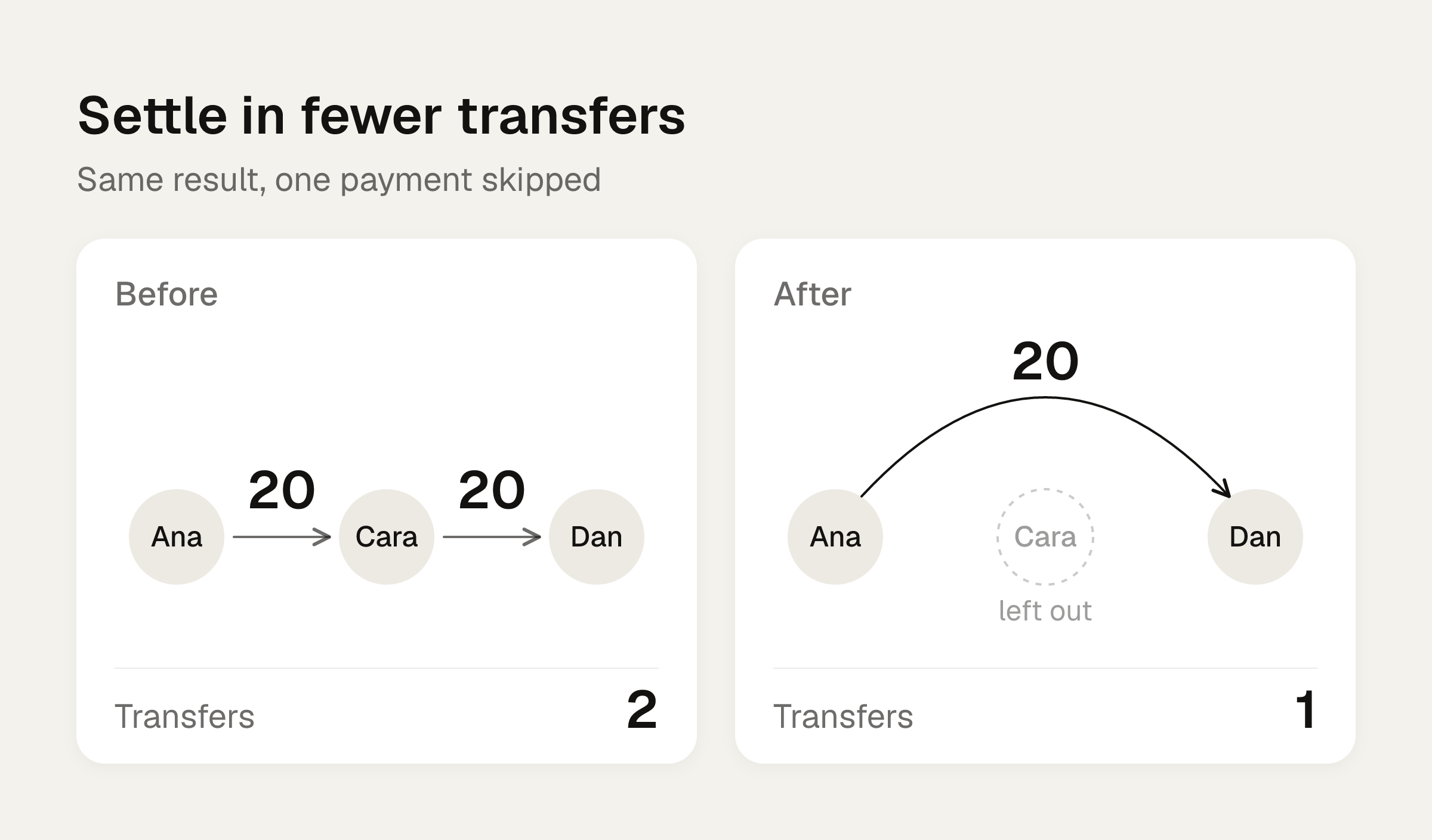
On a multi-day trip, net the balances so the group settles in the fewest possible transfers. If Ana owes Cara 20 and Cara owes Dan 20, Ana can pay Dan directly and Cara is out of it. That beats everyone paying everyone.
Run your own receipt through it
To check your own bill, use the bill split calculator. It splits evenly or by item, with tip. If the receipt is a crumpled paper one, this guide to receipt scanning apps covers getting the line items off it without typing.
Divvy bill splitting is an iPhone app built for this exact job, if you'd rather not do the multiplication at the table. Either way, write the multiplier down before the check arrives: total ÷ subtotal, then each person's food times that number.
Frequently asked questions
How do I find the tax rate on a receipt?
Divide the tax line by the pre-tax subtotal. On the sample dinner, 11.76 ÷ 147.00 is 0.08, so the rate is 8%. If the receipt only shows a total, divide the total by 1 plus the rate to get the subtotal.
What if the restaurant already added gratuity?
Look for a line called gratuity or service charge. If it is there, it is the tip, so don't add a second one unless you want to. Split it in proportion to what each person ordered, the same as a tip.
How much does someone who ordered 8.00 of food owe on the $185.22 dinner?
8.00 × 1.26 = 10.08. That includes their share of the 8% tax and the 18% pre-tax tip.
Why do the shares sometimes miss the total by a cent?
Each share is rounded to the nearest cent, and the rounding doesn't always cancel out. Have one person, usually whoever fronted the bill, absorb the extra cent, or round shares up by agreement.
Sources
- How to Split a Bill Fairly (5 Methods, One Worked Example) · EconoGlance
- Your restaurant receipt, explained: every charge, line by line
- How to split tax and tip: in proportion, not per head
- Split Bill Calculator - Pay Your Part
- Bill Split Calculator - Free Online, With Tax and Tip
- Itemized Bill Splitter — Fair Tip & Tax Split
- How to Read Your Receipt's Tax Breakdown