Divvy
DivvyHow to Settle the Account Without Awkward Math
By The Divvy Team · September 22, 2026 · 12 min read
The check lands on the table after a dinner where one person ordered a salad, another shared several appetizers, and someone else added drinks and an expensive entrée. Splitting the total evenly is quick, but it can leave the lightest eater subsidizing the biggest order. Then someone asks who paid the tax, whether the tip was already included, and why the payment request doesn't match the receipt.
To settle the account cleanly, treat the process as more than arithmetic. Capture the receipt, assign each item, distribute shared costs fairly, send a payment request through a familiar app, and follow up without turning a small balance into a friendship problem. The same workflow helps with restaurant checks, bar tabs, takeout, group trips, roommate expenses, and recurring household bills.
Table of Contents
- Why Settling the Account Fairly Matters More Than You Think
- Scan the Receipt and Assign Every Item Correctly
- Allocate Tax and Tip Proportionally So No One Overpays
- Send Payment Requests That People Actually Pay
- Handle Reminders Disputes and Tricky Edge Cases
- Settle Up Faster and Keep Group Spending Stress Free
Why Settling the Account Fairly Matters More Than You Think
An even split feels harmless until the orders are noticeably different. Suppose four friends share a table, but one person has only a modest meal while another adds drinks, premium dishes, and several shared plates. Dividing the final total by four hides those differences. The result may be mathematically simple, yet it doesn't reflect what each person consumed.
Fairness also changes how people behave at the table. A peer-reviewed field experiment on restaurant bills found that diners who paid equally consumed more than they would have under individualized payment, because the even split weakened the connection between personal choices and personal cost. The practical lesson is straightforward: when everyone pays the same amount, people have less financial reason to moderate an expensive order.
Practical rule: If the orders aren't broadly similar, don't start with an equal split. Start with the items.
A transparent settlement has a visible path from receipt to payment. Everyone can see which entrée, drink, or shared plate belongs to them, how tax and tip were allocated, and why the final request has that amount. That visibility matters for friends who want to avoid awkwardness, roommates who need a repeatable system, and trip organizers who can't afford to maintain a confusing running ledger.
The account is properly settled when three things are true:
- The receipt is accurate: Every line item, fee, discount, tax, and gratuity has been checked.
- The allocation is explainable: Each person's total follows a rule the group agreed to.
- The payment is complete: Requests go through familiar channels, and outstanding balances don't linger without a clear follow-up.
This approach takes a few deliberate choices at the start, but it removes the harder conversation later. Nobody has to guess who owes what, reconstruct the receipt from memory, or challenge an unexplained number after the group has already gone home.
Scan the Receipt and Assign Every Item Correctly
Start while the receipt is still in front of you. Photograph the entire bill in good light, keeping the item names, quantities, subtotal, tax, tip, and any service charges visible. An AI receipt scanner can read those fields and turn the printed check into assignable line items, but you should still compare the scan with the original before sending requests.
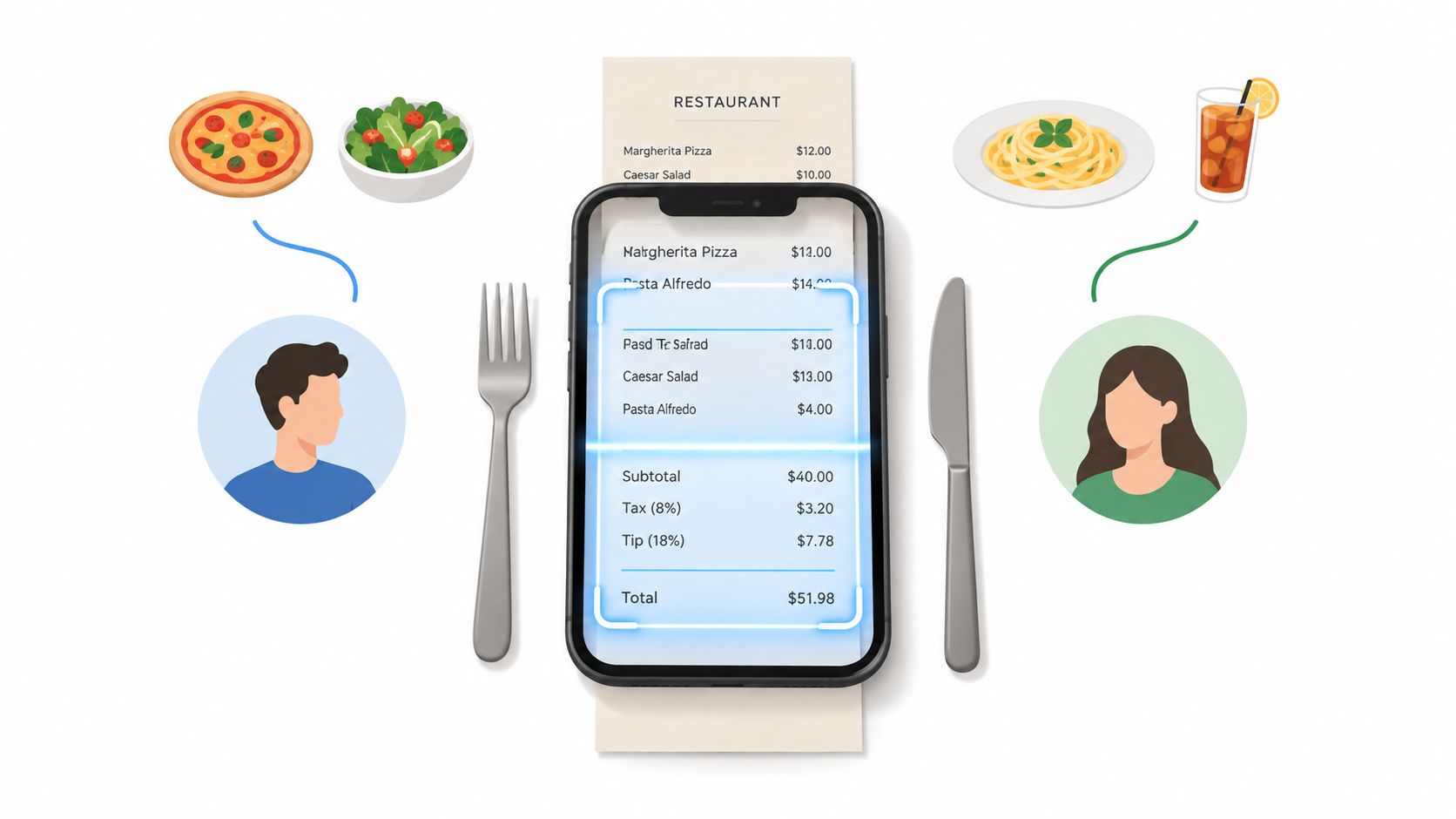
Check the scan before assigning people
OCR can misread a quantity, confuse a decimal, or combine a modifier with the main dish. Verify the following:
- Item names and prices: Make sure every dish appears once and the price matches the receipt.
- Quantities: If the check lists multiple servings of the same item, confirm whether they belong to one person or several.
- Discounts and credits: Identify whether a coupon applies to one item or the whole bill before assigning final amounts.
- Fees and gratuity: Separate tax, service fees, delivery charges, and any automatic tip from food and drinks.
After verification, tap each item and assign it to the person who ordered it. A solo entrée goes to one diner. A bottle shared by four people can be divided evenly. An appetizer shared by two people should be split between those two, not across the entire table just because everyone sat nearby.
A clear assignment also handles mixed preferences. If two people shared a vegetable platter, one person ordered a meat dish, and another skipped alcohol, the receipt should show those distinctions. Add-ons and modifiers deserve the same attention. Extra cheese, a side, or a premium substitution belongs with the person who requested it unless the group explicitly agreed to share it.
For practical advice on keeping receipts readable and organized before you split them, use these receipt tips from Approved Experiences Traveler. Then compare the final assigned items with the physical check, especially when the restaurant prints abbreviated descriptions.
You can also follow this guide to splitting a bill by item when the table includes shared dishes, separate drinks, or several quantities of the same line item.
Once the item list looks right, show the group the assignments before anyone pays. A quick confirmation, such as “This appetizer is split between these two people, and the drinks stay separate,” prevents most disputes before they reach the payment stage.
Allocate Tax and Tip Proportionally So No One Overpays
A small order and a large order should not carry the same tax and tip charge. Allocate those shared costs according to each person's food subtotal, so the receipt balances without making the lighter order subsidize the larger one.
Start with the assigned food totals, excluding tax and tip. Divide each person's subtotal by the group's total food subtotal to get that person's share ratio. Apply the ratio separately to tax, tip, service charges, and other percentage-based common costs. EconoGlance's guide to splitting a bill fairly describes the same proportional approach and notes that a flat allocation on an uneven check can overcharge a light order by roughly one-third.
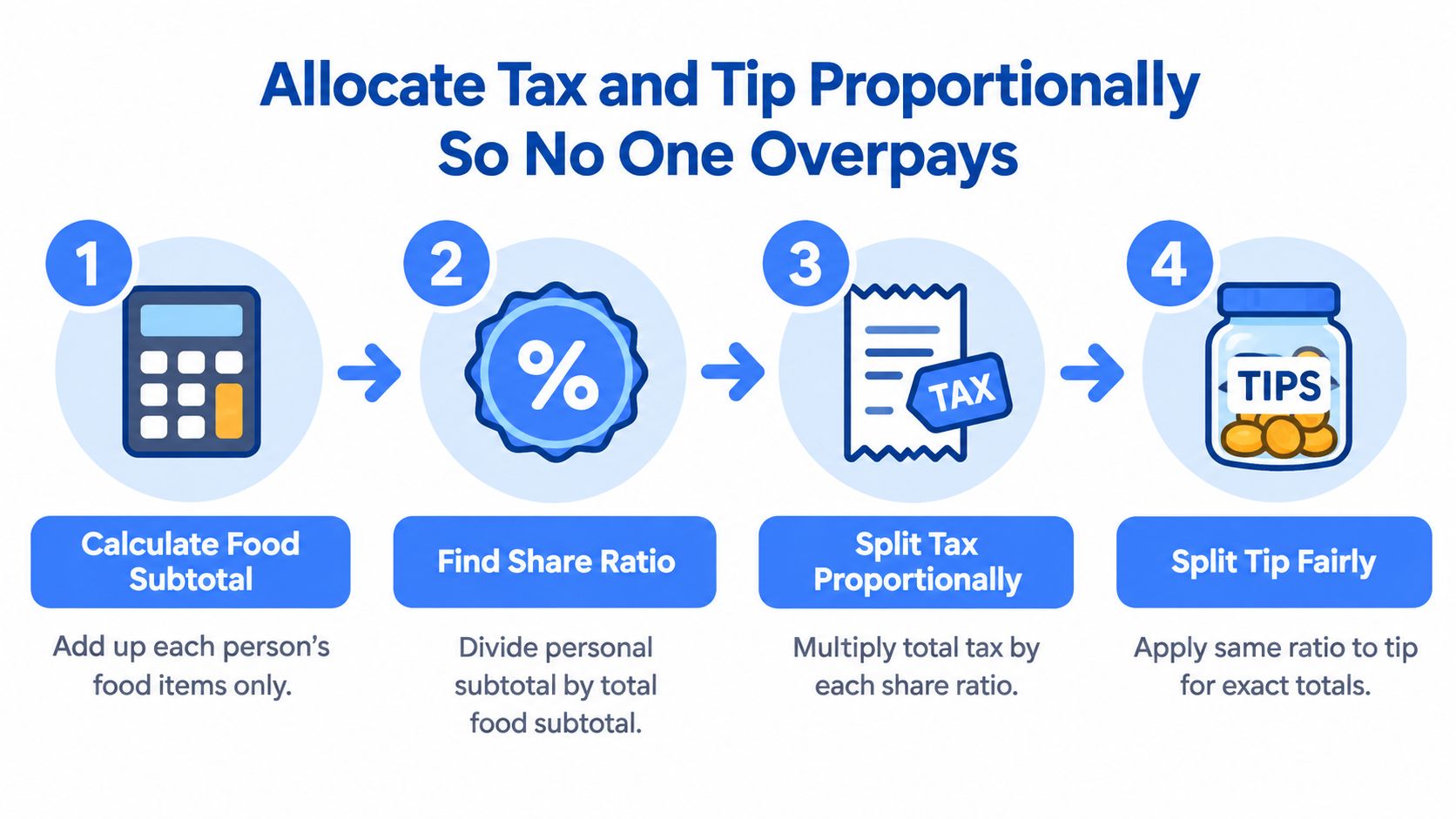
A shared appetizer needs one decision before the calculation. Split its price among the people sharing it, add each portion to those diners' subtotals, then calculate the ratios. The final allocations will reconcile to the receipt, while each person still pays according to what they consumed.
Discounts require the same discipline. Apply an item-specific discount to that item when the receipt identifies one. For a whole-bill discount, use the method the group agreed on, then calculate tax and tip from the reduced subtotal. Otherwise, the group may allocate charges from a subtotal the restaurant has already lowered.
Large parties also need a gratuity check. Look for “auto gratuity,” “service charge,” or “included tip” before anyone chooses an additional tip option. A restaurant may already have added automatic gratuity of around 18–20%. Adding the same amount again can produce an effective gratuity rate of 36–40%.
The workflow is easier to audit when the app shows the assigned items, each subtotal, and the tax and tip allocation before sending payment requests. One-tap requests then reflect a total the group has already had a chance to verify, rather than forcing everyone to reconstruct the math from a screenshot.
For the calculation details, follow this tax and tip splitting guide. The rule stays simple: assign the items, reduce for discounts, calculate each subtotal's share, and apply that share to the common charges.
Send Payment Requests That People Actually Pay
A correct split can still stall at the payment step. Send each person one request through a payment method they already use, such as Apple Pay, Venmo, or Cash App. Asking someone to install an unfamiliar tool for a single dinner adds friction and gives the payment another place to get delayed.
Payment choices usually turn on cost, convenience, and timing. A practical request therefore identifies the sender, shows the exact amount, includes a short memo, and opens a payment path the recipient can use immediately.
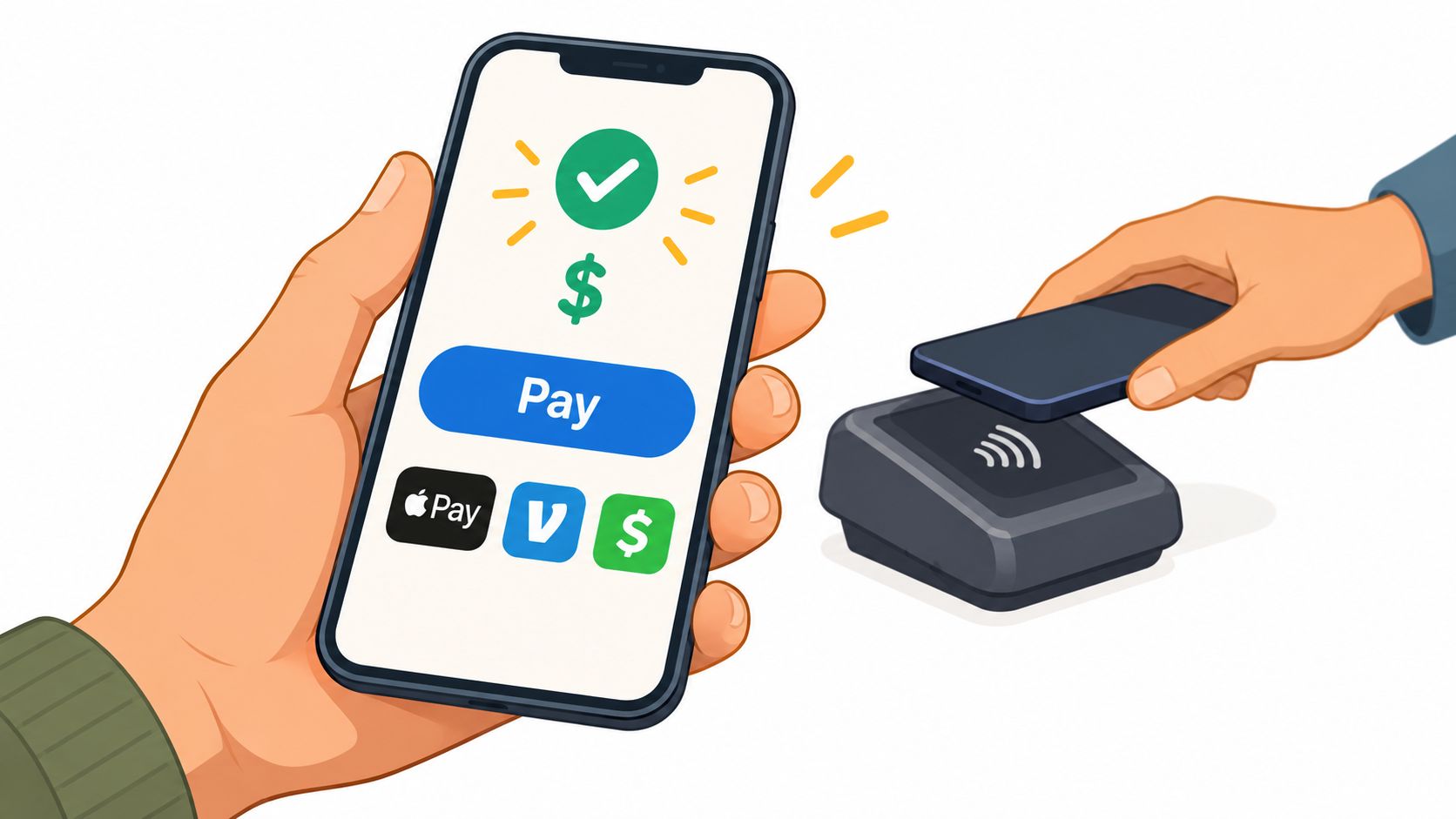
Give the recipient enough context
A clear memo prevents the recipient from guessing which balance is open. “Friday dinner, entrée and shared appetizer” works better than “money owed,” especially for someone handling several reimbursements. Check the recipient, amount, and payment handle before sending, since similar names can lead to misdirected requests.
The request should expose the calculation without turning the recipient into an auditor. Show the assigned items or expense behind the total, select the recipient's familiar payment rail, and send one request for that specific balance. Keep unrelated expenses separate. Record the balance only after the payment is confirmed, because sending a request does not settle it.
Divvy can scan a receipt, assign line items, allocate tax and tip proportionally, and create payment requests through common money apps. Friends can receive a request without installing the app or creating an account, removing a common delay. For platform-specific wording and steps, see this guide on how to request money on Venmo.
Timing and wording affect whether a request feels routine or confrontational. Send it while the meal is still fresh, include the itemized context, and avoid vague language that makes the recipient reconstruct the bill. A short, specific request is easier to act on than a screenshot with no explanation.
Give people a way to flag a real mistake before the request becomes social pressure. If the amount is wrong, correct the receipt and resend the request. If it is right, the itemized memo lets the recipient settle promptly or point to one specific line that needs review.
Handle Reminders Disputes and Tricky Edge Cases
A missed payment request does not always signal resistance. Someone may be driving, moving money between accounts, or assuming another person already paid. Treat the reminder as part of the settlement workflow, not as a personal accusation.
Use a restrained cadence. Trove reports that 58% of invoices are paid after a single reminder, while two reminders recover about 80% of overdue invoices (Trove's reminder guidance). Send one neutral follow-up, then a second only if the balance remains open. Repeated messages add social friction without adding useful information.
Keep the wording factual: “Reminder for your dinner share, the itemized total is still open. Let me know if anything looks wrong.”
Handle a disagreement differently from a delay. Re-share the receipt, show the assigned items, and state how shared dishes, discounts, tax, and tip were allocated. If the group agreed on a rule that differs from the receipt, record the adjustment clearly. A visible change gives everyone one calculation to review instead of creating a private argument about the final amount.
Some cases need a specific operating rule:
- Non-app users: Send the request through a payment method they already use, or provide the itemized amount and agree on another route.
- Partial payments: Record what arrived and leave the remaining balance visible. A partial transfer does not close the account.
- Late add-ons: Recalculate the affected shares when a drink, dessert, or fee appears. Keep it separate from the next unrelated bill.
- Recurring expenses: Set one stable split for each rent, utility, or subscription bill, with one monthly settle-up day. Update variable utilities when the provider's bill arrives.
- Post-relationship balances: Keep contact narrow and factual. A dated itemization and clear payment request reduce repeated personal exchanges.
For clubs and recurring memberships, smart payment compliance for clubs offers a useful reminder principle: consistent follow-ups work better when payment status stays visible. Apply the same rule to roommates and travel groups. Agree on the reminder cadence before the next bill, then use one-tap requests, clear memos, and neutral language so paying is easier than disputing a vague total.
Settle Up Faster and Keep Group Spending Stress Free
The most dependable habit is to close the loop while the receipt is still available. Scan it, verify the line items, assign ownership, allocate shared charges proportionally, and send requests before everyone leaves the table. Waiting turns a clear transaction into a memory exercise, especially after a trip with multiple providers, currencies, deposits, and shared purchases.
An even split is fine when the orders are similar and the group accepts that shortcut. Use item-level allocation when one person skips drinks, another orders substantially more, or shared dishes make the check uneven. For rent and household costs, a dedicated calculator can help compare equal, income-based, room-size, or other agreed methods instead of forcing every recurring expense into a restaurant-style split.
A simple closing checklist keeps the process repeatable:
- Capture the complete receipt: Include tax, tip, fees, discounts, and automatic gratuity.
- Assign every item: Split shared dishes only among the people who shared them.
- Check the totals: Confirm assigned subtotals reconcile with the receipt.
- Send familiar requests: Use the recipient's preferred payment method and a specific memo.
- Follow up neutrally: Remind once, then again if necessary, without escalating the tone.
Divvy is designed for this immediate, single-bill workflow, with AI receipt scanning, item assignment, proportional tax and tip allocation, payment requests, and reminders. Its iPhone app handles restaurant and group checks, while its web calculators support rent and recurring-cost decisions when equal shares don't fit the household arrangement.
Use Divvy at your next dinner or trip to scan the receipt, assign each item, calculate fair shares, and send payment requests before the group disperses. Make settling the account a same-day habit, so shared spending stays transparent and friendships stay easy.