Divvy
Divvy10 App to Split Rent Payments Options Compared
By The Divvy Team · September 8, 2026 · 22 min read
One roommate pays the landlord, another covers the internet bill, and two others send different amounts after someone adjusts the split for a larger bedroom. By the end of the month, everyone may agree on the total, yet the household still has to calculate each share, send requests, remember who has paid, and confirm that the final rent payment went through.
The best app to split rent payments depends on where the money needs to move. Some tools calculate itemized shares and create payment requests. Others maintain a shared ledger for rent and utilities. Consumer payment apps collect contributions, while landlord-backed portals let each roommate pay the property directly.
This comparison focuses on per-person requests, recurring rent support, payment integrations, device compatibility, pricing structure, reminders, and control of the final landlord payment. The distinction matters. An expense tracker can show that someone owes money without collecting it, while a payment portal may move money efficiently but offer little help with unequal room sizes or shared household costs.
Table of Contents
- 1. Divvy
- 2. Splitwise
- 3. Settle Up
- 4. Tricount by bunq
- 5. Splid
- 6. Splittr
- 7. Venmo
- 8. Cash App Pools
- 9. Apartments.com Rent
- 10. Avail by Realtor.com
- Top 10 Rent-Splitting Apps Comparison
- Choose the Settlement Path That Fits
1. Divvy
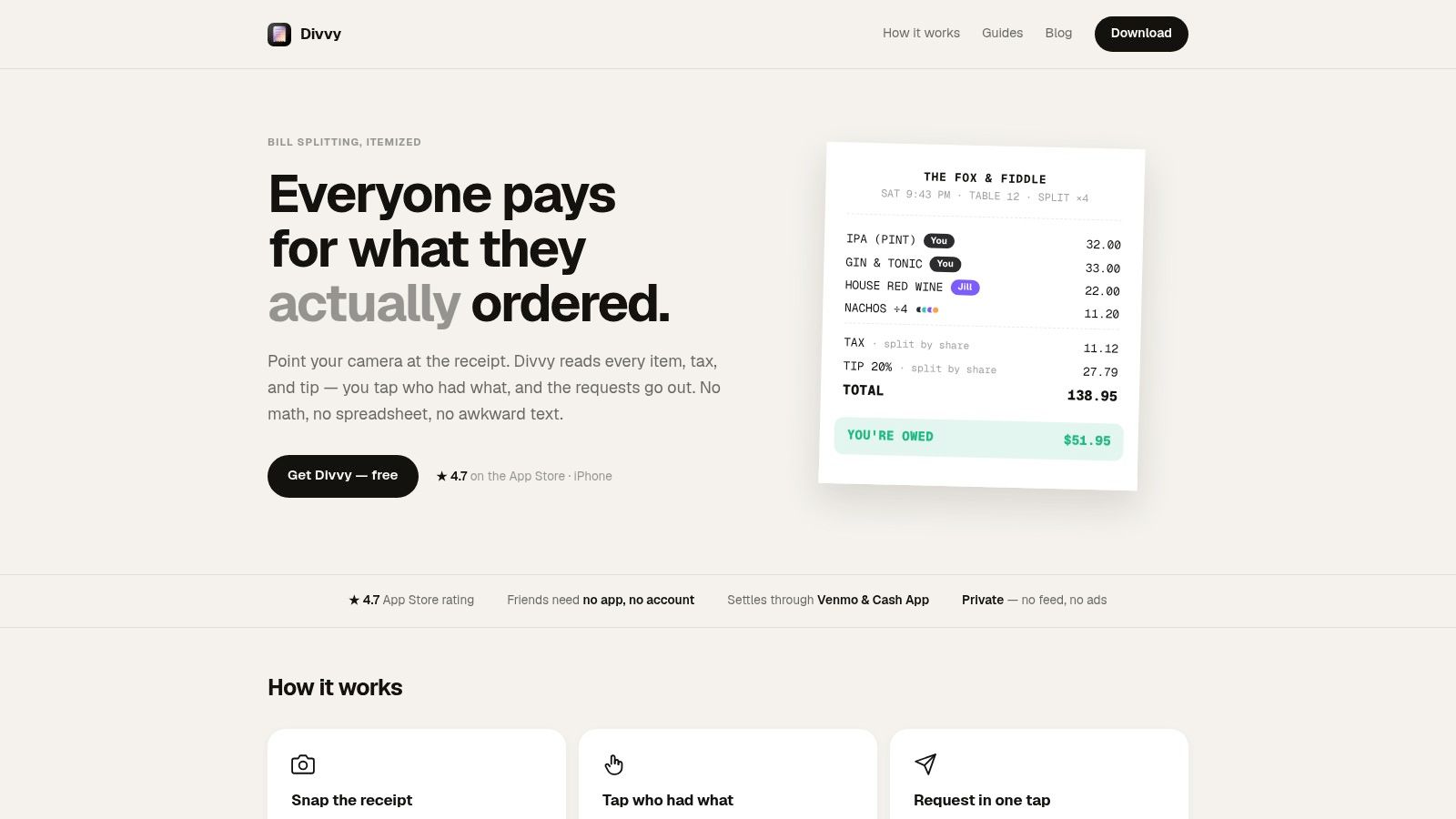
Divvy is the strongest fit when the household needs to calculate individual shares and request payment without forcing every roommate to install the same app. It's an iPhone app built around item-level allocation, but its roommate workflow also supports recurring household costs, including rent and utilities. Its roommate rent-splitting guide explains the practical use case, particularly when people contribute different amounts.
Best for itemized calculations and fast requests
Divvy scans a receipt with AI, reads line items, tax, and tip, then lets the payer assign items to specific people or divide shared plates. Tax and tip are allocated proportionally, so one roommate isn't subsidizing another person's purchases. For rent, its web calculators can support splits based on income, room size, or an even arrangement, which is more useful than a simple equal division when bedrooms differ.
The settlement layer is also more direct than a conventional ledger. Divvy can create payment requests through Apple Pay, Venmo, or Cash App, and friends don't need to download Divvy or create an account to respond. Automated reminders continue until balances are settled, reducing the repeated messages that usually follow a shared bill.
Practical rule: Use Divvy when one person is doing the calculation and the group wants to pay through tools it already uses.
The trade-off is device compatibility. Divvy is iPhone-only, so a household with Android users may need a different primary tool. Heavy users may also need the optional Divvy Pro subscription for unlimited AI receipt scans, while supported payment apps remain necessary for the actual transfer. Divvy is free to download from the App Store, with advanced usage available through Pro.
2. Splitwise
Splitwise functions primarily as a shared expense ledger. Roommates can maintain a record of rent, utilities, subscriptions, and household purchases, while the person who pays the landlord collects each roommate's share through a separate payment service. That separation is the key trade-off: Splitwise organizes obligations, but does not by itself move rent to the landlord.
Recurring expenses allow a household to enter monthly rent and bills without recreating the arrangement each cycle. Roommates can assign percentages, shares, or custom amounts, and debt minimization can reduce the number of repayments across the group. Reminders keep unpaid balances visible when one person regularly covers the full bill.
Where Splitwise stops
The app records who paid, who owes, and how balances change over time through mobile and web interfaces. Its Pro tier adds receipt scanning, itemization, charts, and analytics, but the payment path remains separate from the ledger.
A typical workflow is to record a rent payment in Splitwise, send a request through Venmo or Zelle, then mark the balance settled after the transfer arrives. This creates an audit trail, although it adds setup and settlement friction. The payer must use a second app, and someone must update the ledger after payment. Households that need direct landlord collection should compare Splitwise alternatives that handle collection directly.
Splitwise fits households that value a continuing financial record more than one-tap collection.
Splitwise began in February 2011 as SplitTheRent, expanded into broader expense sharing, added Venmo integration in September 2013, and later added direct bank transfer capability through a partnership with Tink in April 2024. Its funding milestones, including $1.4 million in December 2014, $5 million in October 2016, and $20 million in April 2021, show the category's development beyond informal roommate spreadsheets. The Splitwise history documents those milestones.
3. Settle Up
Settle Up takes the familiar shared-ledger approach and packages it for flatmates, couples, and groups that need recurring entries. A household can create a monthly rent transaction, add utilities and other shared costs, and establish default shares so the same allocation doesn't have to be recreated every billing cycle.
The app supports mobile and web access, which helps mixed-device households avoid a phone-specific workflow. It also offers Splitwise import, an important migration feature for groups that already have a history of shared expenses and don't want to start from a blank ledger.
Flexible pricing, separate settlement
Settle Up includes debt minimization and custom default shares. Those features matter when roommates don't split rent equally or when one person regularly pays for household services. The app can show the cleanest way to settle the group balance rather than requiring every person to reimburse every other person separately.
Its pricing model is a practical differentiator. Depending on the setup, users can choose flexible paid access, including a one-time Group Premium payment, instead of assuming that every household wants another recurring subscription. Advanced features may still sit behind Premium or Group Premium.
The limitation is adoption. Settle Up has fewer existing users than Splitwise, so a new household may need to persuade everyone to join or explain the workflow from scratch. It remains an expense tracker. The app can document that a roommate owes rent, but the transfer itself generally happens elsewhere.
Choose Settle Up when the group wants a polished ledger, recurring transactions, and a potentially less subscription-heavy pricing path. Don't choose it expecting the app to replace the landlord's payment portal or automatically collect every roommate's share.
4. Tricount by bunq
Tricount is a free, no-ads group-expense ledger designed for shared spending. For roommates, its useful feature is flexibility. Each person's share can be adjusted rather than forced into an equal split, which suits houses with different room sizes, varied utility use, or agreed contributions that don't match the headcount.
The app works across iOS and Android, making it easier for mixed-device households to use one ledger. It also supports exports, which can help the household retain a record outside the app or reconcile expenses with another system.
The bunq connection
Tricount's connection with bunq can automatically post linked card payments to a group ledger. That can reduce manual entry for users already inside the bunq ecosystem, but it doesn't turn Tricount into a universal rent collection portal. Native payment movement isn't the central workflow, so the final settlement usually takes place through another service.
This makes Tricount a better choice for households that want a running balance and automatic expense capture than for a group seeking direct-to-landlord payments. A roommate can see the shared position, but someone still has to send or receive the final money and confirm that the ledger reflects the completed transfer.
The more important question isn't “Who owes what?” It's “Does this app move the money, or only describe the debt?”
Some capabilities may continue evolving after the bunq acquisition, and export support can depend on the current product setup. Tricount's main appeal is its straightforward, free ledger model, especially when roommates want ongoing visibility without ads or a subscription requirement.
5. Splid
Splid is a lightweight option for roommates who want a simple expense record without building a complicated shared financial system. It can work offline and sync once a connection returns, which is useful in travel groups, shared houses with unreliable service, or situations where someone wants to record a payment immediately.
The workflow is straightforward. Add an expense, choose who participated, set custom shares, and let the app calculate the resulting balances. Basic use can work without an account in some modes, reducing onboarding friction for a household that doesn't want every roommate to create another login.
Reliable ledger, limited payment layer
Splid is best understood as a calculation and tracking tool. It doesn't provide built-in payment rails, so roommates still need Venmo, Cash App, bank transfer, or another method to send the money. The person who paid the landlord remains responsible for collecting contributions and marking them as received.
That separation can be either an advantage or a drawback. A simple ledger is easier to explain, less dependent on payment-provider policies, and useful when different roommates prefer different payment methods. But it also leaves the most socially awkward step, asking for and confirming payment, outside the app.
Optional Excel export is available through an in-app purchase, giving users a way to preserve or analyze the records elsewhere. Advanced export needs may therefore add a one-time cost, even though the core expense workflow is intentionally light.
Splid suits a household that values offline access and minimal setup. It won't suit readers searching for an app to split rent payments that sends direct requests, supports automated reminders, or routes partial rent to a landlord.
6. Splittr
Splittr is an iOS-focused expense splitter with features that translate well to recurring roommate costs. Recurring expenses can handle monthly rent and bills, while custom categories and offline-capable entry make it practical for a household that records expenses as they occur rather than reconciling everything at the end of the month.
The app also supports CSV and PDF exports, multi-currency expenses, and a smart settle-up function that minimizes the number of payments needed. Multi-currency support is more relevant to trips and international households than ordinary rent, but it can matter when roommates share expenses across borders or move between currencies.
A good ledger for Apple households
Splittr's pricing structure includes a one-time or lifetime option alongside annual access. That gives users a way to evaluate the cost as a longer-term utility rather than automatically accepting another monthly bill. The exact value depends on how often the household uses recurring entries, exports, and settlement calculations.
The central limitation is the same one found across ledger-style tools. Splittr calculates obligations, but payment still occurs outside the app. A roommate may use the smart settlement result, send the recommended transfer through a consumer payment service, and then return to Splittr to confirm the transaction.
Because it's iOS-centric, Splittr isn't an ideal shared platform for a household with Android users. It can be a strong choice for an all-iPhone group that wants a longstanding, focused expense tool and doesn't need direct landlord collection.
7. Venmo
A household can settle rent quickly when every roommate already uses Venmo. The service moves money between people and supports requests to multiple recipients, with separate amounts that can be edited. A primary payer can therefore calculate each share, send itemized requests, and monitor who has paid. For step-by-step instructions, see this guide to splitting a bill on Venmo.
Venmo handles collection rather than household accounting. It records transaction activity and payment status, but it does not create the same structured history as Splitwise or Settle Up for recurring expenses, unequal room arrangements, or itemized utility calculations. The organizer may still need a spreadsheet or separate ledger to show how rent and bills were divided.
Familiar rails, manual rent control
Existing adoption reduces setup friction. If all roommates have accounts, the organizer can send requests without asking everyone to install another expense app. Venmo can also reimburse the roommate who pays the landlord, or send rent directly to a landlord who accepts Venmo.
The trade-off is settlement control. Venmo does not provide automatic recurring peer-to-peer transfers to friends, so someone must initiate or approve each monthly request. Credit-card-funded payments and instant cash-outs may involve fees, requiring an agreement about who pays them. A roommate without Venmo can also force the group to use another payment method, while the app does not coordinate direct landlord collection.
Settlement test: If the payer disappeared after sending the request, would the household still know how each amount was calculated?
Venmo is a consumer payment rail, not a complete rent-splitting system. Pair it with a ledger for an ongoing expense record, or use it with Divvy when the priority is calculating distinct shares and requesting them from roommates.
8. Cash App Pools
Cash App Pools is designed around a shared collection goal. A roommate can create a Pool for the month's rent, set the target, and let contributors add their portions toward that total. The feature can support contributors who don't have Cash App accounts, which is useful when the household's payment preferences are mixed.
This changes the collection experience. Instead of sending separate reminders and tracking several individual transfers manually, the organizer can see contributions against one household target. That doesn't solve the calculation problem by itself, so roommates still need to agree on the amount each person should contribute.
One target, one final payer
Cash App Pools doesn't make the landlord a participant in the process. The organizer still has to move the collected funds to their Cash Balance and pay the landlord through the accepted method. The person who creates the Pool therefore controls the final payment and carries the operational responsibility if a contribution is late or incomplete.
Fees, eligibility, and other policies depend on the Cash App terms and product rules, so the household should confirm the current conditions before relying on Pools for recurring rent. The feature is most useful when everyone agrees that one person will remain the rent coordinator but wants a clearer collection target.
For background on how Cash App fits into broader payment workflows, see this Cash App ecosystem explanation. Cash App Pools is a middle ground between a basic peer-to-peer request and a landlord portal. It centralizes contributions without removing the organizer from the payment chain.
9. Apartments.com Rent
Apartments.com Rent Collection, formerly associated with Cozy, addresses the part most roommate expense apps leave unresolved. Rather than having one tenant collect the full amount and reimburse the landlord, the landlord can invite each roommate to pay an individual portion directly.
That changes the responsibility map. Each tenant's payment reaches the landlord, and the household can see which people have scheduled or sent their share. The primary payer no longer has to front the entire rent or chase reimbursements after the due date.
Landlord participation is mandatory
The system supports split rent and lets tenants choose a payment date within the landlord's configuration. It can also handle deposits and fees as set up by the landlord, which makes it more appropriate for a formal rental relationship than a consumer expense tracker.
The dependency is decisive. The landlord must enable Apartments.com Rent Collection and configure the household correctly. If the property owner doesn't use the platform, roommates can't create a private group and route rent through it.
The platform also doesn't replace the need to decide how the split should work. Roommates may still need a separate calculator or written agreement for unequal rooms, utilities, or move-in changes. Its strength is direct-to-landlord collection, not item-level household accounting.
Choose Apartments.com Rent when the property owner is willing to support separate tenant payments and the household wants to eliminate personal reimbursements. For a broader overview of landlord-oriented rent systems, consult this landlord app guide.
10. Avail by Realtor.com
Avail is another landlord-backed payment portal that supports partial payments toward total rent. Each roommate can pay a share through the tenant-facing system, so the household doesn't have to funnel the full amount through one person before the landlord receives it.
Payment options include bank transfer through ACH or card, with scheduling and tools for editing, canceling, and managing payments. That provides more formal documentation than a casual peer-to-peer reimbursement and gives tenants a clearer record of what they sent toward the property's total balance.
A direct path with a setup gate
Avail's principal advantage is structural. The landlord receives the roommate contributions directly, which removes the reimbursement step and makes the final payment responsibility less concentrated in one tenant. It can also help when a household needs to correct or manage a partial payment rather than send an informal transfer and explain it later.
The limitation is landlord adoption. Avail only works for this purpose when the landlord uses the platform and enables the relevant payment workflow. Card payments may carry fees, and settlement timing depends on the selected payment rail, so roommates should verify the total cost and expected availability of funds before the first due date.
Avail is better than a ledger when the objective is documented, partial, direct rent payment. It isn't the best tool for calculating who should pay what when the household has complicated room-size, move-in, or utility rules. Use a separate calculation method if the portal accepts amounts but doesn't define the household's internal agreement.
Top 10 Rent-Splitting Apps Comparison
| Tool | Core features | UX / Quality (★) | Price & value (💰) | Target (👥) | Unique selling point (✨) |
|---|---|---|---|---|---|
| Divvy 🏆 | AI receipt OCR; per-item & shared-plate splits; auto tax & tip; one-tap Apple Pay/Venmo/Cash App requests | 4.7★, fast, privacy-first iPhone app | Free + Divvy Pro (unlimited scans) 💰 | Friends splitting meals, roommates, trip organizers | ✨ Works without others installing; automated reminders & web calculators |
| Splitwise | Running ledger; recurring bills; debt minimization; optional itemization | ★★★★, familiar, cross-platform | Free + Pro (receipt OCR, analytics) 💰 | Roommates, couples, long-term groups | ✨ Wide adoption & strong debt-simplify tools |
| Settle Up | Recurring rent entries; debt minimization; Splitwise import; web + mobile | ★★★☆, clear UI for roommates | Free + Premium / one-time Group unlock 💰 | Flatmates & groups preferring simple pricing | ✨ Flexible pricing (one-time Group Premium) |
| Tricount (bunq) | Group ledger; uneven splits; bunq auto-posting; exports | ★★★★, ad-free, international | Free (no ads) 💰 | International roommates & travel groups | ✨ 100% free with bunq integration for auto-tracking |
| Splid | Offline-first; per-expense custom splits; optional export | ★★★★, simple, reliable, offline-capable | Low-cost / one-time in-app purchases 💰 | Users wanting a lightweight, reliable ledger | ✨ Works fully offline; no account required in some modes |
| Splittr | iOS-focused splits; recurring expenses; multi-currency; CSV/PDF export | ★★★★, well-rated iOS app | One-time/lifetime or low annual fee 💰 | iOS users, travelers, roommates | ✨ Lifetime pricing option & multi-currency support |
| Venmo | P2P payments; multi-person requests & split edits; social feed | ★★★★, ubiquitous in U.S. | Free (bank); fees for card/instant cash-outs 💰 | US roommates who already use Venmo | ✨ Broad adoption; fast multi-person requests |
| Cash App (Pools) | Create Pools to collect shares toward a target; contributors add funds | ★★★☆, simple pooled collection | Free to use; fees/policies per Cash App 💰 | Roommates collecting monthly rent/goals | ✨ Pool goal collection; some contributors need no account |
| Apartments.com Rent | Landlord-invited split payments; tenants pay landlord directly | ★★★, landlord-dependent experience | Varies by landlord; platform fees possible 💰 | Tenants in buildings where landlord enables it | ✨ Direct-to-landlord per-tenant payments; payment visibility |
| Avail (Realtor.com) | Tenant partial payments; ACH/card; scheduling & payment management | ★★★, robust rent tools when enabled | Depends on landlord; card fees possible 💰 | Tenants whose landlords use Avail | ✨ Partial payments to landlord with scheduling & edits |
Choose the Settlement Path That Fits
The right app to split rent payments is determined less by the brand name than by the point where your household experiences friction. If the problem is calculating unequal shares, assigning individual costs, or sending requests through payment apps people already use, Divvy is the most direct fit. It combines itemized allocation with requests through Apple Pay, Venmo, or Cash App, and recipients don't need to install the app.
For recurring balances, choose a ledger-style tool. Splitwise, Settle Up, Tricount, Splid, and Splittr can maintain a record of rent, utilities, groceries, and other shared expenses. They're useful when the household needs history, flexible split rules, or debt minimization. They generally don't replace the payment rail, so the organizer must still collect money elsewhere and update the record.
If the main collection method is already a consumer payment service, Venmo offers familiar multi-person requests, while Cash App Pools creates one shared target for contributions. Both can reduce coordination work, but neither removes the need to decide who controls the final landlord payment. Cash App Pools can accommodate contributors without Cash App accounts according to its stated product terms, while Venmo is most convenient when the household already uses Venmo.
When the landlord can accept separate or partial payments, Apartments.com Rent or Avail provides the cleanest settlement path. The landlord receives contributions directly, which avoids roommate reimbursements. The trade-off is that landlord participation is required, and the platform may not solve the internal calculation of unequal shares.
Put the workflow in writing
Before the first recurring collection cycle, confirm the following:
- Device compatibility: Check whether every roommate can use the selected app, particularly with iOS-focused tools such as Divvy and Splittr.
- Split rules: Agree on equal shares, room-size adjustments, income-based contributions, utility allocation, and what happens when someone moves in or out.
- Fees and timing: Verify card charges, transfer fees, subscription requirements, processing times, and the date funds become available.
- Final payment control: Decide whether one roommate pays the landlord, a Cash App Pool organizer controls the funds, or the landlord receives separate payments.
- First-cycle test: Run one complete collection cycle before relying on the system for every monthly rent payment.
Rent-splitting products have grown from niche roommate utilities into broader consumer finance services. Splitwise's development and funding history reflects that progression, while Flex's reported scale in 2026, including service to more than 3 million renters and processing of more than $39 billion in rent payments, shows how large digital rent collection has become according to Flex. The practical lesson is narrower but more useful: a calculation tool, a payment request tool, and a landlord collection portal solve different problems.
A 2023 Indonesia usability study illustrates why the calculation layer still matters. 64.3% of 28 respondents said bill splitting was difficult, while the tested app reached 92.73% effectiveness, 92.00% efficiency, 85.50% satisfaction, and 90.08% overall usability after two design iterations, as reported in the study repository. The exact figures apply to that study, not every rent app, but the conclusion is transferable. People need clear item-level allocation and low-friction calculations before payment collection can work smoothly.
Payment compatibility matters just as much. A 2024 survey reported that 48% of U.S. consumers had used digital wallets in the past 90 days, with Venmo used by 22% of digital-wallet users and Cash App Pay by 19%, while the cited research also noted that mobile wallets represented 6% of North American point-of-sale transactions compared with 40% for credit cards. Those figures support a practical design choice, integrate with payment behaviors people already have instead of requiring a new payment habit. Review the digital wallet research for the underlying context.
Finally, don't judge an app only by equal monthly splits. Roommate arrangements change when someone joins mid-lease, moves out, or occupies a larger room. Product FAQs that address these cases, such as the guidance on splitting rent with roommates, point to an underserved requirement: lifecycle handling. Choose a system that can explain and adjust the household's rules, then choose the payment path that makes the final transfer visible and accountable.
Divvy combines itemized calculations, proportional tax and tip allocation, roommate rent tools, and payment requests through Apple Pay, Venmo, or Cash App. If your household wants clear shares without making every roommate install another app, visit Divvy and test whether its workflow fits your first collection cycle.