Divvy
DivvyCost to Rent a Room in a House
By The Divvy Team · October 7, 2026 · 13 min read
You've just found a room that looks affordable. The rent fits your budget, the photos look decent, and the landlord says utilities are “roughly split.” Then move-in week hits, and the actual monthly number is higher than you expected because the bedroom is smaller, the heating bill is brutal, and nobody agreed on parking or internet before signing.
The cost to rent a room in a house is never just the advertised number on the listing. In the UK, the average room reached £753 per month in Q3 2025, with London at £995 and regional averages ranging from £549 in North East England to £749 in the South East, according to SpareRoom's rental index. Those gaps matter because a room in one house can be a bargain and a room in another can be a bad deal, even when the headline rent looks similar. If you're renting out a room yourself, VerticalRent's guide on renting a room in your home is a useful complement, especially when you're deciding what to charge and how to structure the agreement.
Table of Contents
- The Reality of Room Rental Costs
- Key Factors That Determine a Fair Room Price
- Proven Methods to Split Rent Fairly
- Calculating Your Share With Real-World Examples
- Hidden Household Costs Most Roommates Forget
- How to Settle Up and Manage Ongoing Expenses
The Reality of Room Rental Costs
A room can fit your rent budget and still strain your finances once the bills arrive. The advertised figure is only the starting point. Your monthly cost also includes utilities, transport, deposits, and household extras, so calculate the full outflow before signing.
In the UK, room prices vary sharply by location. SpareRoom's Q3 2025 data reports a nationwide average of £753 per month, compared with £995 in London, £549 in North East England, and £561 in Yorkshire and Humberside SpareRoom Q3 2025 rental index. A “cheap room” means little without its location and the costs attached to living there. If you are renting out a room, this guide to renting a room in your home can help you set the charge and define the agreement.
Budgeting exposes weak deals quickly. At £753 per month, rent alone totals £9,036 a year before utilities, deposits, transport, or shared household purchases. Use a simple monthly model: rent plus fixed bills plus variable bills plus agreed extras. For unequal rooms, assign different rent shares, then split utilities equally or according to usage. Put both calculations in writing.
Practical rule: judge a room by the full monthly outflow, not the advertised rent. If the listing lacks enough information to estimate that total, treat the price as incomplete.
Prices also change over time. SpareRoom's later analysis places the UK average room rent at £761 in Q2 2026, alongside a 29% increase over five years to about £749 per month SpareRoom Q2 2026 rental index. Use local, current comparisons rather than relying on one national figure.
Key Factors That Determine a Fair Room Price
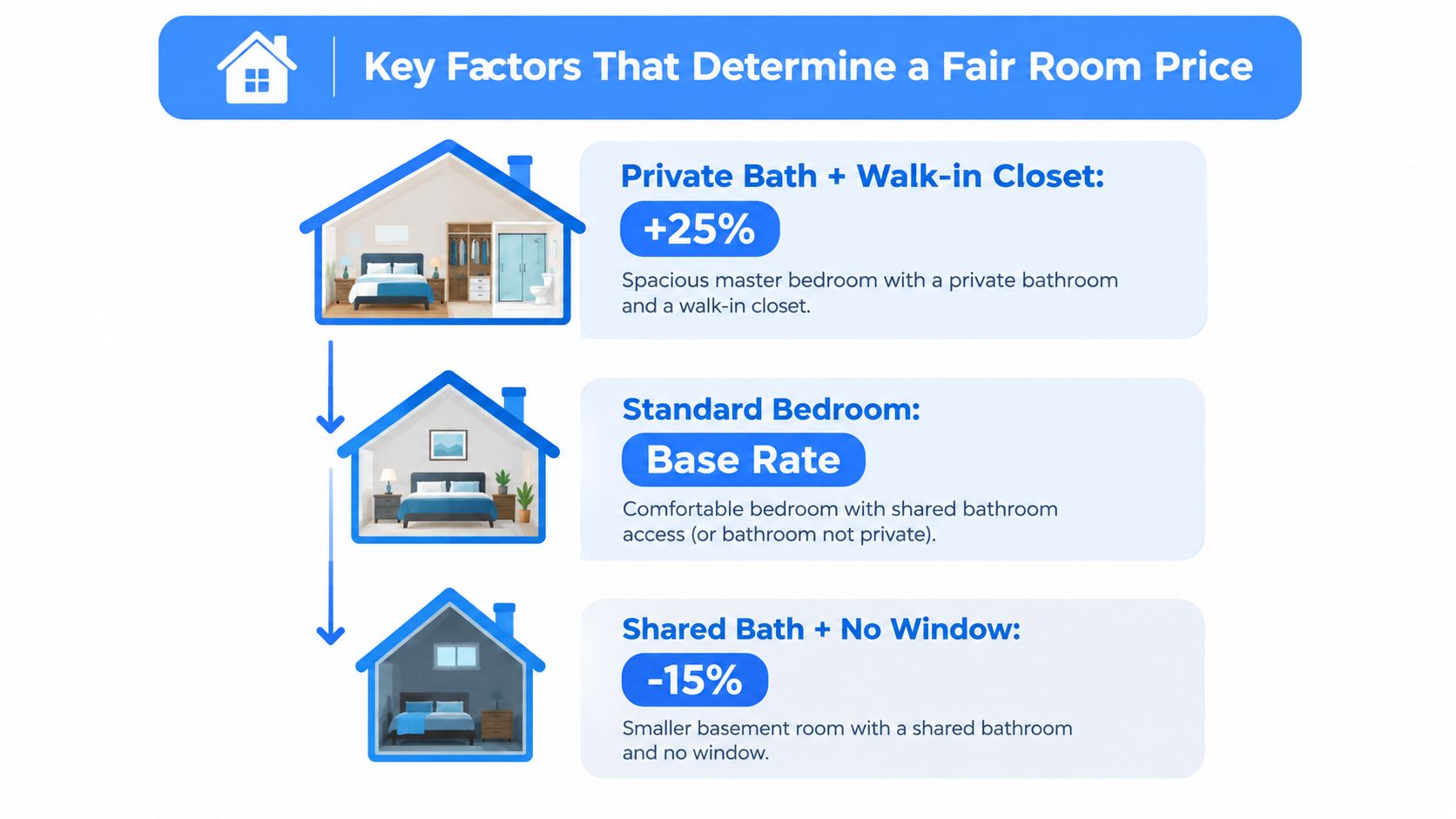
A £750 room with a private bathroom, strong natural light, and quiet surroundings is not equivalent to a £750 basement room beside the kitchen. Compare the features before comparing the prices. That simple rule prevents one roommate from paying for value another roommate receives.
The room itself carries the first premium
Measure the private space, then assess how usable it is. Square footage matters, but natural light, ceiling height, storage, heating, and noise matter too. A smaller, quiet room with a large closet may be preferable to a larger room with poor heating or constant foot traffic.
Use this rent per square foot calculation method to establish a baseline. Then adjust for livability. A measurement gives you a defensible starting point, not a complete valuation.
Amenities change the math fast
Private facilities should affect the room price. An en-suite bathroom, balcony, or dedicated parking space supports a premium. Shared facilities, limited storage, poor light, awkward layouts, and noise support a discount.
Apply adjustments consistently. On a £750 base rent, a 15% en-suite premium adds £112 per month, while a 10% discount for a room without a window removes £75. Write each adjustment down before anyone chooses a room. Clear arithmetic is easier to accept than a vague claim that one room “feels better.”
Use a short house audit:
- Count the private advantages: bathroom, closet size, balcony, parking, light, and privacy.
- Count the private disadvantages: noise, no window, weak heating, awkward layout, and proximity to shared areas.
- Assign a visible premium or discount: record the reason and the amount.
- Compare all rooms against the same baseline: use a standard bedroom as the reference point.
A fair price also reflects the total monthly cost. Add rent, fixed bills, variable utilities, and agreed household purchases before deciding whether a room fits the budget. A cheaper room can cost more overall if it has higher heating needs or poor access to transport.
The wider market provides a boundary, not the answer. Regional benchmarks, including the Q3 2025 figures, help identify an unusual asking price, but they cannot measure a room's light, privacy, storage, or household costs. Check local comparisons, then price the actual room. SpareRoom Q3 2025 rental index
Proven Methods to Split Rent Fairly
A fair rent split starts before anyone claims a room. Agree on the rule first, show the calculations, and include the full monthly cost of shared living. That prevents one roommate from subsidizing another's larger room, better amenities, or heavier utility use.
Use the equal split only when the rooms are close enough
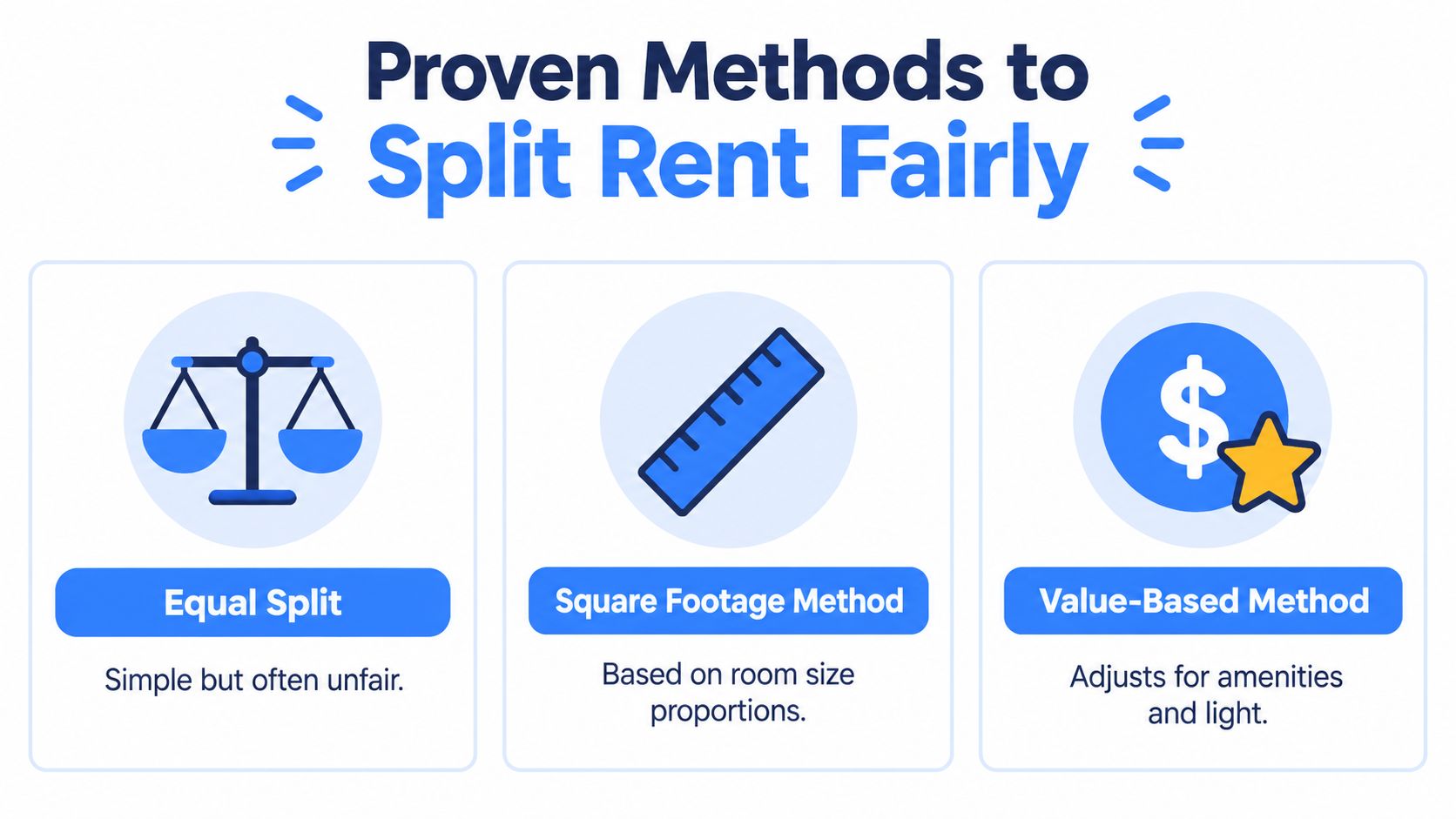
Divide rent equally when bedrooms are similar and no meaningful amenity gap exists. The method stops being fair when one room is larger, brighter, quieter, or includes a private bathroom. Equal shares may avoid an awkward conversation today, but they often create resentment after someone compares what each roommate receives.
Start with square footage
Measure each private bedroom and compare it with the home's total private bedroom area. Assign the base rent according to each room's proportion. A materially larger room costs more, while a cramped room costs less.
This provides a defensible starting point, but square footage alone still misses the practical features people care about. A private bathroom, balcony, better light, larger closet, or greater privacy can support a premium. No window, poor heating, noise, awkward layout, or proximity to shared areas supports a discount.
Apply value-based adjustments
Set each adjustment before room selection. Record the feature, the premium or discount, and the reason. Keep the total rent equal to the lease amount, then allocate agreed fixed bills, variable utilities, and shared household purchases separately. A room with lower rent can still produce a higher monthly cost if it needs more heating or has poor transport access.
The auction method can work for friend groups with clear preferences. Each person states what they would pay for each room, the group checks the proposed amounts against the lease, and everyone adjusts until the figures balance. It is direct, but the result depends on honest bids and a willingness to accept the outcome.
Choose one method before money changes hands. Do not switch from equal shares to square footage, or add amenities selectively, after the lease begins. Changing the rules mid-lease turns a transparent calculation into a recurring dispute.
Best practice: choose the rule before choosing the room. Otherwise, roommates can reverse-engineer the math to support the outcome they already want.
Use the UK market as a boundary, not as the answer. The Q3 2025 SpareRoom Q3 2025 rental index can flag an unusual asking price, but it cannot measure a room's privacy, storage, light, or share of household costs. Compare local rents, then price the actual room and budget for the complete monthly contribution.
Calculating Your Share With Real-World Examples
A three-bedroom house has $3,000 in monthly rent. One bedroom includes a private bathroom, one is standard, and one is smaller with no closet. Equal thirds ignore meaningful differences, so assign a base price by space, then adjust for features.
| Roommate | Private Sq Ft | Amenity Adjustments | Final Monthly Rent |
|---|---|---|---|
| Roommate A | 220 | Private bathroom | $1,150 |
| Roommate B | 180 | Standard room | $1,000 |
| Roommate C | 140 | No closet, smaller room | $850 |
The final amounts total the lease rent. Roommate A pays more for private bathroom access. Roommate C receives a discount for less storage and usable space. Roommate B carries the middle share because the room has neither a premium feature nor a clear drawback.
Calculate rent in two passes
First, calculate each room's base share:
Base room share = room's private square footage ÷ total private square footage × total rent
For this house, the private areas total 540 square feet. Apply that formula to each room, then adjust the results for the bathroom, closet, privacy, or other agreed features. A premium for a private bathroom should come from the other shares, because the total must remain $3,000, not increase beyond the lease.
The calculation should also separate rent from the full monthly cost. Each roommate's contribution can be written as:
Monthly contribution = assigned rent + fixed shared bills + allocated variable costs
Split fixed bills evenly when everyone receives comparable access. For heating, electricity, or water, use an agreed usage rule if rooms differ sharply in size, occupancy, or temperature needs. Record that rule before the first bill arrives.
Make the calculation auditable
The person paying less should see the discount and its reason. The person paying more should see the benefit being priced. Keep the formula, adjustments, and bill rules in one shared worksheet.
Use this how to calculate rent reference to translate uneven room features into monthly figures. Apply the same logic to bedrooms, bathrooms, storage, and other measurable differences.
Use this rule: if everyone cannot explain the split in one minute, revise it before signing the lease.
Hidden Household Costs Most Roommates Forget
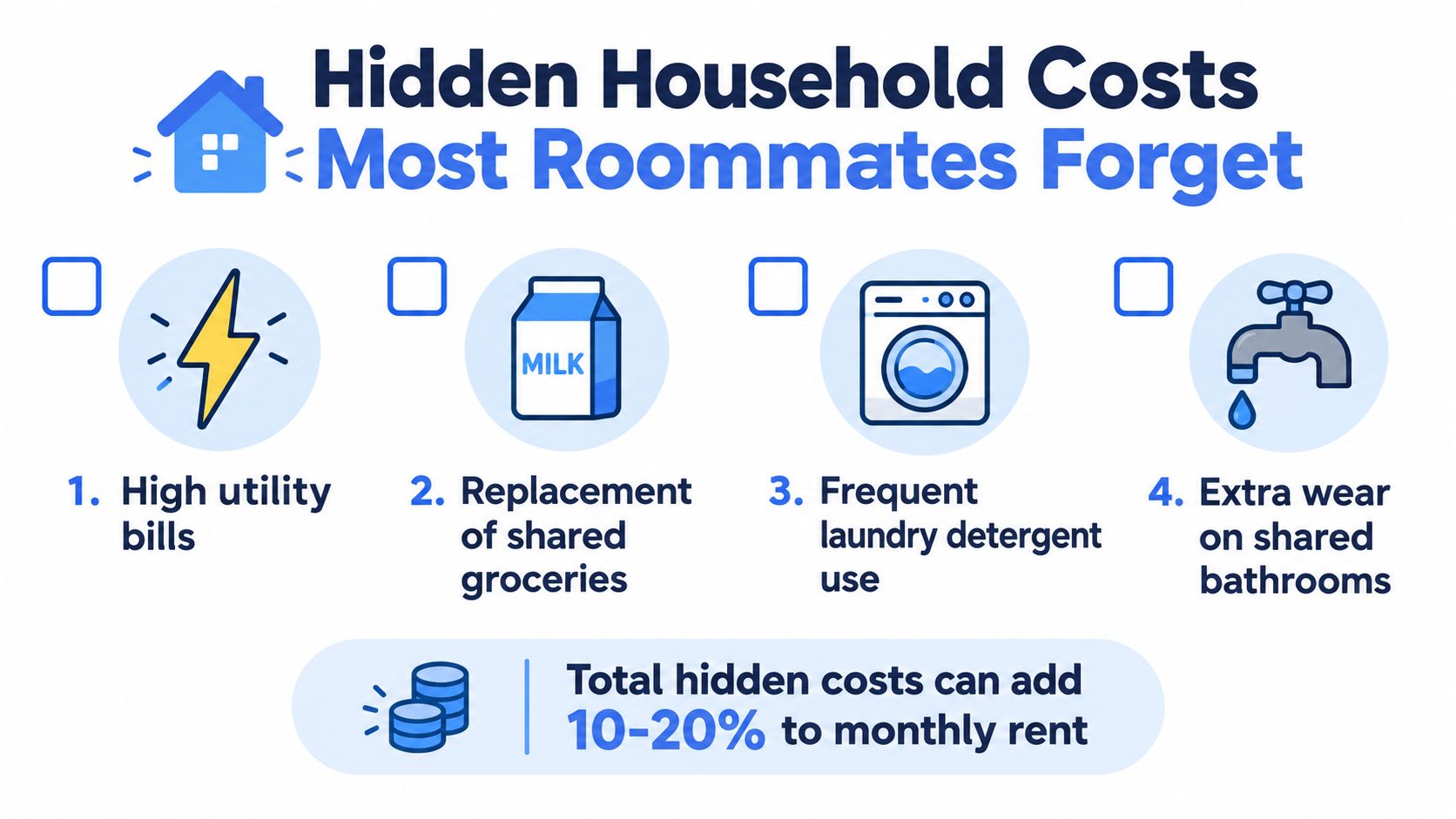
A roommate turns the thermostat up, another works away from home, and the electricity bill arrives. The dispute is rarely about the total. It is about whether the split reflects actual use. Rent gets people through the door, but utilities, groceries, laundry, and bathroom supplies determine the true monthly cost of shared living.
Separate fixed costs from usage-based costs
Internet is usually a fixed shared charge, as are recurring subscriptions and basic household supplies. Add the expected amount to your room budget before comparing rental options. This plan your monthly internet budget reference can help estimate the broadband portion.
Electricity, heating, and water require a different rule. A 50/50 split is easy, but it ignores thermostat settings, time spent at home, room size, and seasonal demand. For example, if variable utilities average $120 in winter and $70 in summer, a 50/50 winter split can overcharge the lower-use roommate by $25 per month when the usage difference is treated separately.
Write the rule before anyone receives the first bill. If rooms have similar use, split the charge evenly. If one person uses substantially more heating or stays home throughout the day, assign a fixed common share first, then divide the remaining usage amount according to the agreed measure. The split utility bills guide offers a practical framework for setting that allocation.
One worksheet solves most arguments
Track household spending in three buckets:
- One-time move-in charges: deposits, keys, and first-time setup costs.
- Recurring fixed bills: internet, subscriptions, and shared cleaning supplies.
- Variable usage costs: electricity, heat, water, laundry, and other personal consumption.
Keep groceries and bathroom supplies visible in the same record. Shared milk, detergent, toilet paper, and cleaning products need a receipt trail and a reimbursement rule. Personal food and toiletries stay personal. Do not classify an item as communal after someone has already paid for it alone.
Use this calculation for each roommate:
Monthly household cost = assigned rent + fixed shared bills + allocated variable costs + agreed shared goods
Review the worksheet monthly. A clear record prevents small purchases from becoming a larger argument about fairness.
Simple rule: rent pays for the room, utilities reflect use, and shared goods require receipts. Blur those categories and roommates will argue over money every month.
How to Settle Up and Manage Ongoing Expenses
A fair split on paper means nothing if no one collects on time. The true test is whether money moves cleanly every month without passive-aggressive reminders or surprise shortfalls. Roommates need a system, not vibes.
Pick one person to track, or automate it
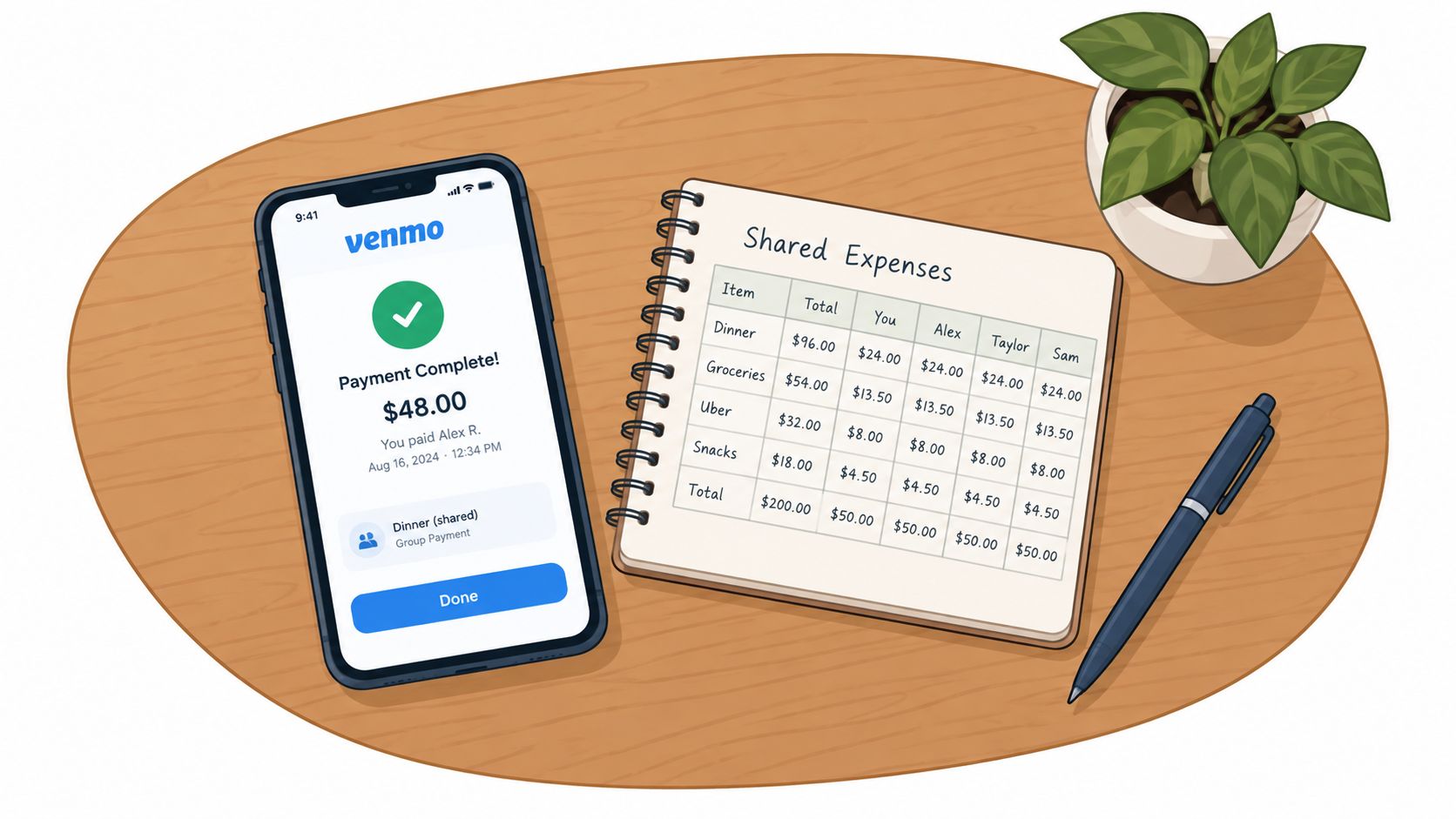
If one person is the leaseholder, that person should either manage collection or use a tool that does it for them. A joint account can work, but only if everyone agrees on deposit timing, reimbursement rules, and what counts as a shared charge. Otherwise, the account becomes another source of resentment.
Use tools that reduce the social friction
Divvy is one option for roommates who want a rent-splitting calculator and shared expense tracking in one place. It supports splitting by room size, income, or equal shares, which makes it easier to match the math to the house instead of forcing a one-size-fits-all approach.
The point is not software for software's sake. The point is removing the awkward part where one roommate has to chase another for money every month. If the system sends reminders and records who paid what, the house stops relying on memory and group chat screenshots.
For anything shared, keep one rule: if it can be reimbursed, it should be logged. Toilet paper, cleaning products, and bulk household purchases all belong in the same ledger as rent, just with a different label.
Make settlement boring
Boring is good. The best roommate money system is the one people stop discussing because it works every month. When the split is clear, the house gets fewer arguments, fewer excuses, and fewer late payments.
If you're setting up a new house or cleaning up a messy one, use Divvy to itemize the split, track what each roommate owes, and keep recurring payments visible. It's built for the exact problem here, the gap between a fair calculation and actual settlement. Set the rules once, run the numbers cleanly, and stop letting monthly money drama eat the house.