Divvy
DivvyHow to Calculate Rent Fairly with Roommates
By The Divvy Team · October 1, 2026 · 13 min read
You're standing in the kitchen with a calculator open, one roommate pointing at the larger bedroom and the other pointing at their paycheck. One person has the master bedroom, private bathroom, and balcony. The other earns twice as much. Both think an equal split is unfair, but they disagree about who should pay more.
That argument happens because fair rent isn't one universal number. It depends on whether your household values equal treatment, proportional use of space, or proportional ability to pay. Before you calculate anything, compare the apartment with similar listings and compare rent against market data so the total rent itself has a reasonable basis.
Table of Contents
- What Fair Rent Really Means Between Roommates
- Three Common Ways to Split Rent
- A Real Rent Split Worked Example With Three Roommates
- Adding Utilities and Shared Bills to the Rent Split
- Handling Mid-Month Move-Ins and Other Edge Cases
- Putting It in Writing With a Simple Roommate Agreement
- Choosing the Right Rent Split for Your Household
What Fair Rent Really Means Between Roommates
Most roommates make the same mistake: they choose a formula before agreeing on what the formula should represent. Dividing total rent by the number of occupants is easy, but it treats a tiny bedroom exactly like a large room with a private bath. That may be acceptable in one apartment and absurd in another.
Use three fairness lenses:
- Equal split: Everyone pays the same amount because the rooms, amenities, and household use are broadly similar.
- Size-based split: Each person pays for an equal share of common space plus a larger or smaller share of private space based on measurable room value.
- Income-based split: Each person contributes according to their share of combined household income.
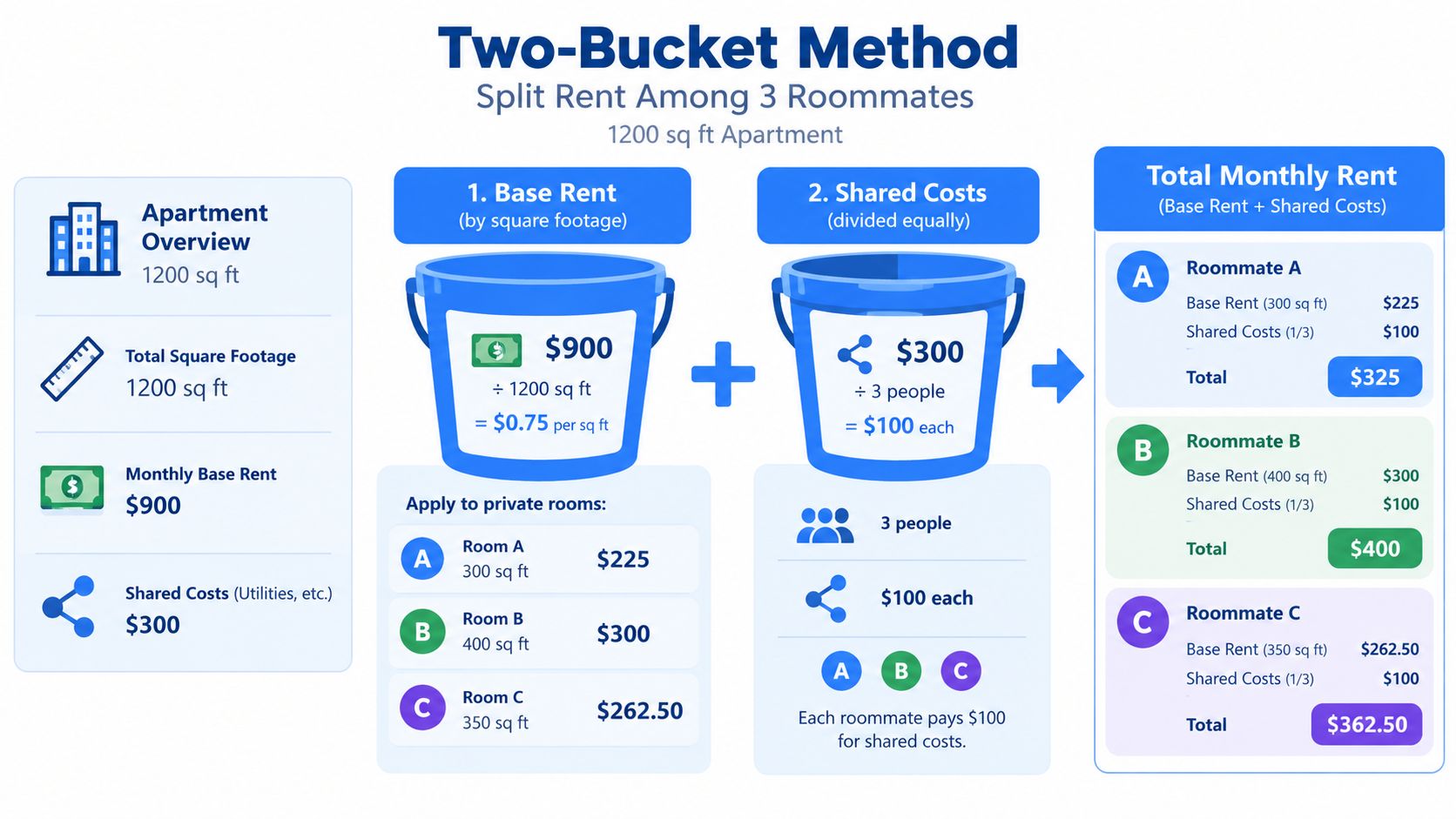
The strongest default is a two-bucket method. Put the apartment into a shared-space bucket and a private-space bucket. Split the shared bucket evenly because everyone uses the kitchen, living room, hallways, and other common areas. Split the private bucket using a measurable driver, usually bedroom square footage, amenities, or income.
That approach avoids two common errors. An equal split can make the person with the smallest room subsidize the person with the largest one. A pure size split can ignore the fact that roommates may have sharply different incomes and still want a sustainable household budget.
Practical rule: Don't debate whether a number feels fair until you agree on what the number is measuring.
Start with the apartment itself. If bedrooms are close in size and amenities, equal splitting is clean and unlikely to create friction. If one room clearly dominates, use room size and adjust for private bathrooms, closets, balconies, parking, or other exclusive features. If incomes differ substantially, use income weighting only when everyone agrees that affordability matters more than equal consumption.
The rest is straightforward arithmetic. Choose the lens, write down the inputs, show every line of the calculation, and make sure the shares add up to the full rent. The three methods below give you formulas you can copy.
Three Common Ways to Split Rent
Equal splitting
The equal method is:
Monthly rent ÷ number of occupants = each person's share
For a $2,400 apartment with two roommates, the calculation is:
$2,400 ÷ 2 = $1,200 each
Use this when rooms are similar, everyone uses the shared areas in roughly the same way, and incomes aren't far apart. It's also the least argumentative option because everyone can verify the result instantly.
Splitting by room size
The size-based method separates common space from private space:
- Assign half or another agreed portion of rent to common areas.
- Divide that shared amount equally.
- Divide the private amount according to bedroom square footage.
- Add each person's shared and private shares.
For a simple example, assume the $2,400 rent is divided into $1,200 for shared space and $1,200 for bedrooms. Two roommates have bedrooms of 120 square feet and 180 square feet, for 300 square feet of private space total.
The smaller room pays:
$600 shared + ($120 × 1,200 ÷ 300) = $1,080
The larger room pays:
$600 shared + ($180 × 1,200 ÷ 300) = $1,320
Measure rooms consistently, including or excluding closets based on the rule you agree on. A practical measurement guide such as how to calculate the area of a room can help prevent disputes over irregular layouts.
Splitting by income
The income method is:
Individual net income ÷ total household net income × total rent = individual share
Suppose one roommate takes home $3,000 per month and the other takes home $5,000. Their combined net income is $8,000.
The first roommate pays:
$3,000 ÷ $8,000 × $2,400 = $900
The second roommate pays:
$5,000 ÷ $8,000 × $2,400 = $1,500
Use net income consistently. Don't let one person report gross salary while another reports after-tax pay. This model works best when roommates have materially different earnings and want housing costs to track their available cash rather than their bedroom size.
| Method | Formula | Best For | Example Share, Rent $2,400 |
|---|---|---|---|
| Equal split | Total rent ÷ occupants | Similar rooms and comparable incomes | $1,200 and $1,200 |
| Room size | Equal shared share + private rent by room area | Unequal bedrooms or amenities | $1,080 and $1,320 |
| Income based | Individual net income ÷ total net income × rent | Materially different earnings | $900 and $1,500 |
For most apartments, the size-based two-bucket model is the best starting point. It recognizes that everyone pays for common space while charging a premium for private space that one person alone controls.
A Real Rent Split Worked Example With Three Roommates
Consider a three-bedroom apartment with $3,300 in monthly rent and 1,400 square feet of total space. The bedrooms measure 220, 180, and 160 square feet, while the shared kitchen, living room, bathrooms, hallways, and other common areas total 840 square feet.
The square footage checks out:
220 + 180 + 160 + 840 = 1,400 square feet
Use the two-bucket method. The shared portion is based on 840 of 1,400 square feet, while the private portion is based on the 560 square feet of bedrooms.
Step one, price the shared bucket
Shared rent is:
840 ÷ 1,400 × $3,300 = $1,980
Each roommate pays one-third:
$1,980 ÷ 3 = $660
So every roommate starts with $660 for common space.
Step two, price the private bucket
Private rent is:
$3,300 − $1,980 = $1,320
The total private bedroom area is:
220 + 180 + 160 = 560 square feet
The per-square-foot private rate is:
$1,320 ÷ 560 = $2.357142 per square foot
Now calculate each bedroom's private share:
- 220-square-foot room: 220 × $2.357142 = $518.57
- 180-square-foot room: 180 × $2.357142 = $424.29
- 160-square-foot room: 160 × $2.357142 = $377.14
The private shares total $1,320 after rounding.
Step three, add the buckets
| Roommate | Shared Share | Private Share | Final Monthly Rent |
|---|---|---|---|
| Roommate A, 220 sq. ft. | $660 | $518.57 | $1,178.57 |
| Roommate B, 180 sq. ft. | $660 | $424.29 | $1,084.29 |
| Roommate C, 160 sq. ft. | $660 | $377.14 | $1,037.14 |
The final total is $3,300. The largest room costs more, but nobody gets stuck paying for the entire common area alone.
A square-footage formula still needs judgment. A private bathroom, walk-in closet, balcony, better natural light, or dedicated parking adds value that floor area doesn't capture. Assign that feature a separate negotiated premium, subtract it from the remaining private-space bucket, and document the adjustment before anyone moves in.
Adding Utilities and Shared Bills to the Rent Split
Keep base rent and utilities separate. Rent reflects the value of the apartment and its private spaces. Utilities reflect consumption, occupancy, or shared household access. Combining everything into one number makes it harder to identify who is paying for what.
A household with $2,400 in rent and $240 in monthly electricity, internet, water, and streaming bills has a total housing cost of $2,640. If the rent shares are 40%, 35%, and 25%, carrying those percentages across every bill would produce:
- Roommate A: 40% × $240 = $96
- Roommate B: 35% × $240 = $84
- Roommate C: 25% × $240 = $60
That isn't automatically the right answer. Use the bill's nature to choose the allocation.
| Bill Category | Examples | Recommended Split | Rationale |
|---|---|---|---|
| Shared utilities | Water, gas, trash | Evenly or by agreed rent percentage | Everyone benefits, but usage may vary |
| Individual usage | Bedroom electricity, personal equipment | Charge the responsible occupant | Prevents one person's heavy use from spreading |
| Household services | Internet, shared streaming | Evenly among users | Access is usually shared |
| Supplies and small subscriptions | Cleaning products, paper goods | Rotate or split evenly | Keeps low-value reimbursements simple |
Electricity can be split evenly if the household has similar schedules. If one person works from home and runs equipment all day, agree on a separate contribution rather than pretending usage is identical. Internet and shared streaming usually work well as equal charges among actual users.
For a clearer system, keep a shared spreadsheet with the bill name, billing period, total amount, allocation rule, each person's share, and payment status. A practical guide to splitting utility bills can help you build the rule before the first bill arrives. For broader guidance on separating housing costs from household services, review this rent and utilities guide.
Don't bury utilities inside rent or round every amount casually. Small rounding differences become larger arguments when nobody can see the underlying calculation.
Handling Mid-Month Move-Ins and Other Edge Cases
A clean monthly split breaks down when occupancy changes. Decide the proration rule before the move-in date, not after someone receives an unexpected payment request.
Use:
Days stayed ÷ days in month × monthly share = prorated rent
If a roommate's monthly share is $1,000, they move in on day 12 of a 30-day month, and you count days 12 through 30 as occupied, they stay 19 days:
19 ÷ 30 × $1,000 = $633.33
Apply the same logic to utilities when the bill covers the partial period. If the lease or landlord uses a different convention, follow the written lease and make the roommate calculation match it.
Couples require a separate decision. Treat the couple's bedroom as one private-space unit, then account for the fact that two people use common areas and may increase utilities. A couple shouldn't automatically pay the same as one person just because they share one bedroom, but they also shouldn't be charged as two separate private rooms.
Move-out creates another risk. Document the apartment's condition at move-in, photograph existing damage, record who paid each deposit contribution, and write down how deductions and refunds will be handled. Don't rely on a verbal month-to-month agreement to settle a deposit dispute.
Write the awkward rule while everyone is still getting along.
Your agreement should cover notice periods, subletting, replacement roommates, deposit treatment, and the exact calculator used for move-in and move-out proration. Consistency matters more than finding a perfect formula.
Putting It in Writing With a Simple Roommate Agreement
A roommate agreement doesn't need to become a thirty-page contract. A signed one-page document is enough to make the money rules visible and give everyone the same reference point.
Include these terms:
- Split formula: State whether rent uses equal shares, the two-bucket room-size method, income ratios, or another agreed formula.
- Payment date: Name the date each person must send money and the person responsible for paying the landlord.
- Payment method: Specify bank transfer, payment app, check, or another method, and identify where receipts are stored.
- Late payments: Define the grace period, any agreed charge, and what happens if a payment is missing.
- Changes: Require written notice before changing a share, adding an occupant, or replacing a roommate.
- Couples and guests: Set a rule for long-term guests, shared-room occupants, and added utility costs.
- Deposits and setup fees: Record each person's contribution and explain how refunds or deductions will be divided.
- Move-out: State the notice requirement, cleaning expectations, inspection process, and proration method.
Write the formula with actual variables and a worked example. “We'll split rent fairly” is not a rule. “Shared space is divided evenly, private space is divided by bedroom square footage, and private-bathroom premiums are agreed in writing” is a rule.
For the calculation itself, Divvy's Rent Split Calculator can generate shares using equal, income-based, or room-size methods. Use the result as a transparent input to the agreement, then have every roommate review and sign the document before the lease begins.
Choosing the Right Rent Split for Your Household
You can choose a method in five minutes by answering three questions.
- Are the rooms and amenities similar? Choose an equal split.
- Does one room clearly dominate? Choose room size, then adjust for a private bath, closet, balcony, or parking.
- Do incomes differ sharply and will the arrangement last? Choose an income ratio if everyone agrees that affordability should guide contributions.
For a three-bedroom apartment with $3,000 total rent, an equal split is $1,000 per roommate. A size-based arrangement might produce approximately $850, $1,000, and $1,150, while an income-based arrangement might produce $775, $975, and $1,250. Those figures are examples of how different lenses can distribute the same total, not proof that one method is universally correct.
Use a calculator and learn how to divide bills based on income if earnings are the deciding factor. Pick the method once, document it, and revisit it at lease renewal rather than reopening the argument every month.
Choose your model tonight. Write the formula into the roommate agreement, calculate utilities separately, and agree on proration before anyone moves in. Then use the same rules for the entire lease unless everyone approves a written change.
Divvy offers rent calculations by equal split, income, or room size, plus itemized bill splitting for household expenses. Use Divvy to make each roommate's share visible, send payment requests through common payment apps, and settle the numbers before they turn into an argument.