Divvy
Does a Joint Account Affect Your Credit Score? A $170 Example
By The Divvy Team · November 14, 2026 · 8 min read
If you're asking does joint account affect credit score, the answer for a standard joint checking or savings account is no. Checking balances and activity aren't reported to the credit bureaus, so opening one or sharing one doesn't move your score. A joint credit card is different, and so is a joint checking account that ends up in collections.
That difference matters if you're the friend who fronts the money. Before you open anything shared for a trip or a house, it helps to see where the risk sits. Here's the short version, then a real bill.
The quick answer by account type
| Setup | Shows on your credit report? | What can hurt you |
|---|---|---|
| Plain joint checking or savings | No | Nothing on its own |
| Joint checking with an overdraft line of credit | Possibly, as credit | Missed overdraft payments |
| Joint checking with an unpaid negative balance | Yes, if sent to collections | A collection entry on both owners' reports |
| Joint credit card | Yes, on both owners' reports | Any late payment, from either of you |
| Authorized user on someone's card | On the user's report | A high balance can raise the primary holder's utilization |
Sources for the table: Experian, The Credit People and Self.
Worked example: a $170.24 dinner, three ways to handle it
Three friends, Maya, Jordan and Sam, are on a weekend trip. They split one appetizer and each order their own mains and drinks. Maya fronts the bill. The numbers below are this article's own, picked to be easy to check.
The receipt
- Shared appetizer: $12.00 (split three ways, $4.00 each)
- Maya: pasta $24.00 and a glass of wine $14.00
- Jordan: steak $34.00 and a salad $9.00
- Sam: salmon $28.00 and a cocktail $12.00
- Subtotal: $133.00
- Tax at 8%: $10.64
- Tip at 20% of the subtotal: $26.60
- Total: $170.24
Each person's share, with tax and tip split by what they ordered
| Person | Items plus appetizer share | Tax at 8% | Tip at 20% | Total owed |
|---|---|---|---|---|
| Maya | $42.00 | $3.36 | $8.40 | $53.76 |
| Jordan | $47.00 | $3.76 | $9.40 | $60.16 |
| Sam | $44.00 | $3.52 | $8.80 | $56.32 |
| Total | $133.00 | $10.64 | $26.60 | $170.24 |
An even split would be $56.75 each. Maya would overpay by $2.99 and Jordan would underpay by $3.41. Small, but it adds up over a weekend. The how to split tax and tip guide covers the proportional method, and the website's free bill split calculator works evenly or by item, with tip.
Maya paid $170.24 and owes $53.76 of it. Jordan and Sam owe her $116.48 combined.
Option 1: Maya fronts it and gets paid back
Maya's card takes the charge. Jordan sends $60.16 and Sam sends $56.32. Nobody opens an account, nobody gets a credit check, and nothing lands on a credit report. The only risk is that someone forgets to pay, and that costs Maya some patience. If you need wording for that nudge, see how to ask someone to pay you back.
Option 2: a joint checking account
Say Maya and Jordan share a joint checking account with $120.00 in it, and the $170.24 dinner goes on its debit card. If the bank lets that through, the account is overdrawn by $50.24, plus whatever fee the bank charges.
The account itself still doesn't touch anyone's credit score. The trouble starts if that negative balance goes unpaid. The Credit People says a bank may write it off after often 90 to 180 days of non-payment and report it as a charged-off account. Once it becomes a collection account, it can stay on the report for up to seven years, even if you pay it or settle for less.
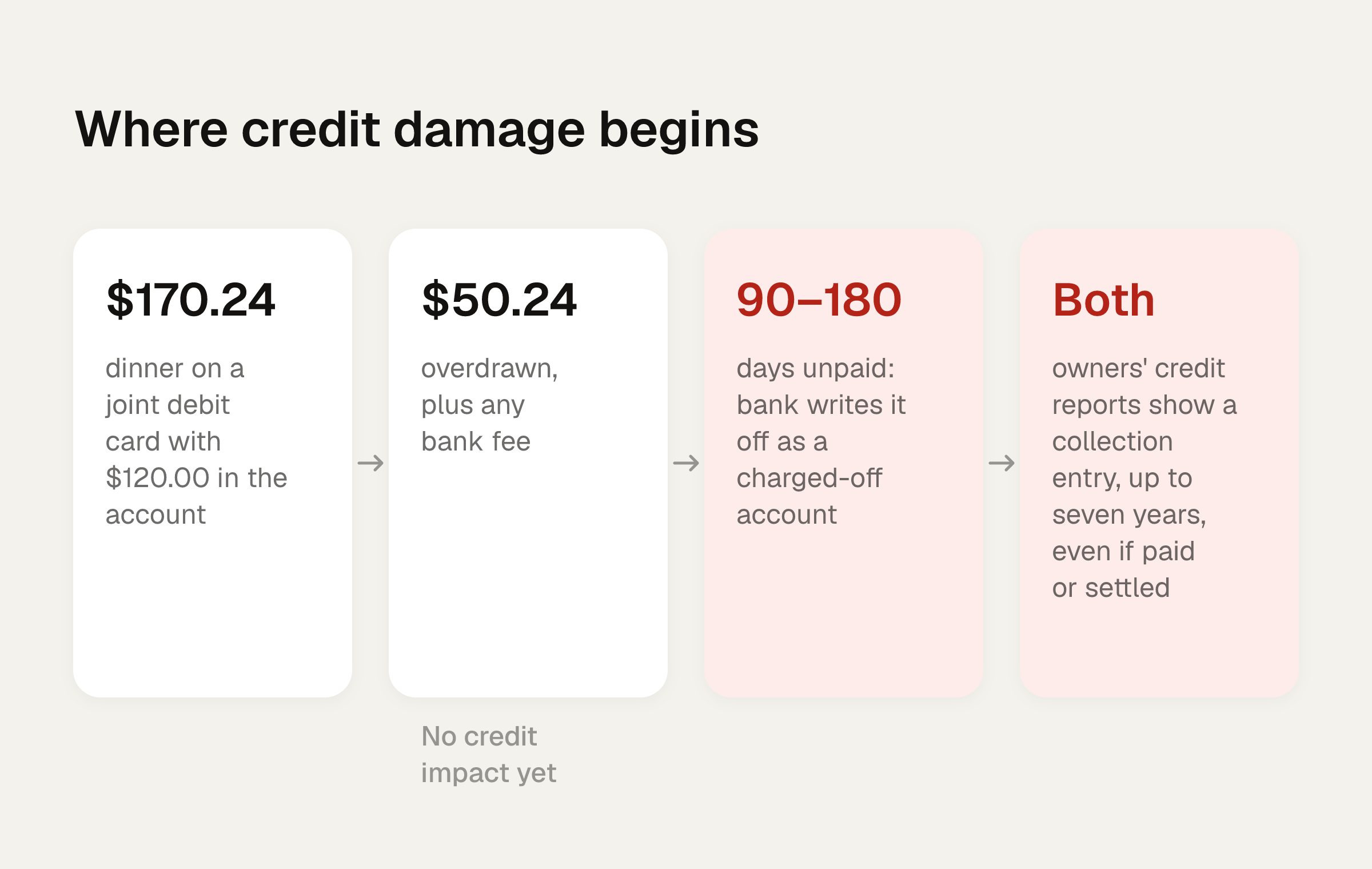
Both owners carry it equally. It doesn't matter who spent the money. If Jordan covers his half and Maya doesn't, the entry still shows on both reports.
Option 3: a joint credit card
Now put the $170.24 on a card that Maya and Jordan hold jointly. The card is reported on both of their credit reports. Both are legally liable for the full balance, and applying as a joint holder triggers a credit check. Per Chase and the CFPB, both owners' scores are affected no matter who made the charge or who paid.
If the payment is 30 days late, The Credit People says the hit may be 30 to 50 points on both co-owners' scores. The mark can stay up to seven years, and Experian says negative items stay that long even after the card is closed. The bureaus don't separate which co-owner missed the payment.
Also, Experian notes that most major issuers don't offer joint credit accounts at all. For a one-off dinner, this option is both the riskiest and the hardest to get.
Does joint account affect credit score? Where the risk actually sits
Pulling the three options together with the sources:
- Plain joint checking or savings: no credit reporting, so no effect on your score.
- Overdraft that goes to collections: a collection entry appears on both owners' reports.
- Overdraft that you settle quickly: the issue stays in the ChexSystems record. That isn't part of your credit report, and it's only consulted when you open a new account. Self says ChexSystems information typically stays five years. You can get a free ChexSystems report every 12 months, or within 60 days of a denial.
- Joint credit card, paid on time: it can help both owners. Chase says on-time payments add positive history for each owner, low utilization helps, and keeping the card open can raise average account age.
- Joint credit card, paid late: it hurts both, as above.
- Applying for one: the credit check is a hard inquiry. Experian says these stay on reports for two years but typically don't have a significant lasting impact.
If you only want to help someone: authorized user
An authorized user isn't legally responsible for the bill, doesn't need a credit check to be added, and can remove themselves easily. The catch, per Experian and Chase, is that a large balance can push the primary holder's utilization up and lower their score. A friend on your card who runs it up in a weekend can cost you points.
Closing a joint account without a mess
Closing with money owed doesn't erase the debt. The Credit People suggests this order:
- Pay off any overdraft or negative balance first.
- Get written confirmation of a zero balance.
- Pull each co-owner's free credit report within 30 days to check it.
Checkmyfile, a UK source, adds that financial associations between joint holders can linger on credit reports after closure. You can ask for them to be removed by proving the tie is severed. Rules differ outside the UK, so check how your own bureaus handle it.
Habits that keep a joint account boring
If you do open one, these come from Experian and Checkmyfile:
- Budget with about a 10% cushion. On a $1,000 bills month, that means keeping $1,100 in the account.
- Name one account manager.
- Check in monthly.
- Keep individual accounts too.
- Set low-balance alerts and approval rules for large transactions.
For a longer look at the setup and the math, see joint account for shared expenses.
When you don't need a joint account at all
For a dinner, an Airbnb or a trip, a shared account adds a risk with no payoff. You can pay with your own card, work out each person's share, and settle up.
Divvy bill splitting is built for that. Point the camera at a receipt and it reads every line item, the tax and the tip. Tap a name on each item to assign it, and shared items can be split between people. Tax and tip are split by each person's share of the items, which is the math in the table above. Each person's share becomes a Venmo or Cash App request in one tap, with reminders until it's paid. Friends don't need the app or an account. They open a share link, see what they owe, and pay. You can see the app here.
If you'd rather stay on paper, run your next receipt through the free bill split calculator first. Then send each person their exact number.
Frequently asked questions
Does a joint savings account show up on my credit report?
No. Like checking, a standard joint savings account isn't reported to the credit bureaus, so opening it or sharing it doesn't change your score.
If my co-owner overdraws a joint account, am I responsible?
Yes. Both holders share responsibility for an overdraft, whoever caused it. If it goes unpaid and ends up in collections, the entry appears on both owners' credit reports.
How long does a late payment on a joint credit card stay on my report?
Up to seven years. The Credit People says a 30-day late payment may cost 30 to 50 points on both owners' scores, and Experian says negative items stay even after the card is closed.
What is ChexSystems and does it affect my credit score?
ChexSystems keeps a record of banking problems such as unpaid overdrafts. It isn't part of your credit report and is only consulted when you open an account. Its information typically stays about five years, and you can request a free report every 12 months.
Is being an authorized user safer than a joint account?
For the person added, yes. They have no legal responsibility for the bill and no credit check on being added. The primary holder still takes the risk, since a large balance can raise their utilization and lower their score.
Sources
- Should Married Couples Have Joint Checking Accounts? - Experian
- Do joint credit card accounts with my spouse affect my credit score?
- Does A Joint Bank Account Affect Your Credit Score?
- Does Opening a Checking Account Affect Your Credit Score? - Self.
- Does a Joint Credit Card Build Credit for Both Users?
- Authorized User vs. Joint Account Holder: What's the Difference? - Experian
- Does a joint account affect your credit score?