Divvy
How to Split Bills With a Spouse: 60/40 vs 50/50 Math
By The Divvy Team · November 9, 2026 · 8 min read
If you're after how to split bills with spouse calculator help, here's the method: add both take-home pays, divide each by the total to get a percentage, then multiply your shared bills by each percentage. Or split 50/50 if you want it simple.
The rest of this page runs one household's real month through both options, so you can see the dollars side by side. It covers the math only and isn't financial advice.
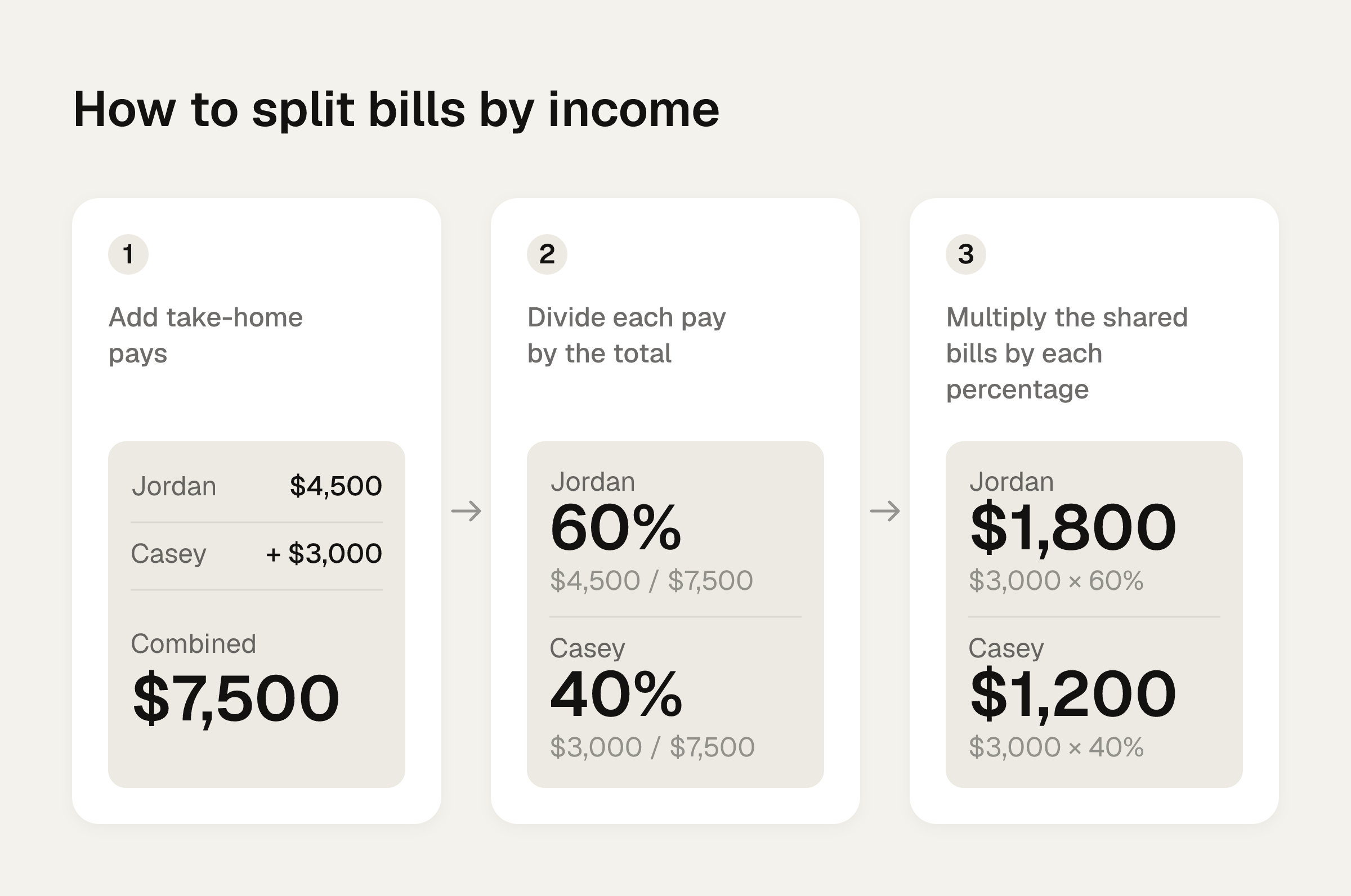
How to split bills with spouse calculator math: the three steps
- Add both take-home pays. That's the combined income.
- Divide each person's pay by the combined income. That's each person's percentage.
- Multiply the shared bills by each percentage. That's each person's share.
For an even split, skip to step 3 and use 50% each. Money is a touchy subject in plenty of homes: a 2022 APA poll found 41% of Americans say money causes a lot of fights or tension in their families (via Origin). Agreeing on a formula before the bills land takes some of the heat out.
Worked example: $3,000 in monthly household bills
Jordan takes home $4,500 a month. Casey takes home $3,000. Combined, that's $7,500.
- Jordan: $4,500 / $7,500 = 60%
- Casey: $3,000 / $7,500 = 40%
Their shared monthly bills:
- Rent: $2,000
- Groceries: $700
- Utilities: $300
- Total: $3,000
Here is the same $3,000 two ways:
| Jordan | Casey | |
|---|---|---|
| Take-home pay | $4,500 | $3,000 |
| 50/50 split | $1,500 | $1,500 |
| 60/40 split | $1,800 | $1,200 |
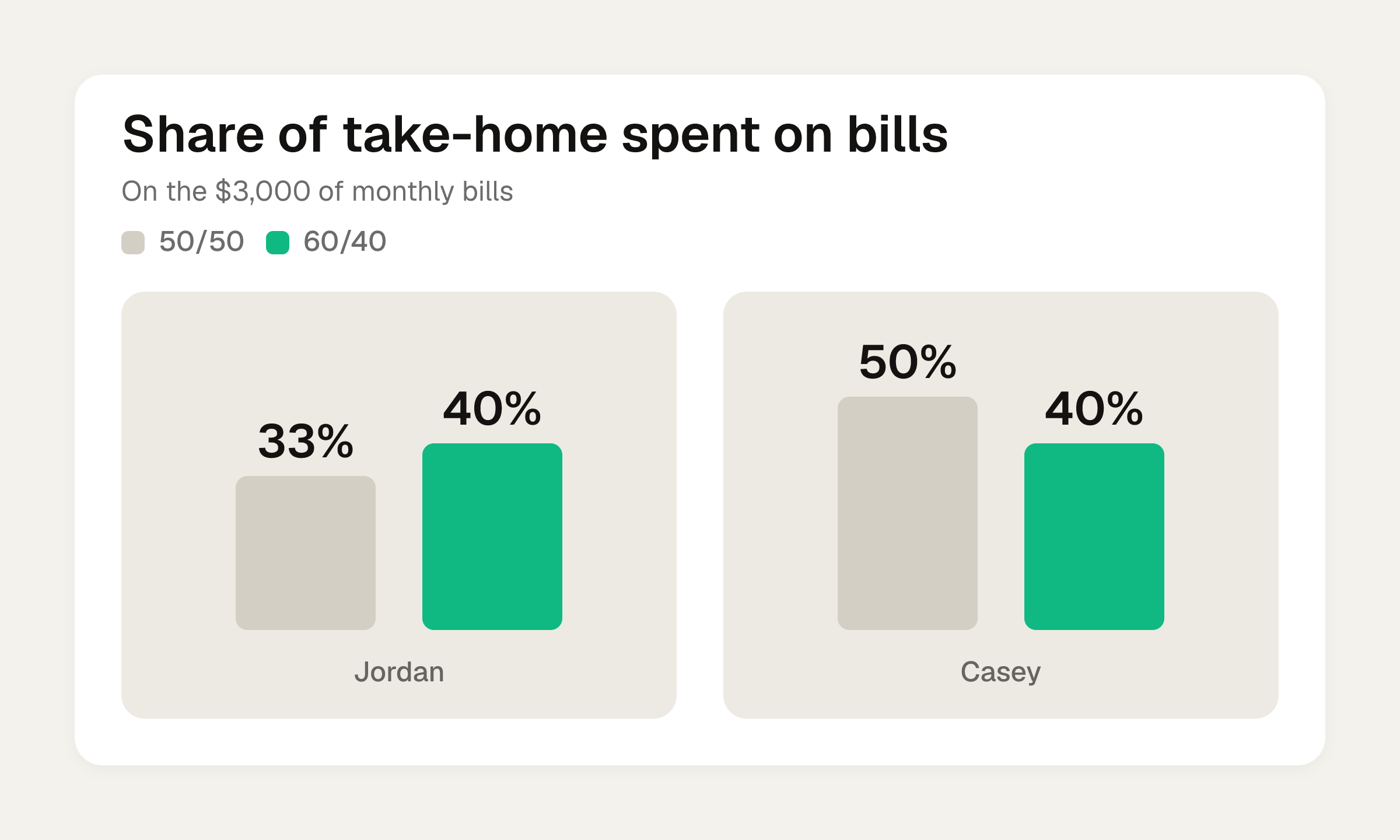
| 50/50 as a share of take-home | 33% | 50% |
| 60/40 as a share of take-home | 40% | 40% |
At 50/50, Casey spends half of their pay on the household and Jordan spends a third. At 60/40, both spend 40% of take-home. Casey keeps $300 more a month, which is $3,600 over a year. Jordan pays that $300 more. Whether that's fair is the conversation. The math just makes it visible.
Not every couple wants income-based. The 50/50 split is still a reasonable choice when incomes are close. Our bills 50/50 guide covers when it holds up.
Check the split one bill at a time
The percentages work on any single bill, which helps if you pay each one separately. At 60/40:
| Bill | Total | Jordan (60%) | Casey (40%) |
|---|---|---|---|
| Rent | $2,000 | $1,200 | $800 |
| Groceries | $700 | $420 | $280 |
| Utilities | $300 | $180 | $120 |
| Total | $3,000 | $1,800 | $1,200 |
Two quick sanity checks. A $100 utility bill at 60/40 is $60 and $40. A $1,000 rent at 60/40 is $600 and $400. For more 60/40 line-by-line examples, see Split 60/40.
A second pair: Sam and Alex, with paychecks
Sam earns $42,000 a year and Alex earns $63,000. Combined: $105,000.
- Sam: $42,000 / $105,000 = 40%
- Alex: $63,000 / $105,000 = 60%
On $2,500 of shared monthly costs, Sam pays $1,000 and Alex pays $1,500. A 50/50 split would be $1,250 each. That is about 36% of Sam's salary and about 24% of Alex's (method from Ellevest).
To put it on a paycheck schedule, divide each monthly share by how many paychecks that person gets a month. If both are paid twice a month, Sam moves $500 and Alex moves $750 per paycheck. If you're paid every other week, that's 26 paychecks a year. Sam's $1,000 a month becomes $1,000 x 12 / 26 = $461.54 per paycheck, and Alex's $1,500 becomes $692.31.
Take-home pay or gross pay?
Take-home pay is the most accurate basis, because it's the money you can actually spend. Gross works if you both use the same basis, but the two can land in different places. A 60/40 split on gross can end up nearer 58/42 on take-home. Fair Split's example: earners at $70,000 and $50,000 split rent about 58/42. Origin's example: $70,000 and $55,000 comes out to 56% and 44%.
Adjustments couples make
- Fixed obligations. Deduct debt payments or childcare from each income before you work out the percentages (Fair Split).
- Extra retirement contributions. If one of you puts extra pre-tax money into retirement, add it back so it doesn't shrink their share (GoodShare).
- Equal leftover. Both of you keep the same amount after the shared bills. In the Jordan and Casey example, $7,500 minus $3,000 leaves $4,500, so $2,250 each. Jordan pays $2,250 and Casey pays $750 (GoodShare). That's a big shift from 60/40, so talk it through first.
- A cap. The higher earner pays at most 65%. In the $3,000 example, 60% is already under that cap (GoodShare).
Other ways to run the money
The percentage method decides how much each of you owes. You still choose how the money moves:
- Assign bills. One of you owns rent, the other owns utilities and groceries.
- Pool everything. All income goes into one pot and bills come out of it (SoFi).
- One pays, the other transfers. One spouse covers the bills and saves the receipts. The other pays their share at the end of the month (SoFi).
A joint account is optional. If you want one, here's the joint account setup, math and risks. Some providers won't take two names or two payments, which is why one person often ends up fronting.
What counts as shared?
Decide this before you do any math. Rent or mortgage, utilities, groceries, insurance and shared vehicle costs are the usual shared list. Individual car payments stay separate (Ellevest). Dining out, vacations and pets are a grey area, so agree on a rule for each (GoodShare).
The grey area: a dinner out
Say Jordan and Casey go out for dinner. The food is $80: Jordan's meal is $50 and Casey's is $30. Tax is 10% ($8) and the tip is 20% on the pre-tax food ($16). The total is $104, and Jordan puts it on their card.
| Rule | Jordan | Casey |
|---|---|---|
| 50/50 | $52.00 | $52.00 |
| By what each person ordered, tax and tip included | $65.00 | $39.00 |
| 60/40 by income | $62.40 | $41.60 |
By-order works like this: Jordan ordered 62.5% of the food, so Jordan carries 62.5% of the tax and tip too. That's $50 + $5 tax + $10 tip = $65. Casey's $30 + $3 + $6 = $39. The tax and tip guide walks through the method.
Pick one rule for dinners and stick with it. Mixing rules week to week is how the "wait, who paid last time?" talk starts.
If an amount doesn't divide cleanly, round one share up and the other down so it still adds to the total. A $101.01 bill at 60/40 is $60.61 and $40.40.
When you fronted the bill: getting paid back
Back to the monthly bills. Say Jordan put all $3,000 on a card to collect the points. Jordan's own share is $1,800, so Casey owes $1,200. Under a 50/50 rule, Casey would owe $1,500. Add the $39 for dinner and Casey sends $1,239 at month's end.
Put the amount in one message with the breakdown (rent $800, groceries $280, utilities $120, dinner $39) so nobody has to ask what it's for.
You can run the numbers on the free bill split calculator, which splits a bill evenly or by item, with tip. The rent split calculator on the site has a by-income option for the percentage math.
If you're the one who fronted and you'd like the request handled, Divvy bill splitting is an iPhone app that's free to download. Point the camera at a receipt, tap a name on each item, and each person's share becomes a Venmo or Cash App request in one tap, with reminders until it's paid. Your spouse doesn't need the app or an account: they open a share link, see what they owe, and pay. Groups keep a running balance of who owes whom across many receipts, so a month of groceries and dinners lands in one number.
Frequently asked questions
Do spouses need a joint account to split bills?
No. A joint account is one option, but you can also have one spouse pay the bills and the other transfer their share, or assign each bill to one person. Pick whichever you'll keep up with.
How do we split bills by income if one of us has irregular pay?
Use an average instead of one month's pay. GoodShare suggests a twelve-month average, and Brightly Budget suggests a cautious average of recent months. Then run the same percentage math on that figure.
How often should we revisit the split?
Sources give a range: every six to twelve months, quarterly, or right after a big income change or major life event. Whatever you choose, redo the percentages when either paycheck changes.
Can the bill split calculator split by income?
The bill split calculator on this site splits a bill evenly or by item, with tip. The rent split calculator has an option to split by income. For a 60/40 split on other bills, multiply the total by each person's percentage.
Sources
- How to Split Expenses With Your Partner
- How to Split Finances As a Couple
- How to Split Bills With a Partner When Incomes Differ — Brightly Budget
- Fair Split Calculator: Split Bills by Income
- Fair Share Calculator: Split Bills and Rent by Income
- How to Budget With Your Partner: The Ins and Outs of the Best Ways to Split Expenses