Divvy
Net Rent Calculator: A Practical Guide for Tenants
By The Divvy Team · October 18, 2026 · 16 min read
Net rent is the amount your household pays after housing benefits, rebates, and shared-cost adjustments are subtracted from the advertised lease amount; a net rent calculator shows that amount and the share of income it consumes, with 30% as a common affordability benchmark. For roommates, the useful result is each person's obligation, not just the total attached to the apartment listing.
You've probably got a lease open, a roommate group chat buzzing, and someone saying the rent looks manageable if everyone splits it. Then another person asks about parking, somebody remembers the internet bill, and the advertised discount suddenly seems less straightforward.
The math doesn't need to be intimidating. It does need separate labels for the rent, the costs around it, and the agreement about who pays what.
Table of Contents
- What Net Rent Actually Means
- The Net Rent Formula in Plain Steps
- Choosing the Right Split Method for Roommates
- Reading Past Headline Rent With Concessions and Fees
- Checking Affordability Against the 30% Rule
- Using Divvy to Settle the Monthly Household Tab
- A Final Checklist Before You Sign the Lease
What Net Rent Actually Means
Your roommate reads the apartment listing and treats the advertised rent as the household budget. You read the lease and notice an assistance credit, separately billed water, and a parking charge. Neither of you can answer what the apartment will cost until those pieces are sorted.
Net rent has a narrower official meaning than everyday budgeting sometimes gives it. It means the rent a household pays itself after housing benefits, rebates, or assistance are deducted. The Office for National Statistics housing expenditure report uses that distinction and reported average weekly net rent of £90.20 in 2014–2015, a historical figure rather than a current rental-price guide.
Utilities aren't automatically something to subtract. If water is already included in the rent, leave it there; if it's billed separately, add it to your broader housing budget. Likewise, a parking charge only disappears from your personal share if someone else has agreed to pay it.
The visual below illustrates the difference between a listing price and an adjusted payment.
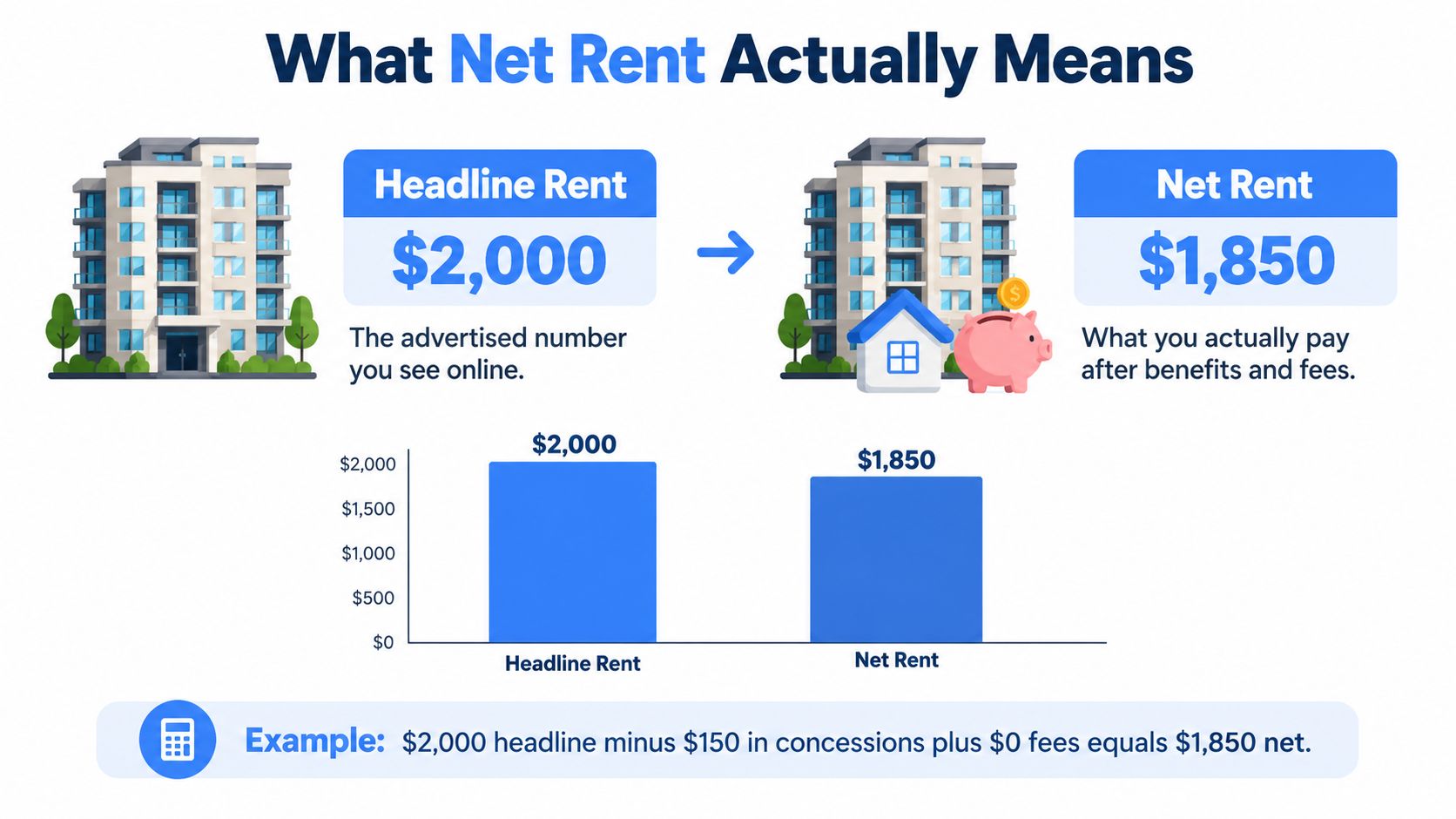
Gross Rent vs Net Rent vs Effective Rent
| Term | What It Includes | When To Use It |
|---|---|---|
| Gross or headline lease rent | The advertised base rent before deductions; check whether the listing includes utilities | Checking the lease's base obligation |
| Net rent | Rent payable after applicable benefits, rebates, or assistance | Understanding the household's out-of-pocket rent |
| Net-effective rent | Lease rent averaged across the term after concessions | Comparing promotional offers |
| Total housing budget | The relevant rent figure plus separately payable housing costs | Planning what leaves your bank account |
Be careful with gross rent: a listing may use it to mean the undiscounted lease price, while housing statistics can use it to include utilities. Read the definition beside the number.
Keep Household and Personal Totals Separate
A roommate reimbursement reduces what you personally fund, but it doesn't reduce the apartment's total cost. Think of the household total as a shopping basket and each roommate's share as their portion of the checkout.
For a room rather than an entire apartment, this guide to the cost to rent a room in a house provides a useful companion to your budgeting worksheet.
Practical rule: Keep rent after assistance, total housing cost, and your personal share in separate fields. They answer different questions.
The Net Rent Formula in Plain Steps
Start with the lease and the bills, not the calculator. A perfectly entered formula still gives a misleading answer if you've left out a mandatory charge or counted an included utility again.
This calculation visual is a useful reminder to work from the base obligation toward the amount you'll fund.
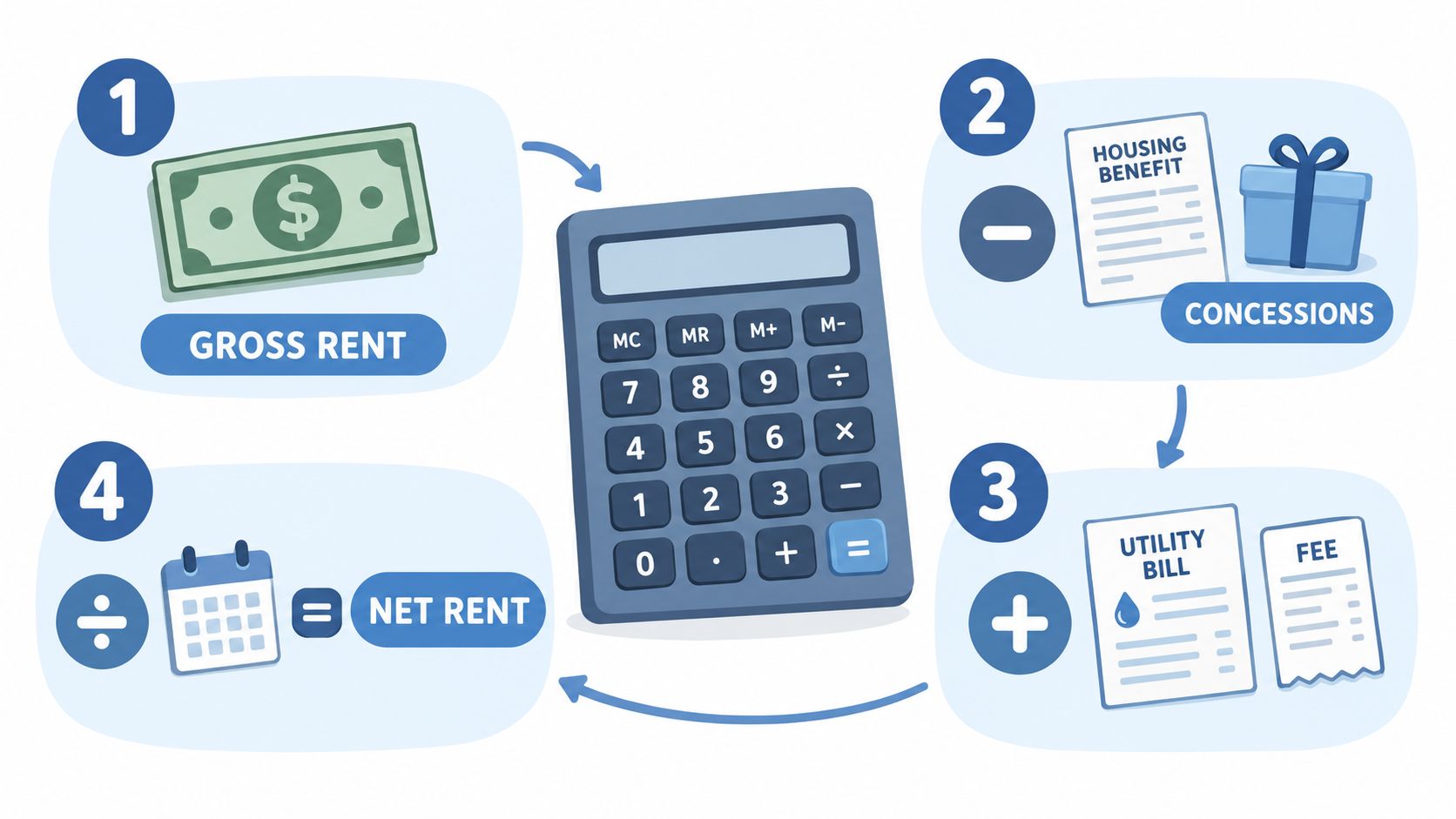
Build the Household Total
Use these copy-pasteable formulas as labels in a note or spreadsheet:
Net rent = base lease rent − applicable housing assistance − applicable recurring rent discounts
Household housing budget = net rent + separately billed utilities + mandatory housing charges
Personal obligation = allocated rent share + allocated shared bills + personal housing charges
Subtract only credits that reduce the obligation you're calculating. A benefit paid directly to the landlord and a rebate paid to you may require different cash-flow entries, even if both eventually reduce what you fund.
- Match the period: Put rent, credits, bills, and income on the same monthly basis.
- Verify inclusions: Mark each utility as included, separately billed, or unknown.
- Separate personal extras: Assign an exclusive parking spot to its user if that's the household agreement.
- Identify uncertain inputs: Label estimated utilities instead of presenting them as fixed lease charges.
Consider a shared apartment with an assistance credit, a parking space used by one roommate, and an internet connection everyone uses. Subtract the applicable credit from rent, allocate the adjusted rent under the household's agreement, split internet under its own rule, and assign parking to its user. Don't divide the entire bundle equally unless everyone has explicitly agreed to that.
Check the Result Before Accepting It
Division by the number of paying occupants is an equal-split option, not the universal final step. If rooms differ or someone receives an individual benefit, the allocation needs more care.
Add all personal obligations back together. They should reconcile to the household's payable costs after applicable credits; if they don't, you've probably omitted an expense or counted a reimbursement as another bill.
Keep deposits and move-in fees in a separate upfront budget. You can save toward them monthly, but that savings target isn't the same as recurring rent.
If you prefer a video alongside the written workflow, use this walkthrough as a companion.
Choosing the Right Split Method for Roommates
A correct household total doesn't settle the fairness question. One roommate may have the smallest room, another may earn more, and another may have the only private bathroom. You're negotiating both ability to pay and housing benefit, and those aren't interchangeable.
The Billablewise rent-split calculator provides a reference for comparing allocation approaches. The most useful household agreement makes its assumptions visible rather than treating a calculator's output as a verdict.
| Method | What Determines the Share | Main Trade-Off |
|---|---|---|
| Equal | Everyone contributes the same amount | Simple, but ignores unequal rooms and access |
| Income-proportional | Each person's income relative to combined income | Reflects ability to pay, not necessarily housing value |
| Room-based | Private room size and agreed amenities | Reflects space, but needs an explicit treatment of common areas |
| Hybrid | Shared-space allocation plus private-space and negotiated adjustments | More flexible, but requires agreement about the inputs |
The illustration below compares the approaches visually.
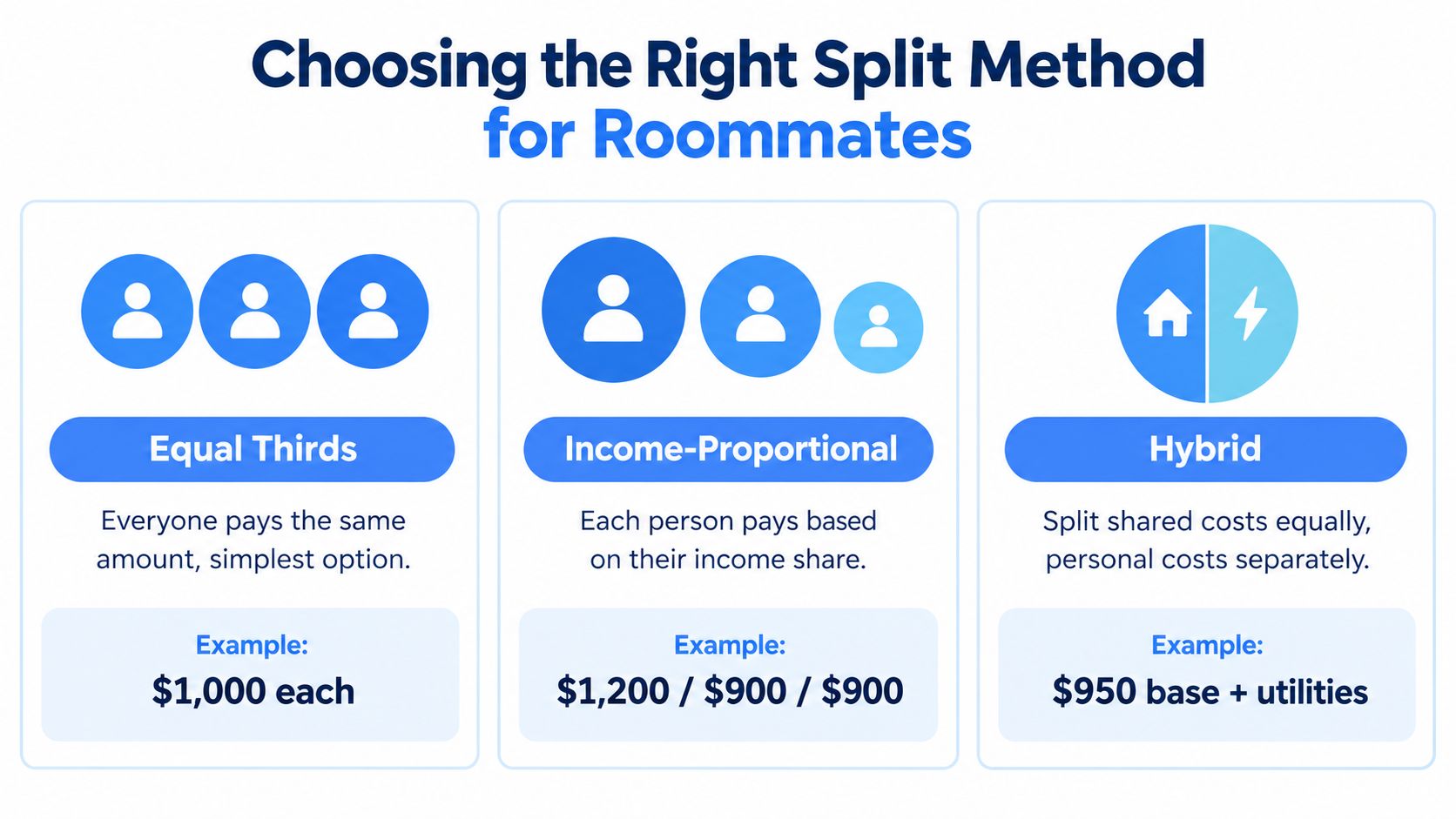
Separate Common Space From Private Benefits
My recommended starting point is a hybrid allocation. Agree how much of the rent represents common-space access, divide that portion equally, then allocate the private-space portion by room size.
The formula is:
Personal rent share = equal share of common-space value + room's share of private-space value + disclosed adjustments
Private-space allocation can use each room's area divided by the combined area of the private rooms. That calculation is straightforward; choosing how much value to assign to common space is a negotiation, not an objective measurement.
A private bathroom, furnishing, balcony, or unusually limited access can justify an adjustment if everyone agrees. Any surcharge needs a corresponding reduction elsewhere so the allocated shares still equal the rent.
Treat Income Adjustments as a Separate Agreement
A higher earner might willingly contribute more to make the apartment workable for the group. But don't build that contribution into a room-value calculation, especially if that person gets the smaller room.
Use this explanation of how to calculate rent alongside a written record of the method you choose.
Non-rent bills don't have to follow the same allocation. Internet might be shared equally, metered expenses might follow an agreed usage rule, and exclusive amenities might belong to their users.
A fair split is one everyone can explain, including what they receive and what they've agreed to subsidize.
Reading Past Headline Rent With Concessions and Fees
A free-rent offer can make an apartment look cheaper without lowering the payment due during its paid months. That distinction matters if you can afford the promotional average but struggle with the regular lease payment.
In early-2025 reporting, effective rent growth lagged advertised rent growth in 82% of major markets, while concessions averaged roughly one month of free rent in some major markets, according to the multifamily concessions discussion. Those dated figures illustrate why advertised and effective prices deserve separate fields.
This visual shows how concessions and separately payable fees can affect a comparison.
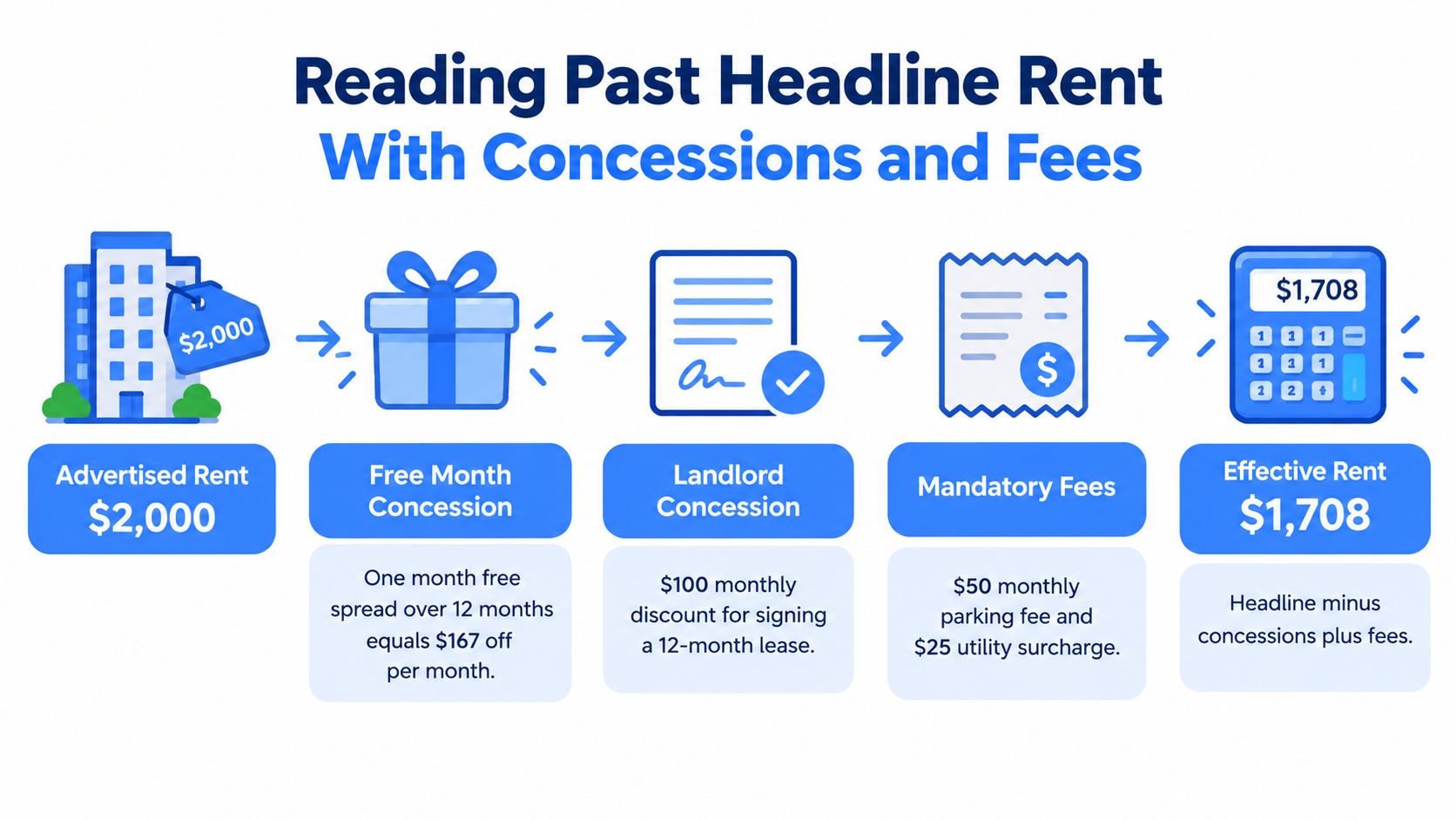
Compare Economic Cost With Cash Due
For a fixed base rent, use:
Net-effective monthly rent = (base monthly rent × lease months − total lease concessions) ÷ lease months
Then build a separate payment calendar from the lease. Record when credits apply, when full rent is due, and which charges remain payable during a free-rent period.
A concession isn't necessarily cash you can spend on another bill. If the landlord applies it only to rent, you still need money for other charges.
- Lease length: Use the actual contractual term, not a guessed promotional period.
- Credit conditions: Check whether early termination triggers repayment.
- Recurring fees: Confirm which charges sit outside the quoted rent.
- Renewal terms: Budget without assuming the incentive will continue.
Allocate Credits Without Hiding Personal Charges
For roommates, an apartment-wide concession can follow the agreed rent allocation. An individual benefit or amenity-specific credit needs its own treatment.
The presence of an exclusive parking spot doesn't automatically change how a general rent concession should be shared. Allocate the parking charge to its user, then apply the rent credit according to the household's rent agreement unless the offer specifies otherwise.
If you're searching in Norwich, use Stay Norwich Apartments' practical 2026 Norwich rental guide as a location-specific companion while reviewing offers.
Cash-flow check: A lower lease-term average doesn't mean the landlord accepts that average as your payment every month.
Checking Affordability Against the 30% Rule
The useful affordability calculation includes the housing costs you're responsible for, not just your room's base rent. Divide that monthly amount by gross monthly income, then express the result as a percentage.
Housing-cost ratio = monthly housing costs ÷ gross monthly income × percentage conversion
Keep a separate take-home-pay check for everyday budgeting. Gross income is the before-tax figure used for the benchmark comparison; take-home income is the money available for bills and other spending. Mixing them produces ratios that aren't directly comparable.
Understand What the Benchmark Measures
U.S. federal housing policy generally treats housing as affordable when costs don't exceed 30% of household income, adjusted for family size; costs above 50% generally indicate severe burden. In 2023, approximately 22.6 million renter households, or 49.5%, were cost burdened, and 26.5% were severely burdened, according to the Congressional Research Service housing affordability report.
Those thresholds are screening tools, not promises that a particular lease will feel comfortable. Debt payments, transport, childcare, irregular earnings, and savings needs still matter.
For an individual planning worksheet, the rent calculator by income guide is a useful companion to your cost calculation.
Check Each Roommate Separately
A household average can conceal a squeezed roommate. Apply the ratio to each person's allocated housing costs and their own income, while recognizing that this is a personal planning check rather than an official household classification.
Use the results to discuss changes before signing:
- A manageable share: Confirm there's still room for essential spending and a buffer.
- A stretched share: Revisit the apartment, the allocation, or optional amenities.
- Unstable income: Test the payment against a realistic lower-income month, not just a strong one.
Landlord approval is a different question from personal affordability. Homes By Carmen's guide on how to pass rental screening can help you prepare for the application process, but your budget still needs its own decision.
Using Divvy to Settle the Monthly Household Tab
The lease calculation establishes who owes what. Monthly settlement answers a different question: who has already paid, and who needs reimbursement?
Your roommate might pay the internet provider while you cover a grocery run. Sending each other the full bills would ignore both ownership and money already advanced. Keep the underlying expense separate from the transfer used to settle it.
Match the Tool to the Job
A web rent-split calculator is useful for establishing recurring shares by income, room size, or equal allocation. A receipt-splitting app serves a different purpose: assigning purchases to their users and calculating the resulting reimbursement.
| Task | Useful Record | What to Avoid |
|---|---|---|
| Establish rent shares | Agreed allocation and assumptions | Reopening the negotiation with every payment |
| Allocate a grocery receipt | Personal items and shared items | Splitting someone's personal purchase across everyone |
| Reimburse a paid bill | Original expense, payer, and outstanding shares | Recording the repayment as another expense |
| Close the month | Settlement status | Assuming a payment request means payment arrived |
For shared shopping, assign personal items first and divide shared items under the agreed rule. Where tax or tip applies, proportional allocation can preserve the relationship between someone's purchases and their total.
That's useful for shared takeout as well as household purchases. It doesn't mean every utility bill needs restaurant-style tax-and-tip treatment.
Keep the Settlement Transparent
Use itemized receipt tools for itemized purchases and the rent agreement for recurring housing obligations. Payment requests through familiar services such as Venmo, Cash App, or Apple Pay can then communicate the amount due without requiring everyone to reconstruct the arithmetic.
- Identify the payer: Record who advanced the money.
- Show the allocation: Give each person enough detail to understand their share.
- Check the balance: Deduct amounts already paid before requesting reimbursement.
- Confirm settlement: Mark the obligation complete when payment arrives.
Don't reuse a dinner split for utilities just because the people are the same. Reuse the workflow, not the allocation: consumption at a meal and responsibility for a household bill may follow different rules.
A calculator helps establish the obligation. A clear settlement record helps everyone finish paying it.
A Final Checklist Before You Sign the Lease
Before you commit, gather the lease, concession offer, utility information, and proposed roommate agreement in one place. Leave unknown costs visibly marked so nobody mistakes an estimate for a confirmed amount.
If the contract language is unfamiliar, Royal LePage Brookside Realty's explanation of what is a lease agreement is a useful starting point. Ask for clarification on any payment term you can't explain in plain language.
Gather the Inputs
- Base lease rent: Use the contractual amount, not just the listing's promotional figure.
- Benefits and rebates: Confirm eligibility, recipient, timing, and any restrictions.
- Concessions: Record the credit amount, application schedule, and repayment conditions.
- Utilities: Identify what's included and what requires a separate payment.
- Parking and mandatory fees: Distinguish household charges from exclusive benefits.
- Paying occupants: Confirm who contributes and how couples or changing occupancy will be treated.
- Split method: Save the chosen formula and every negotiated adjustment.
- Upfront costs: Keep deposits and one-time fees visible outside the recurring budget.
- Income: Use a consistent period and distinguish gross earnings from take-home pay.
Run the Final Sanity Checks
Check the affordability result for each roommate, then review the actual payment schedule after concessions end. Both should be acceptable before anyone treats the advertised offer as affordable.
Also reconcile the allocations. The personal shares should account for the household's payable costs without missing charges, duplicated utilities, or unexplained credits.
Write down what happens if someone moves out, income changes, or a benefit ends. You don't need to predict every disagreement, but you do need a shared procedure for revisiting the arrangement.
Finally, have each roommate explain their payment in their own words. If someone can't tell what they owe, when it's due, and what might change, the agreement needs more work before signing.
Rent math is easier to revise than a lease. Save the inputs and agreed assumptions so you can update the calculation when circumstances change instead of starting the argument again.
Divvy offers a Web Rent Split Calculator for comparing roommate shares and an iPhone app for itemizing shared receipts, allocating tax and tip, and requesting repayment through familiar payment apps. Visit Divvy with your lease inputs ready, work out the rent allocation, and use receipt-level splitting to settle the household purchases that follow.